.jpg)
Spinnenkop Wedderveer
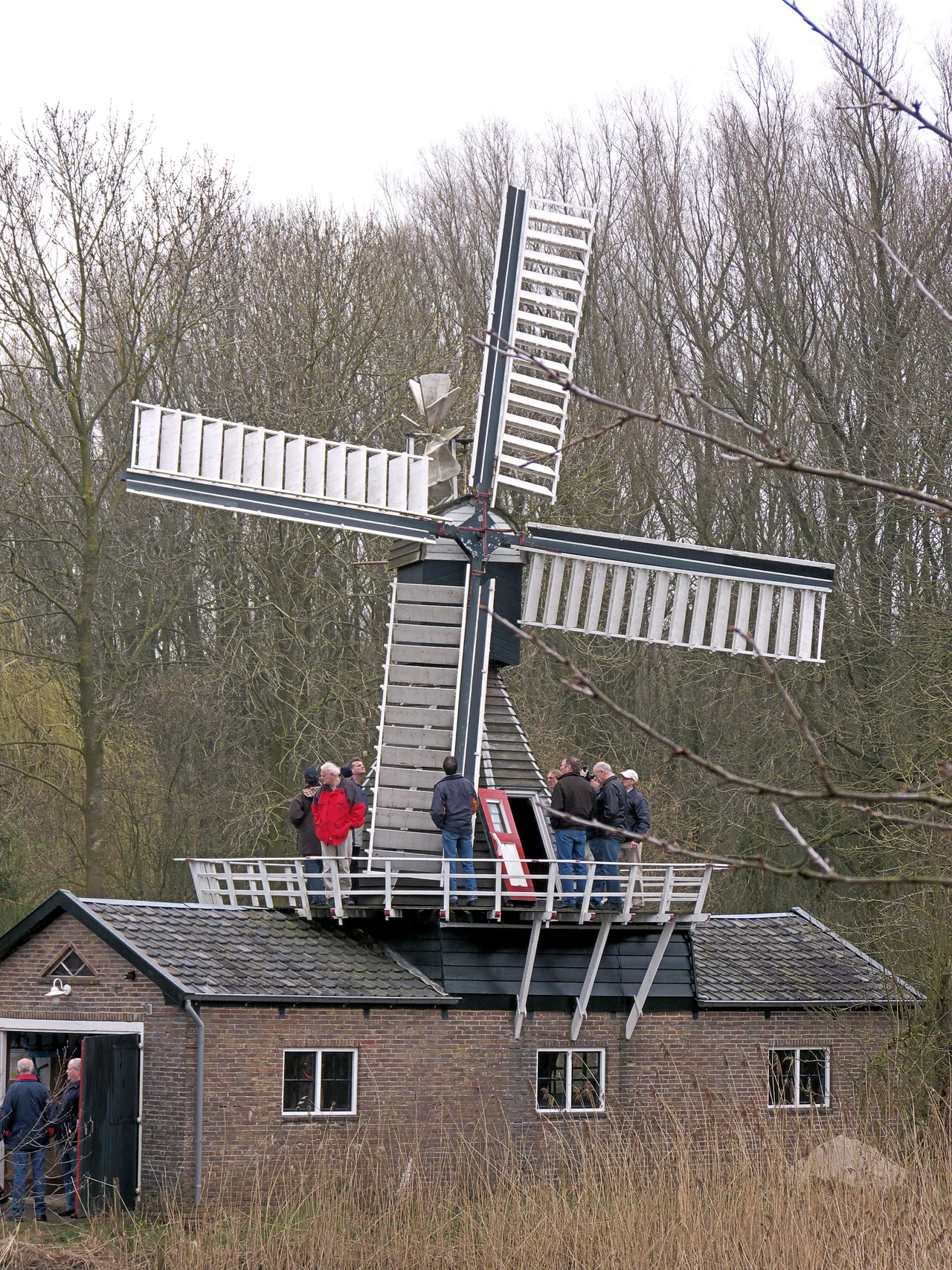
Eiko Jan Feunekes wanted to saw his own lumber. He had an oak plantation in the village of Wedderveer in Groningen, and in 1938 he commissioned the architect Luitje Wiersema to design him a windmill that would do the job. What Wiersema drew was something small, idiosyncratic, and almost extinct: a spinnenkop, a spider-head mill, with its hollow body perched on top of a brick shed. Two years after the mill went up, Feunekes was dead. The mill kept turning.
Spider Head, Brick Body
The Dutch call this type of windmill a spinnenkop because its small head and outstretched sails suggest the silhouette of a spider. Technically it is a hollow post mill, a category that includes mills where the main shaft runs down through a hollow post into a substructure below. What makes the spinnenkop unusual is its winding system: instead of the typical tail pole that a miller would manually push to turn the mill into the wind, a fantail at the back catches the wind itself and automatically rotates the head until the main sails face into the breeze. Of all the windmills in the Netherlands, only two still use this fantail-on-spinnenkop system. The other is De Sterrenberg in Nijeveen. Everything else has either gone or been converted to other systems.
What the Patent Sails Drive
The four sails span ten meters across and are carried on a steel windshaft. When the wind turns them, the brake wheel on the windshaft engages the wallower at the top of the upright shaft. The upright shaft runs through the body - called the head on a spinnenkop, because in this design the body is small - and continues down through the main post into the substructure below. At the bottom, a crown wheel transfers the motion to a horizontal shaft fitted with pulleys. A flat belt then runs from those pulleys to whatever the miller wants to power. Originally Feunekes used the system to drive a horizontal saw mounted outside the brick shed. Today the same belt drives a bandsaw housed inside. The mechanism is essentially unchanged. Only the tool at the working end has been updated.
Saved by a Plaque
After Feunekes died in 1940, ownership of the mill changed several times. By 1985 the mill was in such poor condition that someone had begun to consider dismantling it. The structure was tilting; the sails were probably unsafe; the brick shed below needed work. Then in 1990 the mill received status as a Rijksmonument - the Dutch national heritage designation - which made demolition far more difficult and unlocked government restoration subsidies. New owners A. Dost and O. Schaver used those subsidies to bring the mill back to working order in 1997. It is now Rijksmonument number 388083, listed in the national register and protected as a piece of twentieth-century Dutch industrial heritage. A small mill at the edge of a small village would almost certainly have been lost without that 1990 designation.
A 1938 Mill in 2026
Wedderveer is a small village in the Westerwolde region, north of Bourtange and east of Wedde. The mill stands on the edge of the settlement, the only windmill of its specific type in Groningen province and one of just two of its kind nationally. Public access is by appointment only. There is no permanent staff and no admission gate; arrangements are made directly with the volunteers who maintain it. Watching the fantail catch the wind and slowly rotate the head to face the breeze is the kind of mechanical poetry that the Netherlands has been producing for six hundred years - the only difference here being that the mill that does it dates from 1938, a generation younger than most Dutch windmills still in service, built when most of the country had already switched to electric motors.
From the Air
Located at 53.0839 N, 7.0681 E in Wedderveer, Groningen province, Netherlands. The small spinnenkop mill sits in flat polder country in the northern part of the Westerwolde region. Nearest commercial airport is Groningen Airport Eelde (EHGG), about 45 km west. Bremen Airport (EDDW) is about 105 km east. The German border lies about 14 km east. The mill is a recognizable visual landmark from low altitudes, though small compared to traditional Dutch tower mills. Best viewed at lower altitudes in clear conditions.
Nearby Stories
- Dollart 4.3 km away
- St. Walfriduskerk 6.7 km away
- Meppen 7.5 km away
- 2011 CPISRA Football 7-a-side World Championships 7.6 km away
- Friesoythe 8.7 km away
- Hoogeveen 15 km away
- Quakenbrück 16 km away
- Lordship of Gödens 29 km away