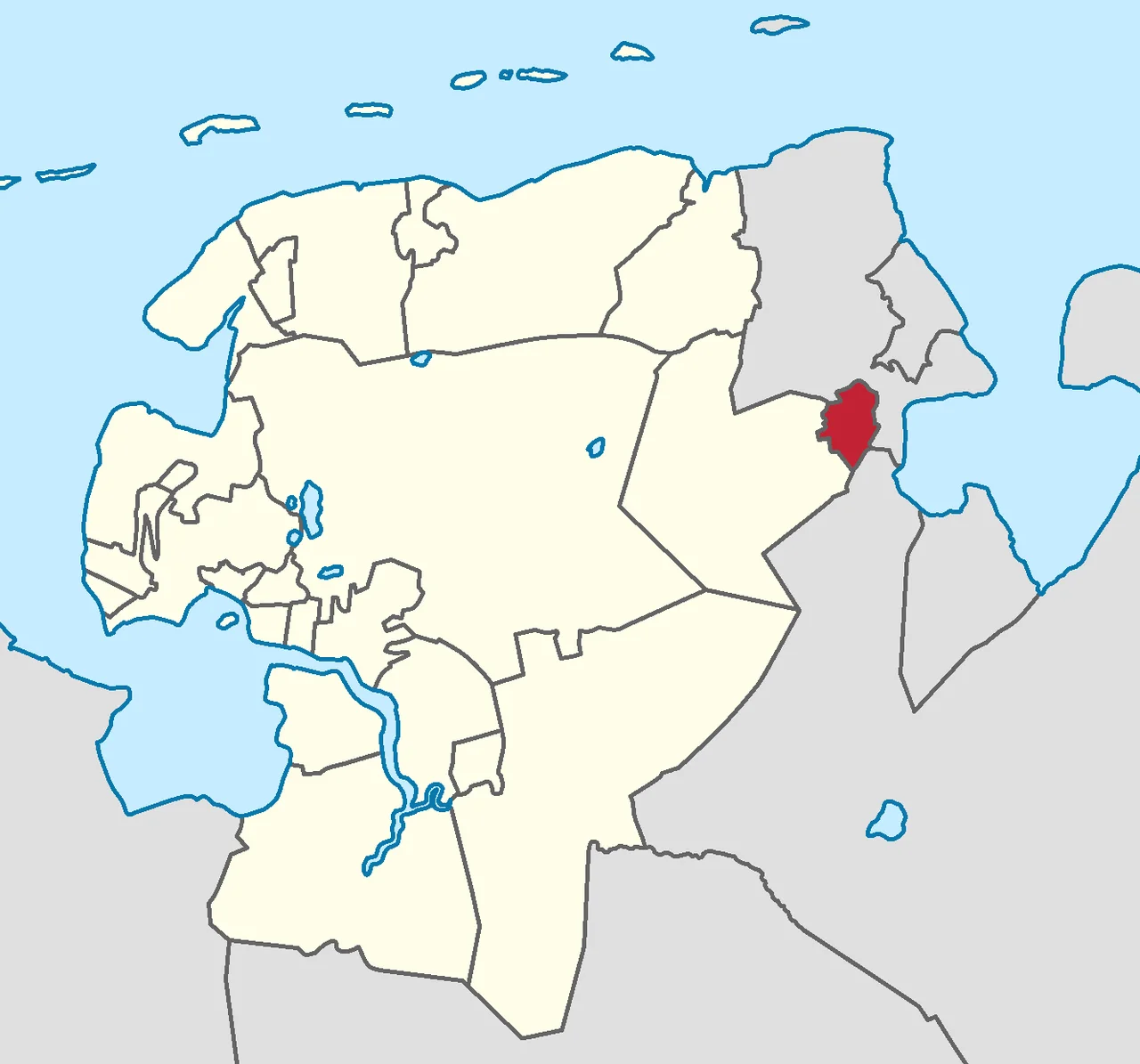

Lordship of Gödens
Five churches. Eight hundred residents. That is the arithmetic of Neustadtgödens in the second half of the 17th century, a small market town inside a small feudal lordship on the eastern edge of the East Frisian peninsula. Most German towns this size had one church. Some had two if the Reformation had drawn a line through them. Neustadtgödens had Reformed, Lutheran, Catholic, Mennonite, and Jewish congregations - five communities of faith, each with their own house of worship, all crammed into a settlement you can walk across in fifteen minutes. The lords of Gödens were not running this experiment out of any deep belief in pluralism. They were running it for cash.
The Chieftain Who Switched Sides
The story begins in 1451 with a North Frisian chieftain named Edo Boing, the first to sign documents as Hovetling of Gödens. He held his land under the nominal rule of Jever, but he and the Jever chieftains spent most of their time in open hostility. When Edo died in 1481, the lordship passed through his daughter Almut to her husband Hicko of Oldersum. In 1495, Hicko did something audacious: he defected from Jever and placed his lands under Count Edzard the Great of East Frisia, the rising power next door. The Jever chief, Edo Wiemken the Younger, fought the defection but lost. From that moment Gödens was East Frisian territory - a tiny lordship pressed between Oldenburg to the south and Jever to the northeast, governed from a moated castle and held together by clever marriages.
Building a Town for Profit
In 1517 the family built a new two-winged moated castle to replace the original keep, which had been wrecked in 1514 during the Saxon Feud. By 1544 the lord's wife, Hebrich von Inn- und Kniphausen, had organised the founding of Neustadtgödens - new town Gödens - on reclaimed marsh nearby. The town was built around a sluice harbour cut through the Schwarzer Brack, giving it salt-water access to trade with Emden, Amsterdam, Bremen, Hamburg, and eventually the Baltic. Hebrich also pegged the lordship's religion to Calvinism, the strictest of the Reformed traditions, which would later become important. The recruiting strategy was simple: bring in Dutch craftsmen, charge customs on imports, build wealth on trade rather than agriculture. For a few decades it worked spectacularly.
The Dam That Killed Trade
Then in 1597 the Counts of Oldenburg started building the Ellenser Damm, a coastal dyke that cut Neustadtgödens off from direct access to the Jade Bight. The town's sluice harbour was now an inland canal-port, reached only by working through Oldenburg-controlled waterways. The lords of Gödens fought back through the imperial high court at Speyer, won the right to pass duty-free under the dam, but the easy money was gone. The town pivoted to weaving. After the Thirty Years' War scattered religious refugees across the continent, the lordship made a virtue of necessity and began selling protection to communities other German states refused to host. Mennonite linen weavers came from Holland, Leer, and Emden, bringing their craft. From 1660 onward, Jewish families were allowed to settle. Both groups paid for letters of protection, and the lordship's accounts swelled.
Five Faiths, Five Churches
The architectural consequence is what makes Neustadtgödens unusual even today. The Reformed community built first, joined within a year by a Catholic congregation - the Catholic St. Joseph's Church was the first post-Reformation Catholic church built anywhere on the East Frisian peninsula. The Lutherans built theirs. The Jewish community received permission in 1708 for their own cemetery and built a synagogue first mentioned in 1752. The Mennonites finished a fourth church in 1741. By the mid-18th century all five communities had their own houses of worship within sight of one another, an outcome that was the rarest thing in early modern Germany: not tolerance born of conviction, but tolerance manufactured from policy and necessity, and made permanent by the buildings it left behind.
What Stayed Behind
In 1692 the Frydag family - which had inherited the lordship through marriage - was raised to the rank of count by Emperor Leopold I. The line later died out and the lordship passed to the Wedel-Jarlsberg family of Westphalia, who still own Gödens Castle today. The political lordship itself ended in 1839, absorbed into the new Friedeburg administrative office, and the territory disappears from political maps. What remains is the moated castle, rebuilt in Dutch Renaissance style after a fire in 1669 and still considered one of the most beautiful in northwest Germany, and the religious geography of Neustadtgödens. The Jewish community of Neustadtgödens was destroyed by the Nazis - the synagogue burned, the families murdered or driven into exile - and the cemetery on the road to the castle now holds a quiet weight that the lords who first welcomed those families could not have imagined.
From the Air
Located at 53.49 north, 7.96 east on the East Frisian peninsula, about 12 km southwest of Wilhelmshaven and about 5 km south of the modern coast. Gödens Castle sits within a moat in the village of Sande, with Neustadtgödens about 2 km west. Nearest airports: Wilhelmshaven-Mariensiel (EDWI) about 10 km northeast, Wittmund (ETNT) Luftwaffe base about 15 km north, Bremen (EDDW) about 60 km south. Best viewed from 1,500-3,000 ft - the moated castle is a clearly geometric feature in the flat farmland, and the five surviving churches of Neustadtgödens show as a tight cluster of steeples and gables only a kilometre or two away. Coastal westerlies prevail.
Nearby Stories
- Wangerooge 0.7 km away
- Aurich (district) 4.5 km away
- Rheiderland 6.4 km away
- Valentin submarine pens 6.8 km away
- Bad Zwischenahn 11 km away
- HVDC DolWin2 37 km away
- Teufelsmoor 41 km away
- Lilleø 233 km away