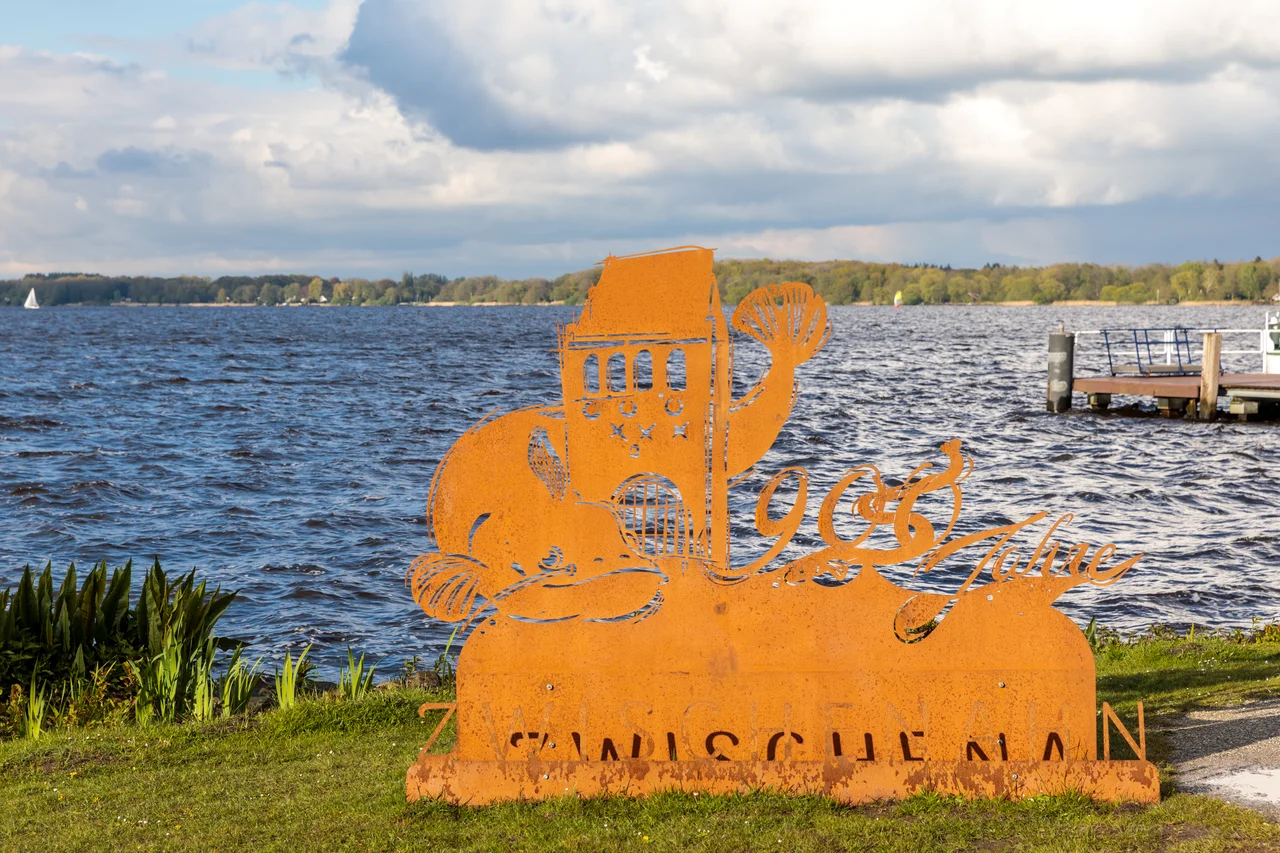

Bad Zwischenahn
The local way to eat a smoked eel in Bad Zwischenahn involves a tin spoon, a glass of grain schnapps called *Ammerländer Löffeltrunk*, and a small ritual cheer that the host and the guests take turns reciting. When the eel is gone, the schnapps does double duty: you also use it to clean your fingers. This is a town that has spent most of its life as a lakeside resort on the Zwischenahner Meer, a broad shallow lake where ferries still run between Bad Zwischenahn, Dreibergen and Rostrup. It is also a town whose 20th-century history is shadowed by darker things - a Luftwaffe airfield that became a test site for rocket-powered fighters, and a psychiatric hospital eight kilometres east whose patients were murdered in their beds during the Nazi euthanasia programme.
A Lake and a Spa
The first written mention of Zwischenahn dates from 1124, in connection with the founding of St John's Church by Count Egilmar of Oldenburg. The lake - the Zwischenahner Meer - is the reason the town exists and the reason it became a *Kurort*, a designated spa town, picking up the *Bad* in its name. For the well-to-do urban populations of Oldenburg and Bremen, this has been the place to take the cure, sail a boat, eat smoked eel and stroll the lake promenade for over a century. Tree nurseries are big business - Ammerland is one of Germany's leading nursery regions. So is sausage-and-ham production. There is an above-average number of holiday apartments here, many graded three stars or higher; retirees, in particular, settle in for the quiet and the spa facilities. An open-air museum farm of 14 historic buildings, anchored by a windmill that originally stood in Westerstede in 1811, brings the Ammerland of the past into walking distance of the lake.
Adlerhorst
Between 1933 and 1945 the lake town also became something else. Bad Zwischenahn was one of the Nazi strongholds in Ammerland, and during the war the airfield at Rostrup - named *Adlerhorst*, Eagle's Nest - was the largest Luftwaffe base in northern Germany. From here, Luftwaffe units flew strikes against the Netherlands and Britain starting on 10 May 1940. In 1943 the airfield took on a more sinister role: it became home to Erprobungskommando 16, the service-test unit for the rocket-powered Messerschmitt Me 163 Komet, and later to elements of Jagdgeschwader 400. The Komet was the most advanced fighter in the world and one of the most lethal to its own pilots, a topic of its own story. By 1944 and 1945 the airfield itself was a heavily bombed target. In April 1945, as Canadian forces pushed across Lower Saxony, Pastor Wilhelm Schulze of Bad Zwischenahn talked the local German garrison into surrendering and negotiated with the Canadians to spare the town - a quiet, decisive act that meant Bad Zwischenahn was not razed the way Friesoythe, sixty kilometres south, had been just days before. The Adlerhorst airfield is now a golf course.
Wehnen
Eight kilometres east of Bad Zwischenahn, in the village of Wehnen, stands what is today the Karl-Jaspers-Klinik, an academic psychiatric hospital affiliated with the University of Oldenburg. It was founded in 1858. Between 1933 and 1945 it was something else. Patients here were systematically killed under the Nazi euthanasia programme - the policy known as Aktion T4 - in many cases by deliberate starvation. The crime was largely buried after the war. Scientific investigations into what had happened at Wehnen did not begin in earnest until around the year 2000. In 2004 a small building on the hospital grounds, the *Alte Pathologie*, was opened as a memorial centre. The 2017 film *Ich werde nicht schweigen* - 'I Will Not Keep Silent,' starring Nadja Uhl - dramatised the true story of a woman wrongly committed to Wehnen by the Nazis and what she endured there. The patients murdered at Wehnen were not statistics. They were the elderly, the mentally ill, the disabled - people whose families brought them somewhere for care and whose names are still being recovered.
Spoon and Eel
The town that absorbed all of that history is still, day to day, a lake resort. Trains on the Oldenburg-Leer line stop at Bad Zwischenahn station with Intercity and regional services. Ferries criss-cross the Meer to Dreibergen and Rostrup. The water is good for boating, bathing and, still, a little eel fishing. The Ammerländer Buurnhus open-air farm museum continues to grow - 14 historic houses and outbuildings transplanted to the same site between 1909 and 2004, with the Spieker building doing duty as a restaurant. And the smoked eel still arrives at the table with a tin spoon and a small glass of *Löffeltrunk*, the cheer alternating between host and guests, line by line, until the schnapps is finished and the fingers are clean.
From the Air
Bad Zwischenahn sits at 53.18 degrees north, 8.01 degrees east, on the Zwischenahner Meer in the Ammerland district of Lower Saxony, about 15 km northwest of the city of Oldenburg and 70 km south of the North Sea coast. The lake is the dominant landscape feature from the air - a broad oval of open water bordered by woodland and the resort town itself. The former Adlerhorst airfield in Rostrup is now a golf course; its runway and dispersal patterns are still faintly readable from altitude. Bremen airport (EDDW) lies about 60 km east. The smaller Ganderkesee airfield (EDWQ) is about 35 km east-southeast. Local weather can be hazy off the lake, particularly in mornings.
Nearby Stories
- 2006 European Blackout 2.9 km away
- Wiegboldsbur 3.2 km away
- Lathen train collision 4.5 km away
- Lordship of Gödens 6.4 km away
- Valentin submarine pens 6.6 km away
- Cloppenburg (district) 11 km away
- Minden 75 km away
- Lilleø 257 km away