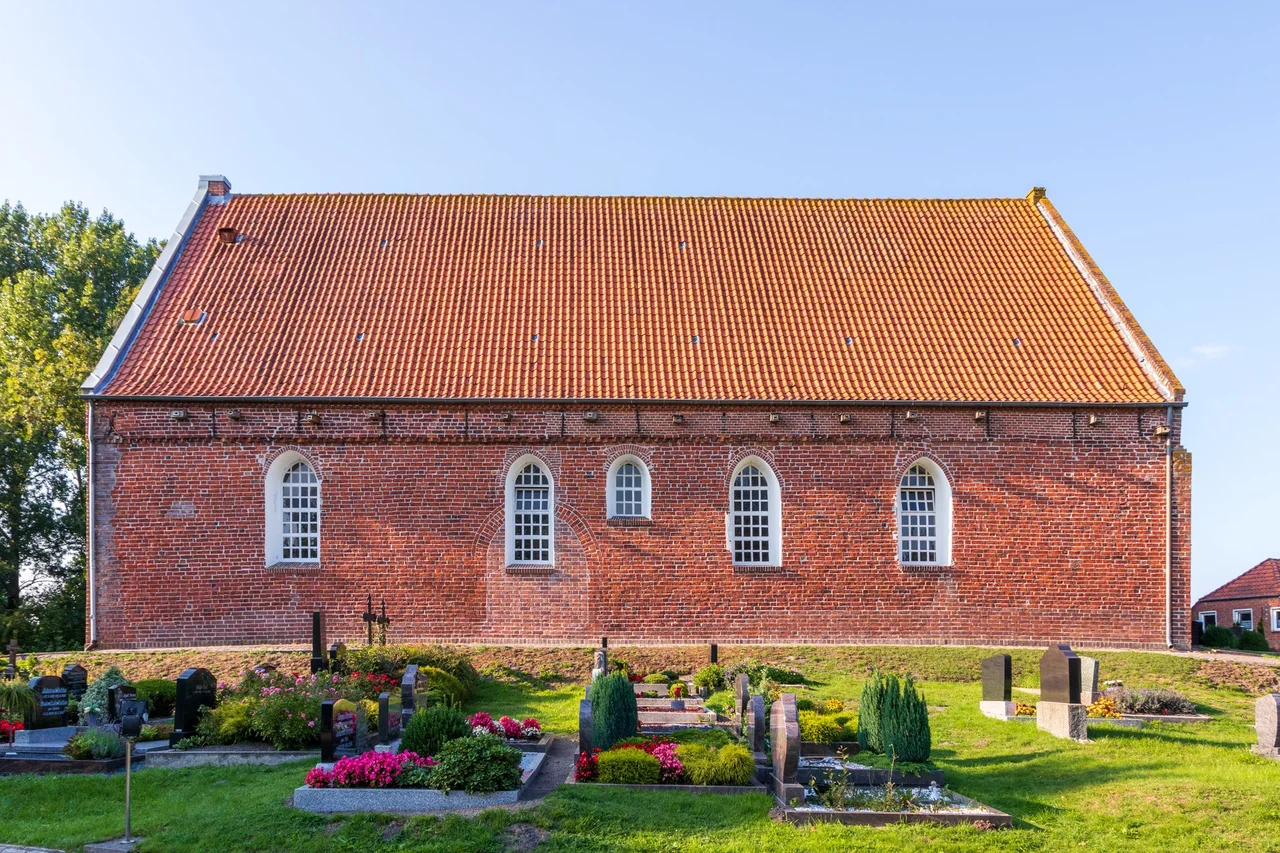

Wiegboldsbur
On the wall of a brick church in a village of ribbon-stretched farmhouses, an iron neck collar is bolted into the masonry. It is the kind of detail a traveler walks past twice before noticing - a small dark crescent against old red brick. The collar is a pranger, the medieval tool for shaming offenders in public, and its presence at Wiegboldsbur is not decorative. It marks the place where, eight centuries ago, the Brok people came to settle their disputes.
The Brokmerbrief's Quiet Town
In the 13th century, the inhabitants of the marshlands west of Aurich wrote down their laws in a document called the Brokmerbrief. Section 218 is precise and a little unusual. It forbids any hired retinue - mercenaries, in plainer English - within the parish of Wigboldsbur, under penalty of eight marks and the forfeiture of the offender's house. The clause reads at first like a local quirk, but it tells you something important: this small place was meant to be safe ground. Where there is no place for hired swords, there is room for judges. Historians read the law and conclude that the court of Brokmerland sat here, probably in the shadow of the church. Wiegboldsbur, in other words, was the courtroom of a free Frisian republic that ran its own affairs long before princes carved up the coast.
A Church on a Made Hill
The Wibadi Church was built around 1250, raised on a warf - one of the artificial dwelling mounds that East Frisians piled up against the storm tides. Its foundations run more than a meter deep into the made earth, and it replaced a wooden church that had burned. No one remembers who Wibadus was. The name attached to the church and stayed there, untraceable, like an inscription whose first half has worn away. Inside, an organ built in 1818 by Wilhelm Eilert Schmid still stands almost as he left it, eight stops of voiced pipework that have survived two centuries of damp North Sea air. The church holds two bells again, though that was not always true. One was melted down for the First World War; a replacement arrived in 1985, restoring a sound the village had been missing for nearly seventy years.
The Mill and the Marsh Farm
Just outside the village center stands the Wiegboldsbur windmill, a three-storey tower mill called a Galerieholländer, finished in 1812. It has a fantail to keep its cap turned into the wind and spring sails that can be feathered like Venetian blinds. Volunteers maintain it, and on Friday afternoons they open the doors without charging admission. A short walk away, the Woldenhof - an East Frisian Gulf farmhouse listed as a historic building since 1858 - is run by NABU, the German nature conservation union, as a school farm. Since 2002, classes have come to learn near-natural agriculture under the motto "Natur erleben - Natur verstehen." Experience nature, understand nature. The phrase is simple enough that it does not need translating twice.
Why Names Survive
Wiegboldsbur has been called many things over the centuries. Werden Abbey's registers list it as Wiboldesholte. Other parchments record Wilboldeswolde, Wibolduskeriken, Wibbodeshoff, Wibaldinga. A baptismal vessel from 1496 reads Wibelsburen. Each spelling is a small archaeological layer, and together they suggest a settlement old enough that scribes had to guess at it. Today the village is part of the municipality of Südbrookmerland - merged into a larger administrative unit in 1972 - and sits about ten kilometers northwest of Emden on the Großes Meer, a shallow inland lake whose name simply means "great sea." The court is long gone. The neck iron remains.
From the Air
Located at 53.45°N, 7.34°E in northwest Lower Saxony, about 10 km northwest of Emden's port. Recommended viewing altitude 3,000-4,000 ft for the patchwork of marsh fields, the Großes Meer to the south, and the ribbon settlement pattern that defines this part of East Frisia. The nearest airports are Emden (EDWE) to the south and Norderney (EDWY) to the north. Visibility is best in the long summer evenings when low sun rakes across the dike fields.
Nearby Stories
- SM U-30 3 km away
- Lewenborg 4.4 km away
- Wittmund (district) 6.2 km away
- Rheiderland 6.9 km away
- Wangerooge Island Railway 9.3 km away
- Bad Zwischenahn 20 km away
- Alpha Ventus Offshore Wind Farm 25 km away
- HVDC DolWin2 28 km away