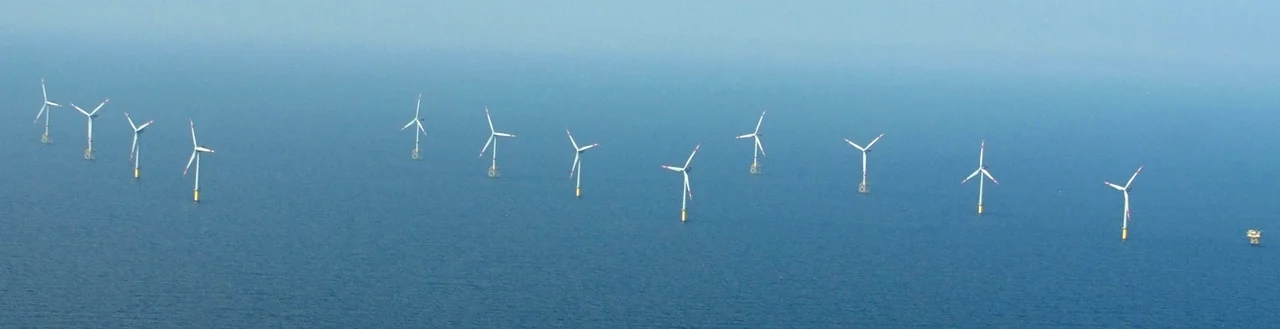

Alpha Ventus Offshore Wind Farm
Twelve turbines stand in formation about 45 kilometres north of Borkum, far enough from the island that holidaymakers on the beach see only horizon. Out here, in 30 metres of North Sea, Germany ran an experiment. The country had spent decades arguing about how its post-nuclear, post-coal grid should look — and what it would actually take to plant industrial machinery in salt water and keep it spinning. The first answer was alpha ventus. The name is intentionally lowercase, the alpha small and unassuming, as if to say: this is just the beginning.
A Decade From Paper to Power
The application landed on regulators' desks in 1999. The permit came back in 2001. Contracts for turbines and a subsea cable followed in 2007, and only in July 2008 did anyone actually start building the substation. That timeline — nine years from idea to first steel in the water — explains why Germany's offshore industry exists at all. Everything had to be invented or argued through: the foundations, the maritime law, the grid connection, the insurance, the helicopter routes. The twelve turbines that finally went operational between August 2009 and November 2009 represented a kind of practical thesis defense. On 27 April 2010, with the official ribbon cut, the Federal Republic could finally point at the North Sea and say: there. We did it.
Two Foundations, Two Bets
Look closely at the formation and the symmetry breaks. Six of the turbines are Adwen AD 5-116 machines, descended from the Multibrid M5000, planted on tripod foundations dropped by the jack-up barge Odin. The other six are REpower 5M turbines, bolted to OWEC jacket quattropods set down by the crane vessel Thialf, one of the largest semi-submersibles in the world. The same five-megawatt rating, two completely different ways of getting there. The whole site was designed as a comparison — a working bake-off between competing offshore foundation philosophies, with engineers from research platform FINO 1, 400 metres to the west, taking notes on everything from wake turbulence to seabird collisions.
The Record That Wasn't Repeatable
In 2011 alpha ventus posted a capacity factor of 50.8 percent — meaning the turbines, averaged across the year, produced just over half of what they could theoretically deliver running full bore every hour. That was the highest figure for any European offshore farm at the time. In 2012 they hit 55 percent, a global record. The engineers had projected 42 percent and called themselves conservative. They were not conservative enough. Then in 2013 the number fell to 42.7 — back to the original estimate. The likely culprit was unromantic: neighbouring wind farms had begun to fill in the German Bight, and turbines, it turns out, slow the wind a little for whoever stands downstream. Even pioneering yields fade once the neighbourhood arrives.
Built to Be Studied, Built to Retire
From the start alpha ventus was less a power plant than a national instrument. The Federal Ministry for Environment funded a stack of research projects sitting on top of every cable and bolt: wake measurements, induction-zone studies, ecological monitoring of harbour porpoises and seabirds, new control-system topologies. Almost every offshore turbine that Germany has installed since carries something learned here. And like most experiments, it has a finite run. With cost overruns pushing the price from €190 million to €250 million, and with a generation of bigger, cheaper turbines now standard, decommissioning is scheduled around 2028. A tender for taking the site apart went out in late 2025. The legacy will outlast the steel.
From the Air
Coordinates 54.011°N, 6.608°E, about 45 km north of Borkum in the German Bight. The cluster is best appreciated from 2,000-3,000 ft AGL — close enough to see the two foundation styles, high enough to take in the FINO 1 research platform 400 m to the west. Nearest airports: Norderney (EDWY) and the Dutch coast around Eelde (EHGG); Bremen (EDDW) is the closest large field. Visibility over the North Sea is famously fickle — fog can close in within minutes.
Nearby Stories
- Gemini Wind Farm 2.1 km away
- BARD Offshore 1 4.7 km away
- Norderney 12 km away
- SMS Ariadne 12 km away
- German Bight 19 km away
- Offshore wind farm He Dreiht 20 km away
- Borkum 25 km away
- Buren, Friesland 40 km away