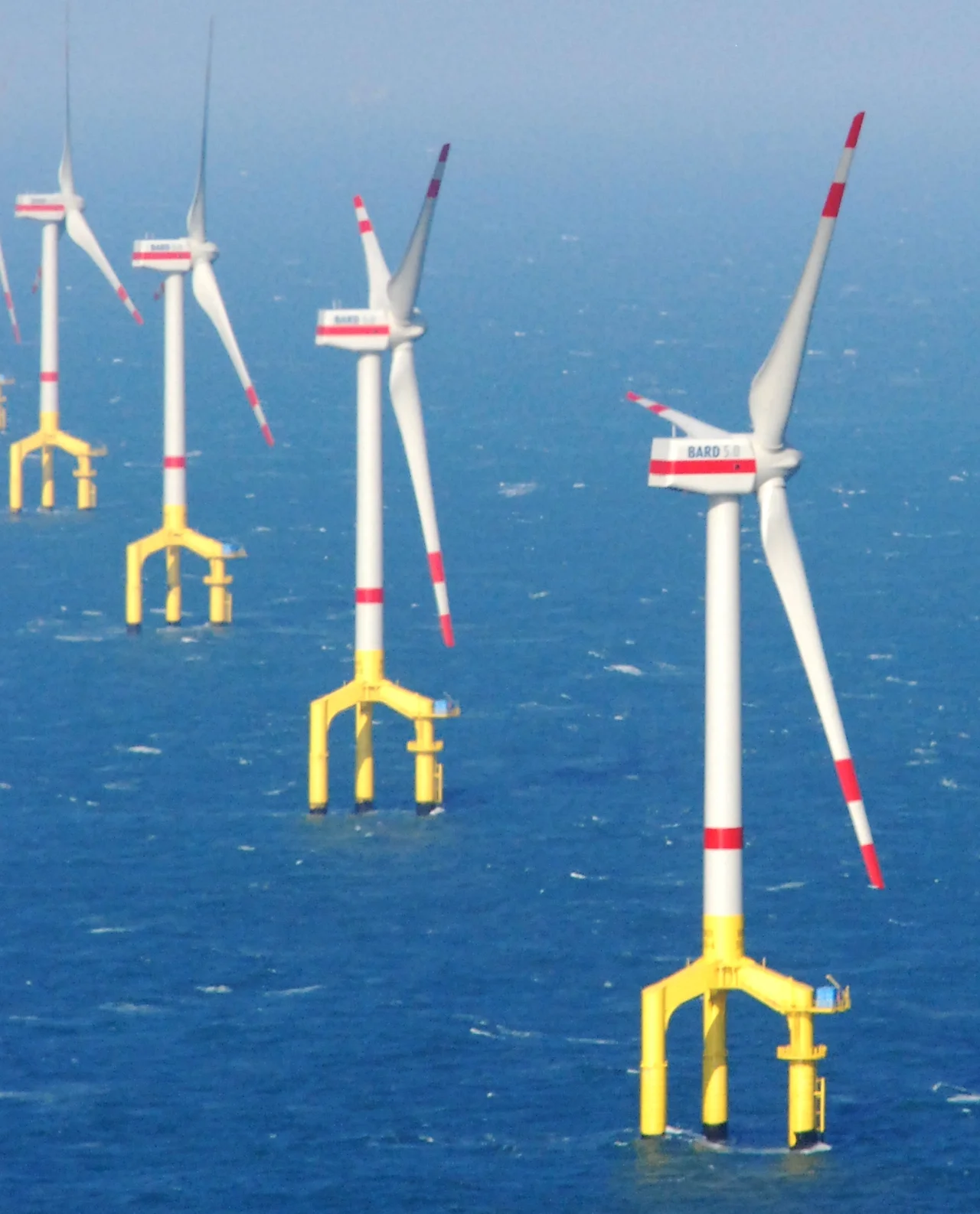

BARD Offshore 1
Dr. Bekker wanted to leave something for his children. In 2006, with offshore wind still a new industry, he could not buy five-megawatt turbines in the numbers he needed — so he decided his company, BARD, would build its own. Rotor blades and nacelles from a new factory in Emden. Foundations from Cuxhaven. Eighty turbines installed in 40 metres of water, 100 kilometres northwest of Borkum. It would be one of the most ambitious industrial projects in modern German history, and a cautionary tale that wind-industry executives still tell each other in quiet voices. Bekker's children would inherit not a thriving company but the lessons of its collapse.
The Plan, and the Distance
Most early offshore wind farms hugged the coast. BARD Offshore 1 went further than anyone had gone — 100 kilometres into open North Sea, in water deeper than any operating wind farm at the time, beyond the limit of routine helicopter response. The 200-kilometre cable connection back to shore was the longest of its kind in the world. It was also the first offshore wind farm anywhere to use high-voltage DC transmission, through the newly built BorWin1 link and its converter platform BorWin Alpha. Two prototypes had been erected at the Rysumer Nacken in 2007, another at Hooksiel in 2008. The remaining 79 turbines would have to be installed in conditions no one had operated in before, by a purpose-built jack-up vessel called Wind Lift 1, lowering 470-tonne, 21-metre foundations onto the seabed.
Two Lives Lost
Two people died building BARD Offshore 1. A commercial diver in 2010 — the German press reported a diving accident in the wind park, without naming the man for his family's sake. And in January 2012, an offshore worker went missing in conditions the German Maritime Search and Rescue Service eventually called unsurvivable. These were not statistics in a press release. They were the first reminders that the North Sea, 100 kilometres out, does not forgive the construction shortcuts that are routine on land. The wind farm's official inauguration in August 2013 took place against this background, and within the industry the memory has shaped safety protocols ever since.
Bankruptcy, Then a Mystery
The bill kept climbing. The original budget was already ambitious; by completion, the project had cost roughly €3 billion, three years behind schedule. BARD itself filed for bankruptcy in November 2013, just months after the inauguration. Worse, when the farm finally tried to feed power south through the BorWin1 link, the system would not stay up. Engineers eventually traced the problem to overvoltage and harmonic interactions between BARD's custom-built transformer and the BorWin Alpha converter platform — exactly the kind of incompatibility that arises when a company tries to vertically integrate every component instead of using standard equipment. A March 2014 fire at the transmission station made things worse. By late 2014, most of the turbines were not delivering power to shore, and the German press estimated that the failure was costing ratepayers €2 million per day.
Turned Around, Quietly
The story did not end in ruin. Operations were run by Ocean Breeze Energy, who extended their power-marketing contract with Statkraft in September 2015. By May 2016, the operating company could report that the wind farm had produced three terawatt-hours of electricity and was running stably at full capacity. Availability climbed from 66 percent in 2014 to 95 percent by 2017 — a rehabilitation that the industry now studies as a textbook recovery. In 2019, Macquarie Infrastructure and Real Assets bought the facility. The lessons — about supply chains, about modesty in pioneering projects, about who pays when a vision exceeds its execution — are now standard reading in offshore wind project management. Dr. Bekker's children may not have inherited a company, but the industry inherited what their father's company learned the hard way.
From the Air
Coordinates 54.358°N, 5.975°E, about 100 km northwest of Borkum in deep water near the German-Dutch maritime border. From 3,000-5,000 ft AGL the 80-turbine grid is impressive in its regularity. Nearest airports: Norderney (EDWY), Bremen (EDDW), Eelde (EHGG). The site is far enough offshore that helicopters supporting the farm operate from staging points along the coast — watch for transiting traffic at low altitude.
Nearby Stories
- Gemini Wind Farm 16 km away
- HVDC DolWin1 17 km away
- SM UB-22 32 km away
- Oerol Festival 85 km away
- Maritime Institute Willem Barentsz 116 km away
- Hörnum 127 km away
- Rantum Loran-C Transmitter 161 km away
- Alexander L. Kielland (Platform) 242 km away