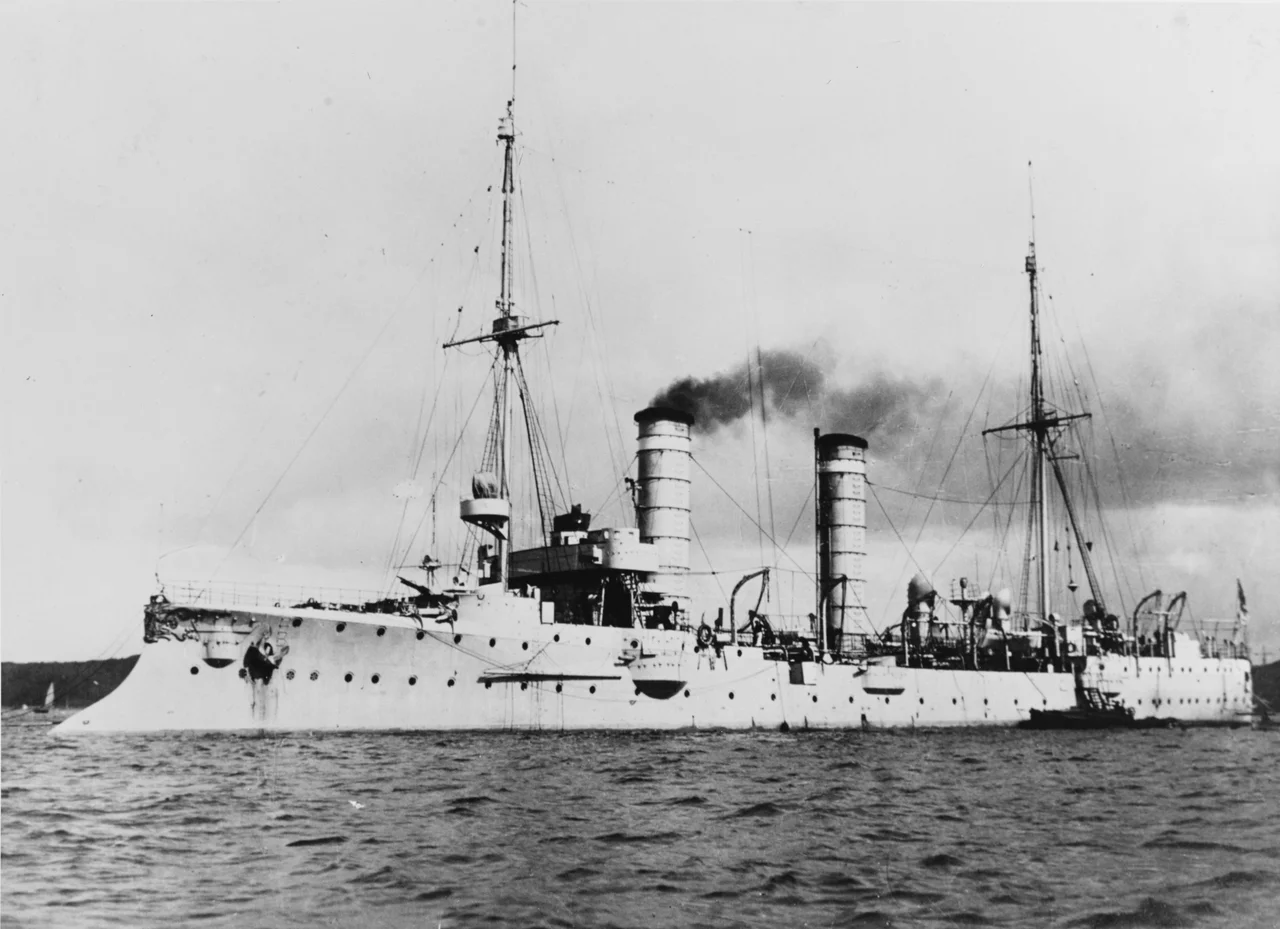

SMS Ariadne
She lay at the bottom of the North Sea for fifty-nine years before anyone found her again. Divers in 1973 located the wreck of the SMS Ariadne about four nautical miles from where the official log said she had gone down - which is unsurprising, because the men who watched her capsize on 28 August 1914 had other things on their minds than a careful bearing. Ariadne was a Gazelle-class light cruiser of the Imperial German Navy, the fifth of ten built around the turn of the century, and on the morning of the first naval battle of the First World War she was caught steaming hard toward gunfire she did not understand by British battlecruisers whose 12-inch and 13.5-inch guns she could not answer. The fight took twenty minutes. She lasted another two hours, on fire from end to end, before she rolled over.
The Quiet Years
Ariadne was the kind of ship navies build a lot of and then do not quite know what to do with. Laid down at AG Weser in Bremen in December 1899, launched in August 1900 with a speech from the director of the Imperial Shipyard at Wilhelmshaven, she was 105 meters long, displaced about three thousand tons, and carried ten 10.5-centimeter guns in single mounts. Her sea trials in 1901 nearly ended badly when a port-side boiler exploded, killing three men. She was finally fit for service in October 1902. For the next four years she steamed with the I Squadron and I Scouting Group out of Kiel - training cruises to Norway, a visit to King Edward VII at the Kiel naval review of 1904, escort duty for the Kaiser's yacht Hohenzollern, a port call at Copenhagen for the coronation of King Frederik VIII of Denmark. Routine work. In September 1906, with newer cruisers coming into service, she was paid off into reserve. There she stayed for eight years.
Reactivated
When war broke out at the end of July 1914, the Imperial Navy needed every hull. Ariadne was recommissioned on 2 August - two days after the German declaration of war on Russia, two days before Britain declared on Germany. Her new commander was Kapitaen zur See Hans Seebohm. Her new job was flotilla leader for the coastal-defense torpedo boats guarding the estuaries of the Jade and Weser rivers, where the Imperial fleet rode at anchor. It was a defensive posting at a vulnerable spot: every chart of the bight showed how few approaches there were and how hard they would be to defend if the Royal Navy ever showed up in force. Twenty-six days later, the Royal Navy showed up in force.
Fog and Battlecruisers
On the morning of 28 August, Ariadne was at anchor inside the Weser estuary, having just rotated out of the patrol line. Reports of British cruisers and destroyers attacking off Heligoland started coming in. She raised steam and went out. The fog that day was thick enough that ships were finding each other by sound. At about 13:40 she stumbled into the British light cruiser Strassburg's chase and almost immediately afterward into Vice Admiral David Beatty's five battlecruisers, which had come south from Scapa Flow at maximum speed. The first hits tore into her forward boiler room. Coal in the bunkers caught fire. Five boilers went out and her speed collapsed to fifteen knots. Two battlecruisers - one of them probably HMS New Zealand - closed to three thousand meters, point-blank range for guns that size, and fired into her at will. Ariadne returned fire from what guns she still had, hopelessly. At 14:15 the British checked fire and let her drift away.
Hours on Fire
Her surviving crew flooded the forward magazine to keep the propellant from cooking off, then assembled on the forecastle while fires raged through the rest of the ship. The German light cruiser Danzig came alongside before three o'clock and began taking men off, joined by Stralsund and another consort. Stralsund tried to take Ariadne under tow. At 16:25 she capsized, took some hours to settle, and finally sank. Rescue boats were driven back repeatedly by ammunition cooking off on her decks - the practical reality of a ship dying that no battle painting captures. The casualty figures are honestly contested: the historian Gary Staff says nine officers and fifty enlisted men were rescued, implying very heavy losses; Hildebrand, Roehr and Steinmetz say around two hundred and fifty were saved and sixty-four died. Either way, dozens of young Germans went down with her or burned to death waiting for rescue.
The Wreck and the Lesson
Ariadne lies today north of the island of Norderney, at 54 degrees 9 minutes north and 7 degrees 7 minutes east, in water deep enough that recreational divers can reach her in good conditions. She was a small loss in the grand arithmetic of the First World War - one of three German light cruisers sunk that day, along with Mainz and Coeln - but the loss of three cruisers in a single morning was enough to convince Kaiser Wilhelm to keep the High Seas Fleet bottled up in port for months. The strategic decision haunted Germany for the rest of the war: a navy that does not sail does not win. Ariadne's hull is the rusting evidence of the moment that decision was made.
From the Air
The wreck lies at 54 degrees 9 minutes north, 7 degrees 7 minutes east, about four nautical miles from her last reported position and roughly thirty kilometers north of the island of Norderney in the East Frisian chain. This is open North Sea, on the western edge of the Heligoland Bight. Cruising altitude of 4,000-6,000 feet on a clear day shows the long arc of the Frisian islands - Norderney, Juist, Baltrum, Langeoog - to the south, with Heligoland's red cliffs about thirty nautical miles east. Nearest airports: Norderney (EDWY) and Juist (EDWJ) on the islands themselves, with Bremen (EDDW) and Emden (EDWE) on the mainland inland.
Nearby Stories
- Heligoland Lighthouse 11 km away
- SM U-51 12 km away
- SM UB-22 22 km away
- Alpha Ventus Offshore Wind Farm 25 km away
- Baltrum 28 km away
- Amrumbank West 32 km away
- MV Pallas 36 km away
- Borkum 42 km away