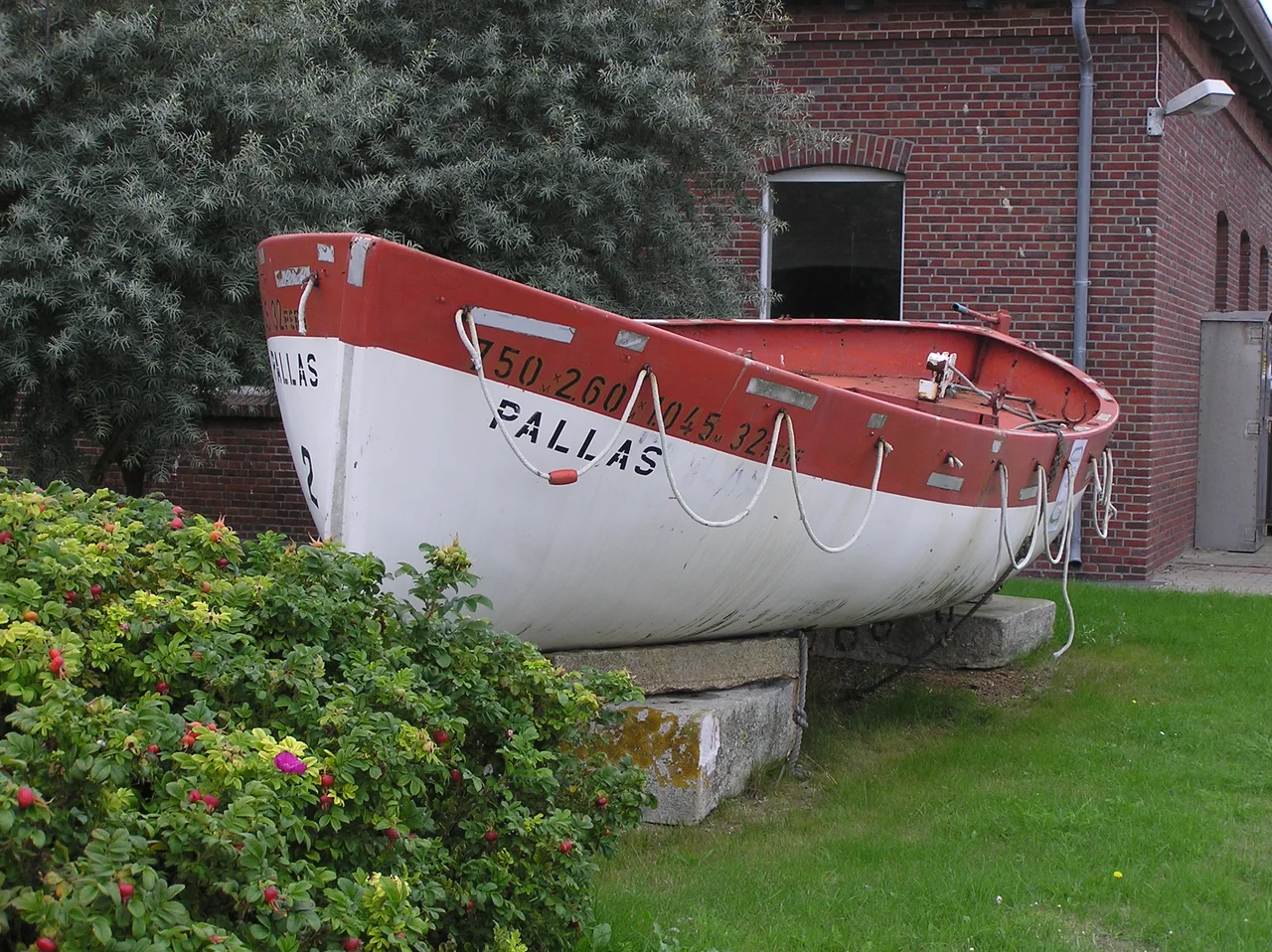

MV Pallas
The fire started in the lumber. The Pallas, a 147-metre cargo ship built in 1971, had cleared the Swedish port of Hudiksvall on 20 October 1998 with 2,500 tonnes of sawn timber bound for Morocco. Five days later, somewhere off the west coast of Jutland, the hold began to burn. The captain tried to smother it. He could not. At 11:54 p.m. on 25 October the Pallas broadcast a Mayday into the North Sea, and a Danish and a German rescue helicopter went out into the dark to find a freighter on fire. The fire would smoulder for a month. By the time it was finally extinguished, the ship was on the sandbar off Amrum and 16,000 seabirds were dead.
Bahamian Flag, Italian Owners, Swedish Wood
The Pallas was the kind of vessel that defines late-twentieth-century shipping: registered in the Bahamas, owned by Bogazzi Servizi Navali of Italy, crewed internationally, carrying timber from one peripheral economy to another. Her callsign was C6LO9. Her IMO number, 7039206, would outlive her as the bureaucratic ghost of a ship that no longer existed. The crew was rescued. The cargo, blackened and burning, drifted south on the current and the wind until 29 October, when the Pallas grounded in the shallows off Amrum, inside the boundary of the Schleswig-Holstein Wadden Sea National Park - a protected ecosystem that had, until that morning, never had a major oil spill.
The Eiders
Between two hundred and three hundred tonnes of heavy fuel oil leaked from the hull. It was not the largest spill ever recorded in European waters - the Erika off Brittany would dump nineteen thousand tonnes a year later - but it landed in exactly the wrong place. The eastern North Sea is one of the most important wintering grounds for the common eider. Tens of thousands of the birds raft along the Wadden Sea coast each autumn, diving for mussels in the shallows. Oiled feathers lose their insulation; the birds freeze before they drown. About 16,000 seabirds died in the weeks after the grounding, almost all of them eiders. Volunteers walked the Amrum beaches for weeks picking up the bodies.
A Minister and a Mayday
The political aftermath was, in some ways, more consequential than the spill. The Pallas had been burning for days before any German authority took clear responsibility for towing or salvaging her. Germany's North Sea coast in 1998 had no centralised command structure for maritime emergencies of this scale. Rainder Steenblock, the Schleswig-Holstein environment minister from Alliance 90/The Greens, was sharply criticised for his slow response. He travelled to Amrum only under pressure from his state's prime minister, Heide Simonis. Environmental groups including NABU and BUND called for his resignation; so did MPs from his own coalition. Steenblock survived politically, but the federal government did not let the question die. In 2003, after years of investigation and reports, Germany created the Havariekommando - the Central Command for Maritime Emergencies - precisely so that the next Pallas would have somewhere to call.
A Mahnmal in the Sand
Parts of the hull are still out there. The salvage operation never fully recovered the wreck, and at low tide, on a calm day, the rusting plating breaks the surface of the Wadden Sea about a kilometre west of Amrum's shore. Tourists walking the Kniepsand stop to photograph it. Local environmental educators bring schoolchildren to look at what they call the Mahnmal - the memorial, the warning. The eiders have largely returned. The mussel beds healed within a few years. But the silhouette of a freighter slowly dissolving in the tide is still the most visible reminder on this coastline of how a routine shipment of Swedish lumber became the worst maritime environmental disaster in German history.
From the Air
The wreck site lies at approximately 54.542 N, 8.287 E, in the Wadden Sea just off the southwest coast of Amrum. The nearest airport is Sylt (EDXW), 30 km north. From cruise altitude the location is identifiable by reference to the Amrum lighthouse to the east and the broad pale band of the Kniepsand sandbank. In clear weather and at lower altitudes, the surviving hull plating is visible at low tide as a dark rectangle on the otherwise pale shallows.
Nearby Stories
- Amrumbank West 6.7 km away
- Battle of Heligoland Bight (1914) 20 km away
- HMS Ariel (1911) 21 km away
- Stalag X-B 104 km away
- Teufelsmoor 144 km away
- Tvindkraft Wind Turbine 157 km away
- Lilleø 173 km away
- Battle of Jutland 236 km away