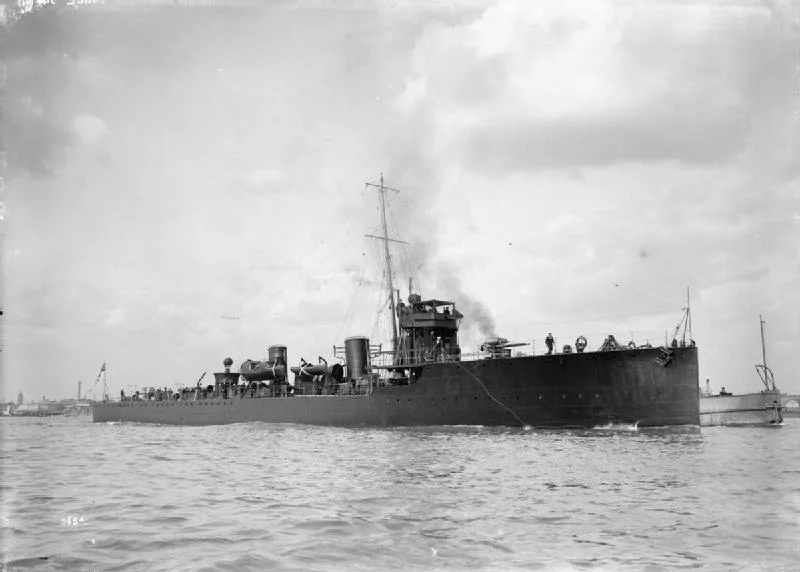
_IWM_Q_38184.jpg)
HMS Ariel (1911)
She was named for an airy spirit. Shakespeare's Ariel, the wind-sailor of The Tempest who can fly faster than thought - and possibly also the biblical spirit of the same name; the Royal Navy left the genealogy ambiguous. HMS Ariel was the tenth and last ship in the Royal Navy to carry that name. She was laid down at the Woolston yard of John I. Thornycroft, launched on 26 September 1911, and ran her trials at 29 knots, slightly faster than the standard Acheron-class destroyer, slightly longer, slightly more powerful. The Thornycroft yard called the type a "Thornycroft special." Ariel had a complement of seventy men, two 4-inch guns, and 21-inch torpedo tubes. She would spend her short career haunting one stretch of grey water - the Heligoland Bight - and she would die there.
First Patrol of the War
On 5 August 1914, one day after Britain declared war on Germany, Ariel was towing a Royal Navy submarine across the North Sea toward Terschelling, off the Dutch coast. With a cruiser and a second submarine in company, she released the tow, and the two submarines slipped beneath the surface to begin the first Heligoland Bight patrol of the First World War. It was a small action, almost a footnote, but it set the geometry of the next four years. The Heligoland Bight - the half-moon of water bounded by the German coast, the Dutch islands, and the rock of Heligoland itself - would be the strangling ground where Royal Navy destroyers and German U-boats hunted each other across minefields for the rest of the war. Ariel would not leave it until she sank.
Heligoland Bight, Dogger Bank, Jutland
Three weeks after that first patrol, Ariel was at the Battle of Heligoland Bight on 28 August 1914 as part of the Harwich Force's First Destroyer Flotilla, under Commander Dashwood Moir, and she shared in the prize money for the battle. Five months later she was at the Battle of Dogger Bank on 24 January 1915. On 31 May 1916, under Lieutenant Commander Tippet, she was at the Battle of Jutland - the largest naval battle of the war, the one engagement where the British Grand Fleet and the German High Seas Fleet finally met in open battle. Among the dozens of destroyers crisscrossing through smoke and shellfire in the night actions of Jutland, Ariel survived the fight and came home with her flotilla. For a small ship in a war that fed small ships into U-boat campaigns and minefields without mercy, three of the war's signature actions in three years was already a remarkable record.
Ramming U-12
On 10 March 1915, off the Aberdeenshire coast, Ariel and two of her sister destroyers were searching for a German submarine reported by a trawler. At 10:12 in the morning they sighted U-12 about two nautical miles away. All three destroyers turned toward her. U-12 crash-dived and then made the small, fatal mistake of raising her periscope. Ariel saw the periscope at 200 yards. Her captain turned to ram. In the final seconds before impact, the conning tower of U-12 was just visible under the water. Ariel struck the submarine at a fine angle - hard enough to crush her own bow so badly that she had to be towed back to port. U-12 sank with most of her crew. Nineteen German sailors died; ten survivors were rescued. The trade was brutal: a wrecked British bow for a German submarine and the men inside her. In the calculus of 1915, that was considered a good day's work.
Conversion and End
By 1917 the war had shifted underwater. The British decided to try to seal the Heligoland Bight - to lay so many mines across the entrances to the German naval bases that no U-boat could safely leave port. Ariel and her sister Sandfly were converted to minelaying destroyers, each able to carry forty mines, and reassigned to the 20th Flotilla based at Immingham. On 27 March 1918, while laying a barrier minefield seventy nautical miles northwest of Heligoland, Ariel and her sister Ferret and a third destroyer encountered three armed German trawlers - Polarstern, Mars, and Scharbentz. All three German vessels were sunk. Seventy-two prisoners came aboard the British destroyers. Then, on 2 August 1918, three months before the Armistice, Ariel was minelaying in the western Heligoland Bight when she ran onto a German mine. She sank. Forty-nine of her crew died, including her commanding officer, Lieutenant Frank A. Rothera. The Bight took back what it had been giving up.
From the Air
Ariel was lost on 2 August 1918 in the western Heligoland Bight, roughly 54.17°N, 8.07°E. The site is open water in the German Bight, about 30 km east of Heligoland and within the modern offshore wind farm zone. Heligoland-Düne (EDXH) is the nearest airfield; Cuxhaven (EDHC) and Sylt (EDXW) are the main mainland alternates. The wreck site lies under busy modern shipping lanes serving the Elbe and Weser estuaries. Weather changes rapidly here; the same conditions that hid minefields from the Royal Navy in 1918 still reduce surface visibility today.
Nearby Stories
- SM U-51 3.5 km away
- Amrumbank West 14 km away
- SMS Ariadne 19 km away
- Baltrum 26 km away
- SM UB-22 58 km away
- Stalag X-B 77 km away
- Teufelsmoor 109 km away
- Lilleø 201 km away