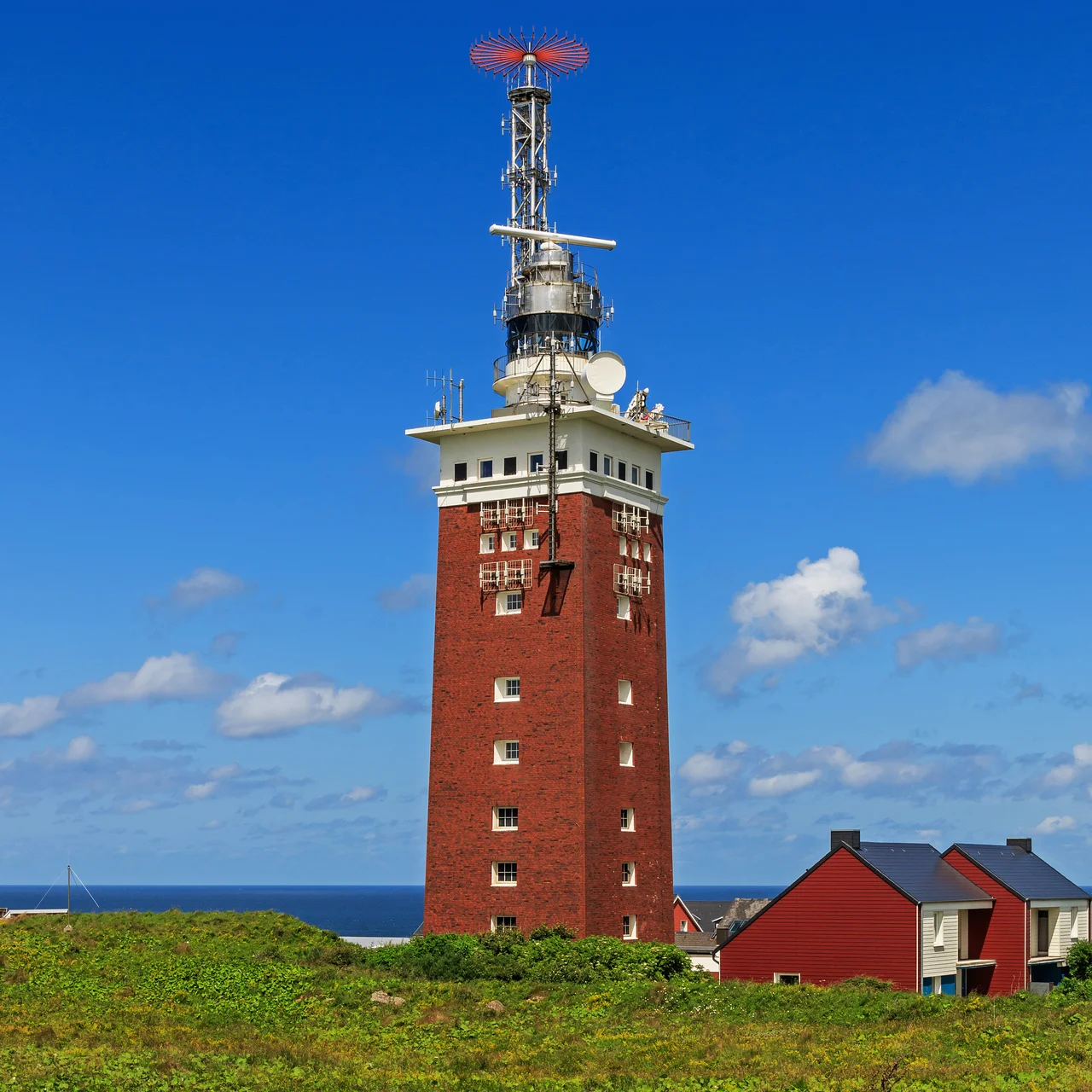

Heligoland Lighthouse
On the cliffs of Heligoland stands a square concrete tower with a brick veneer that, at a glance, looks like every other coastal lighthouse in northern Europe. It is not. The body of this lighthouse was built in 1941 by the Wehrmacht as a flak tower - heavily reinforced concrete designed to mount anti-aircraft guns and survive what was already coming. Six years later, when the Royal Navy detonated 6,700 tonnes of munitions across the island in Operation Big Bang, the flak tower was the only building on Heligoland that survived. In 1952 the British, who had spent that interval using the island for target practice, modified it to hold a lantern, and the strongest beam on the German North Sea coast began its working life inside walls designed to shoot down airplanes.
Three Centuries of Light
Heligoland has lit a lamp for ships since 1630, when the Duke of Schleswig built the first coal-fired beacon and charged Hamburg, Bremen, and Stade shipowners a Lübeck shilling per Last in "fire money" for the privilege of using it. It went bankrupt in seven years and shut down. The City of Hamburg tried again in 1676, importing high-quality Scottish coal to feed the flame. That second lighthouse stood on a small rise about two hundred yards from the village houses, its coal fire burning year-round. A nineteenth-century traveller wrote that, perched on ground two hundred and sixteen feet above the sea, the beacon "may be distinguished at an immense distance, and according to the report of sea-faring men, it surpasses in this respect, most of the light-houses in the European seas." When Britain owned Heligoland, Parliament transferred control of the lighthouse to Trinity House in 1836. After Heligoland passed to Germany in 1890, the coal-fired tower was finally retired.
Thirty Million Candles
The Prussian administration ordered a new lighthouse in 1902, a round brick tower built from the same plans as the Cape Arkona light on Rügen in the Baltic. The optics were extraordinary for their time. Three arc lamps, each paired with a silvered-glass parabolic reflector, rotated together to flash every five seconds. Above them, a fourth searchlight spun three times faster, sending an extra pulse between the others. Each beam, according to the Siemens engineers who built the assembly in Nuremberg, threw thirty million candlepower across the German Bight. For forty-three years that light worked. On 18 April 1945 - the same date the Royal Air Force would, two years later, choose for Operation Big Bang - a thousand-bomber raid destroyed the 1902 tower and killed its keeper. After the war, the surviving lens and lantern were salvaged. They were carried across to Fehmarn island in the Baltic, mounted on the Staberhuk Lighthouse, and they are still working there today.
The Flak Tower Becomes a Beacon
When the British arrived to demolish Heligoland's defences in 1947, the 1941 flak tower stood on the central plateau, reinforced concrete several metres thick. Operation Big Bang detonated 6,700 tonnes of explosives across the island's bunker network. The blast levelled the southern tip and cracked the cliffs. The flak tower didn't move. By 1952, with the island handed back to West Germany and a new use for the structure required, German engineers fitted a temporary lantern to the top. The current shape, with the brick veneer that softens its military silhouette, came from a 1965 renovation. The optics were modernised in 1963: three converging lenses with 250-millimetre focal lengths, mounted at 120-degree intervals on an electric rotator, lit by a 2,000-watt xenon arc lamp. The light's range is 28 nautical miles, the strongest on the German North Sea coast, visible from as far as the East Frisian and North Frisian islands and the Halligen.
Working Light
Heligoland Lighthouse is not a museum piece. The Tönning water and shipping authority operates it, and since 1982 the small lighthouse on the neighbouring Düne island has been controlled remotely from this tower. The Wilhelmshaven shipping authority uses it as a relay radio station, regulating traffic through the eastern German Bight, where ferries, fishing boats, offshore wind service vessels, and the occasional container ship cross paths. The xenon arc lamp pulses through the lens stack and the beam fans out across the water that has been fought over since the seventeenth century. The same tower that was built to shoot aeroplanes out of the sky now guides ships home, the war it was built for forgotten by everyone except the historians and the visitors who notice that the walls are too thick for any lighthouse anyone designed from scratch.
From the Air
Located at 54.1818°N, 7.8824°E on the Oberland of Heligoland's main island, atop the central plateau. The square brick-veneered tower stands at about 41 metres above ground, 82 metres above sea level, and its 28-nautical-mile beam is one of the most powerful in the German Bight - a useful waypoint at night or in marginal visibility for any traffic working the offshore wind fields. Heligoland-Düne airfield (EDXH) is on the smaller eastern island; Cuxhaven (EDHC) lies 70 km southeast on the mainland. The lighthouse sits within walking distance of the Operation Big Bang memorial bunker and the Lange Anna sea stack.
Nearby Stories
- SM U-51 3.5 km away
- Amrumbank West 14 km away
- SMS Ariadne 19 km away
- Baltrum 26 km away
- SM UB-22 58 km away
- Stalag X-B 77 km away
- Teufelsmoor 109 km away
- Lilleø 201 km away