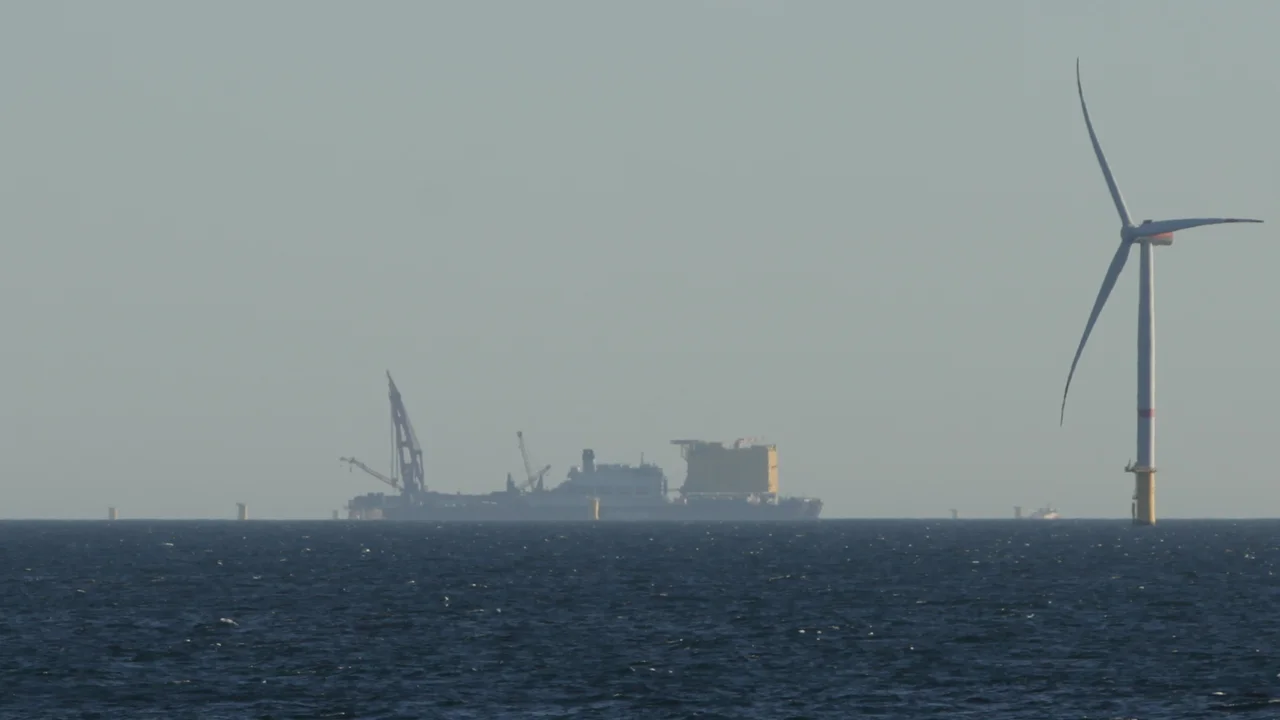

Offshore wind farm He Dreiht
In April 2017, the German energy company EnBW filed a bid for a patch of North Sea seabed and offered to build a 900-megawatt wind farm on it for a subsidy of zero. Not zero cents per kilowatt-hour above the market price. Zero. No guaranteed feed-in tariff, no premium under the Renewable Energy Sources Act - just the right to plug into the grid, plus whatever the wholesale electricity market would pay them. The bid won. The wind farm is called He Dreiht, Low German for 'it turns', and as of 2026 it is finishing construction 85 kilometers north of Borkum.
The Zero-Cent Bet
He Dreiht's zero-subsidy bid stunned the European energy industry. For years, offshore wind had been treated as a still-fragile technology that needed guaranteed pricing to attract capital. EnBW was effectively saying: turbines are now cheap enough, financing is now cheap enough, and the wholesale price of electricity will be high enough that we can do this on our own. The bet rested on two assumptions - that 15-megawatt turbines would be available by the time construction started, and that commercial banks would lend against unsubsidized offshore revenue. Both assumptions held. The contract for 64 of Vestas's V236-15.0 MW turbines was signed; the European Investment Bank put in 600 million euros.
Bigger Blades, Fewer Towers
The Vestas V236-15.0 MW is a turbine designed to make zero-subsidy economics work. Its rotor is 236 meters across - wider than the London Eye is tall - and each unit produces 15 megawatts at full output. He Dreiht needs only 64 of them to reach 960 MW, where a farm built a decade earlier would have needed two or three times as many. Heerema Marine Contractors installed the monopile foundations. Steelwind Nordenham manufactured the 64 steel cylinders that hold the towers, each weighing more than a thousand tonnes. Smulders and Sif jointly built the transition pieces - the yellow-painted segments that bolt onto the top of each monopile.
The Money Behind the Turbines
In March 2023, EnBW made the final investment decision and immediately sold 49.9 percent of the farm. The buyers were a club of long-horizon institutional investors: Norway's sovereign wealth fund (through Norges Bank Investment Management), Allianz Capital Partners, and the Danish infrastructure platform AIP Management. EnBW kept 50.1 percent. The arrangement turned He Dreiht into a poster child for a quieter shift in the energy business - the moment offshore wind stopped being a government-subsidized public works project and became a piece of infrastructure that pension funds and sovereign wealth funds wanted on their balance sheets.
It Turns
Commissioning began in stages through 2025 and continues into 2026. From the deck of a passing ship - or, more often, from the window of a flight tracking the German coast toward Scandinavia - the He Dreiht turbines stand in a pattern like surveyor's pins driven into the sea. Each blade sweeps an area larger than a soccer field. The lights blink red and white at night to warn aircraft. Somewhere beneath the waves, the cables carry their output toward the BorWin and DolWin converter platforms, then on to mainland substations, then onto the grid. He Dreiht. It turns.
From the Air
He Dreiht lies in the German exclusive economic zone of the North Sea at approximately 54.35°N, 6.20°E - about 85 km north of Borkum and 104 km west of Heligoland. Nearest airports: Emden (EDWE), Bremen (EDDW), Heligoland (EDXH). Best viewed from 8,000-15,000 ft on clear days, when the 64 turbines stand in regular rows across roughly 90 square kilometers of open water. Note the active wind-farm airspace restrictions; the V236-15.0 MW turbines tip out at over 280 m above the waterline, taller than many low-altitude restricted flight zones permit overflight. Adjacent to the BorWin and DolWin HVDC clusters.
Nearby Stories
- Gemini Wind Farm 17 km away
- HMS Arethusa (1913) 19 km away
- HMS Sunfish (81S) 33 km away
- Terschelling 85 km away
- Hörnum 104 km away
- Oerol Festival 117 km away
- Rantum Loran-C Transmitter 138 km away
- Alexander L. Kielland (Platform) 255 km away