.jpg)
HMS Arethusa (1913)
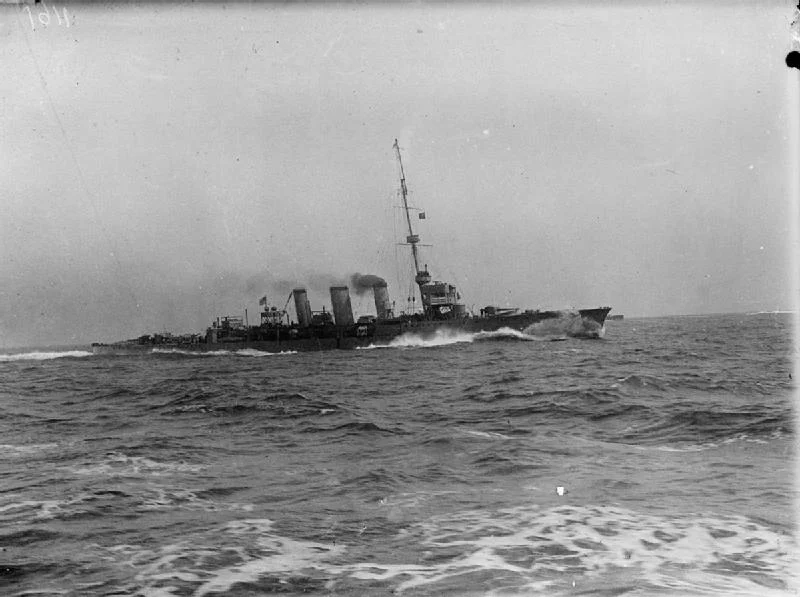
She was the ship the Admiralty wanted faster than anything else in 1913 — a 456-foot light cruiser built to lead destroyer flotillas, fast enough to outrun any battleship and gun-heavy enough to swat aside the destroyers that menaced the fleet. Her name was a borrowing, the seventh Royal Navy ship to carry it, after a Greek nymph who once fled across the seabed to escape an unwanted suitor. Whether her crew remembered the myth is unknown. What is known is that HMS Arethusa lived hard and died young: three years from launching to wreck, packed with engagements, and finally undone not by another ship but by a small floating canister of explosive on a chain.
Speed in Steel
The Arethusa class was an answer to a specific problem. Royal Navy battle squadrons of the Edwardian era moved at perhaps 21 knots; destroyers harassing them could do close to 30. The cruiser meant to ride herd on those destroyers had to keep up, and Arethusa did — eight Yarrow boilers feeding four Brown-Curtis steam turbines, 40,000 shaft horsepower across four shafts, a designed speed of 28.5 knots. She burned fuel oil rather than coal, which meant a single fuelling stop instead of the back-breaking ritual of coaling that defined navy life until then. Her main armament was modest by capital-ship standards — two 6-inch guns fore and aft, six 4-inch guns at the beam, four 21-inch torpedo tubes — but she was meant to slash and run, not slug it out.
Heligoland Bight, 28 August 1914
Three weeks into the war Arethusa was already in the thick of it. As flagship of Commodore Reginald Tyrwhitt's Harwich Force, she led destroyer flotillas into the Heligoland Bight on 28 August 1914 in a confused, fog-thickened raid on German patrol lines. She traded fire with German light cruisers, took a hammering that left only one 6-inch gun in action, and survived the day. Three German cruisers and a destroyer did not. The Brierley Hill War Memorial in Dudley still carries a relief panel showing Arethusa's boats out in the water afterwards, picking up German survivors — a humane gesture in a war that would forget such gestures fast.
Dogger Bank, and a Mine off Felixstowe
At the Battle of Dogger Bank on 24 January 1915, Arethusa was again on the picket line as Beatty's battlecruisers chased Hipper's into a running gunfight that ended with the German armoured cruiser Blucher capsizing under British fire. Just over a year later, on 11 February 1916, Arethusa was returning to Harwich from a routine sweep when she struck a mine laid by the German submarine UC-7. She drifted onto the Cutler shoal off Felixstowe and broke up in the surf. Ten of her crew died. The wreck lay in shallow water, and salvage parties returned over the following weeks to pull off what they could.
A Gun That Outlived a War
On 27 March 1916, divers brought up one of Arethusa's 4-inch guns. It was fitted to the yacht Vittoria for minesweeping duty, served until February 1918, then went to the drill ship HMS Satellite in 1920 for anti-submarine training. When the Second World War began, it was retired. In February 1948 the breaker's firm J. G. Potts presented the gun to the Armstrong & Aviation Museum at Bamburgh Castle on the Northumberland coast, where it still sits — a piece of a ship that has been on the seabed for over a century, still pointed at an enemy that no longer exists.
From the Air
The Wikipedia coordinates (53.97°N, 6.70°E) place the position roughly in the German Bight, near where Arethusa would have operated in 1914-15 patrols and during the Heligoland Bight and Dogger Bank actions. The actual wreck site, however, is on the Cutler shoal off Felixstowe on the English east coast, near 51.92°N, 1.30°E. From cruising altitude the German Bight is open water — no airports nearby in international waters; on the English side, Felixstowe sits under approaches to Stansted (EGSS) and the various Suffolk fields. Visibility over the Bight is often hazy.
Nearby Stories
- Tiefwasserreede 5.2 km away
- East Frisian Islands 6.6 km away
- Offshore wind farm He Dreiht 9.1 km away
- Schule am Meer 15 km away
- Gemini Wind Farm 24 km away
- HMS Sunfish (81S) 27 km away
- Amrumbank West 31 km away
- Schiermonnikoog National Park 34 km away