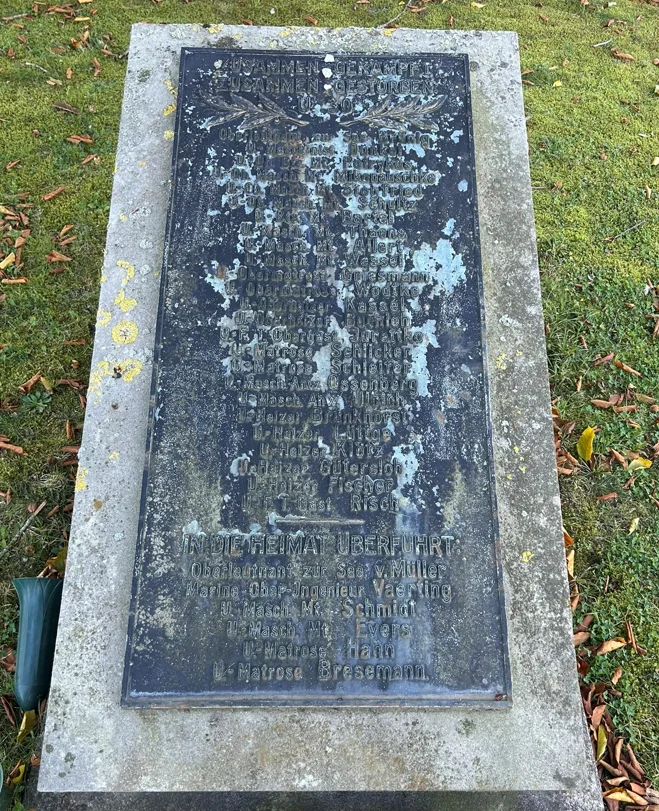

SM U-30
On the afternoon of 1 May 1915, twenty nautical miles west of the Scilly Isles, the lookouts aboard SM U-30 spotted a small convoy and made the decision that would put their boat into the history books. A torpedo was already in the water before the captain's officers noticed the flag on the lead vessel: stars and stripes. The ship was the American tanker Gulflight. The United States was officially neutral. Germany's standing orders forbade attacks on neutral shipping. The torpedo could not be recalled.
A Week of Sinkings
The patrol that ended in the Gulflight incident had begun a week earlier, on 24 April 1915. U-30 was a Type U 27 boat, one of 329 submarines that would eventually serve the Imperial German Navy in the First World War, and her crew was working the Western Approaches - the busy shipping lanes funneling into the British Isles. On 28 April she stopped the collier Mobile, allowed the crew off, and sank the empty hull with her deck gun. The next day she sank the 3,220-ton Cherbury the same way. The day after that, the steamer Fulgent refused to halt; a warning shot to the bridge killed the captain and quartermaster, and only then did the rest of the crew abandon ship. The 3,102-ton Svorno followed that afternoon. By 1 May she had added the grain carrier Edale and the French ship Europe. Six ships in five days. The procedures - stop, allow crews to escape, then scuttle - reflected the cruiser rules of international law, the rules navies were still pretending applied to submarine warfare.
The Drifter and the Patrol
Late on 1 May, U-30 stopped a Dutch ship roughly forty-five nautical miles northwest of the Scillies. The Netherlands was neutral, the vessel was let go, and U-30 submerged to continue her patrol. What her crew did not know was that a small steam drifter, the Clara Alice, had watched the encounter from a distance and radioed the submarine's position to a Royal Navy patrol. The patrol came looking. They never found U-30. What they did find was the Gulflight, an American tanker bound from Port Arthur, Texas, to Rouen with a load of oil. Believing they were doing her a favor, the British escorted her. Under the international law of the time, a neutral ship escorted by armed belligerent vessels could be treated as a legitimate target. The escort that was meant to protect the Gulflight had effectively marked her for destruction.
One Torpedo
U-30 surfaced briefly, sighted the convoy, dove again, and fired. The torpedo struck the Gulflight forward. Only then, as the tanker shuddered and began to settle by the bow, did U-30's lookouts make out the American flag through their periscope. The boat broke off the attack at once - her orders on neutrals were explicit - and disappeared. The Gulflight did not sink. She was towed into Crow Sound and eventually repaired. But two of her crew drowned trying to abandon ship, and her master, Captain Alfred Gunter, died of a heart attack that same night. Three Americans dead, an American merchant vessel torpedoed without warning by a German submarine. In another year, in another war, the incident would have been a casus belli. In 1915 it was something stranger - a diplomatic crisis that arrived in the post.
Overshadowed by Lusitania
Six days after the Gulflight was hit, on 7 May 1915, the Cunard liner Lusitania was torpedoed off the Old Head of Kinsale by another U-boat, U-20, and 1,198 people died. The Gulflight, which would have been the lead story of the spring, vanished into a footnote. Together with the attack on the steamer Cushing the week before, the two incidents formed the backbone of a formal American protest to Berlin. Germany, anxious to keep the United States out of the war, agreed to conduct further submarine operations strictly under cruiser rules. The concession bought eighteen months. By early 1917, with the German high command betting that unrestricted submarine warfare could starve Britain into surrender before America could mobilize, the agreement was thrown out. President Wilson asked Congress for a declaration of war in April. U-30, the boat that had fired the first torpedo at an American ship in the Great War, was by then one of hundreds. But she had been first.
From the Air
The memorial coordinates given are 53.55°N, 6.67°E - the Ehrenfriedhof in Emden, on the German North Sea coast, where a plaque commemorates U-30 crew members lost during the war. The Gulflight attack itself occurred about 20 nautical miles west of the Scilly Isles, near 49.9°N, 7.0°W, in the open Western Approaches. For viewing the Emden memorial site from the air: nearest airport is Emden (EDWE), with Bremen (EDDW) and Groningen Eelde (EHGG) within easy range. The coast here is flat, marshy, and prone to maritime haze - clearest visibility comes with cold easterly air off the German plain.
Nearby Stories
- Hanze University of Applied Sciences 3 km away
- Leybucht 4.6 km away
- Ypey Mole, Ryptsjerk 6.6 km away
- Oldambt 7.8 km away
- Buren, Friesland 15 km away
- HMS Arethusa (1913) 24 km away
- Gemini Wind Farm 28 km away
- SMS Ariadne 41 km away