
Hanze University of Applied Sciences
In 1798, a year after the French had rewritten the map of the Netherlands and the Batavian Republic was barely standing, a group of Groningers founded a school with an ambitious and unusually progressive mission. The institution would teach drawing, construction, and the nautical sciences "within all ranks of society, and in particular to improve the skills of the disadvantaged". They called it the Academie Minerva. It was the first multi-sectoral institute for practical higher education the Netherlands had ever seen. Nearly two centuries later it would become the founding cell of one of the largest universities of applied sciences in the country.
The 1986 Merger
By the mid-1980s the Dutch government had decided its vocational education sector was too fragmented to be efficient. A policy paper with a typically Dutch title - "Expansion, Division of Tasks, and Concentration in the Higher Educational System" - recommended large-scale consolidation. Groningen moved first. In 1986, sixteen of the city's twenty-four vocational schools merged into a single institution. The combined school took on a new name with deep regional resonance: Hanze. The word is the Dutch form of Hanseatic, referring to the medieval trade league that Groningen belonged to from 1282 to 1669 - nearly four hundred years of mercantile partnership with ports as distant as Bergen, Lübeck, and Bruges. To call the new institution Hanze University was to declare a particular kind of geographic identity, north-facing and trade-minded.
What Got Folded In
The 1986 consolidation drew together schools that, individually, would have been notable institutions in their own right. The Academie Minerva brought fine art and design, with its 1798 mission still legible in its prospectus. The Prince Claus Conservatoire absorbed the city's classical music and jazz teaching, named for the Dutch prince consort and now offering training from composition to conducting. The Hanze Institute of Technology took the engineering streams. The International Business School Groningen handled the commerce side. The North Netherlands Dance Academy joined for performing arts, and an Academy for Pop Culture - a remarkably forward-looking addition - rounded out the creative offering. Today the merged institution operates as roughly nineteen schools running more than seventy programmes.
International from the Start
Hanze UAS moved early into the European exchange networks that would shape higher education across the continent. In 1989, only three years after its founding, the university joined the Erasmus Programme - the EU initiative that funds student mobility across member states. In 2014 it became a holder of the Erasmus Charter for Higher Education for the 2014-2020 cycle. The institution teaches in Dutch, English, and German, and offers full-degree programmes in all three languages. Around 8.1 percent of its 28,000 students hold international passports - a meaningful proportion for a regional Dutch university, and one that reflects Groningen's broader pull on northern European students looking for somewhere that combines low cost of living with a genuine university-town atmosphere.
Sensor Technology and Sustainable Energy
The programme list reads as a sketch of what the regional economy of the northern Netherlands needs. Sensor Technology, taught at the bachelor level, feeds the high-tech sector clustered around the city. International Power Generation and Distribution speaks to the energy transition - particularly relevant in Groningen, where decades of natural gas extraction have shaped the local economy and now its decommissioning. The European Master in Renewable Energy and the European Master in Sustainable Energy System Management, both run under the EUREC consortium, draw students from across the continent. On the medical side there are bachelors in Nursing, Physiotherapy, Medical Imaging, Oral Hygiene, and Speech Therapy, all feeding the UMCG academic hospital that anchors the city's healthcare sector. Architecture, scenography, fine art painting, and interactive media sit at the other end of the catalogue - the Academie Minerva inheritance still very much alive.
The Alumni Wall
Two centuries of art training have produced an alumni list that punches above the institution's weight. Jozef Israëls, one of the leading figures of the nineteenth-century Hague School of painting, studied at the Academie Minerva from 1835 to 1842 before going on to become one of the most internationally recognised Dutch painters of his era. Otto Eerelman, the painter and lithographer best known in the Netherlands for his portraits and animal studies, came through the same institution. Wim Crouwel, the modernist graphic designer whose typography defined the visual language of postwar Dutch design - including the famous typeface he created for the Stedelijk Museum in Amsterdam - is another Academie Minerva alumnus. The contemporary roster includes Kimberley Bos, the Dutch skeleton racer who won an Olympic bronze, and Martijn Verschoor, the racing cyclist. The mix - painters, designers, athletes, civic leaders like Peter Snijders who became mayor of Zwolle - speaks to what a true polytechnic produces when it commits, as Hanze does, to teaching both the arts and the engineering on equal terms.
From the Air
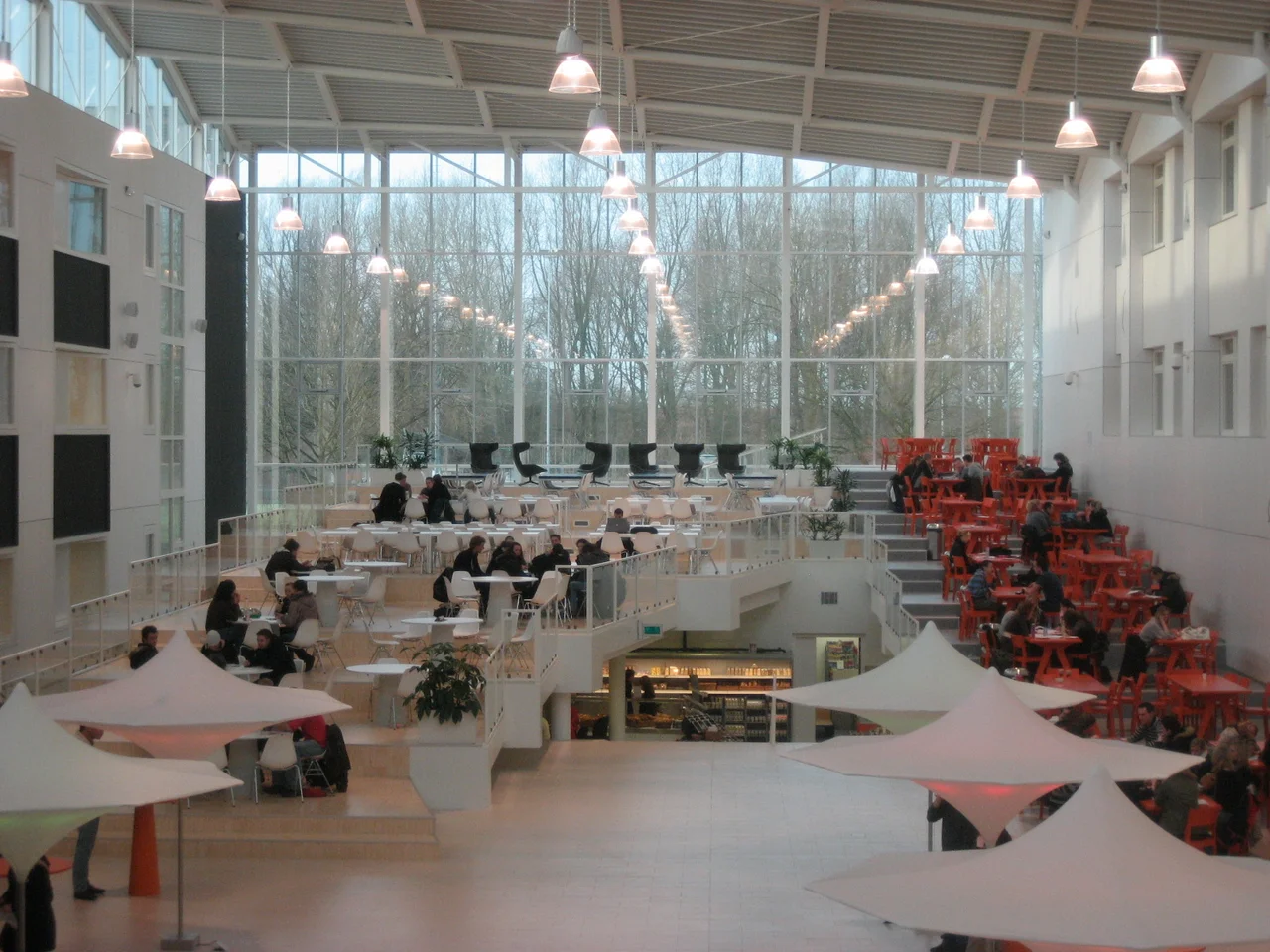
Hanze University of Applied Sciences is distributed across several campuses in Groningen, with its largest concentration at the Zernike campus in the north of the city. The geographic reference point for the institution sits at 53.241°N, 6.533°E - roughly 2 kilometres northwest of the diepenring canal ring that defines old Groningen. Nearest airport: Groningen Airport Eelde (EHGG), about 7 nautical miles to the south-southeast. Recommended viewing altitude 2,500-3,000 feet over the flat Groninger landscape; the Zernike campus is a distinctive cluster of modern academic buildings northwest of the Martinitoren, with its own bus interchange served by Q-Link line 15.
Nearby Stories
- Hooghalen train crash 2.6 km away
- Winschoten 2.7 km away
- Visquard 5.7 km away
- Ypey Mole, Ryptsjerk 7.4 km away
- Zuiderduintjes 11 km away
- Buren, Friesland 12 km away
- Weerribben-Wieden National Park 15 km away
- Bourtange moor 15 km away