
2006 European Blackout
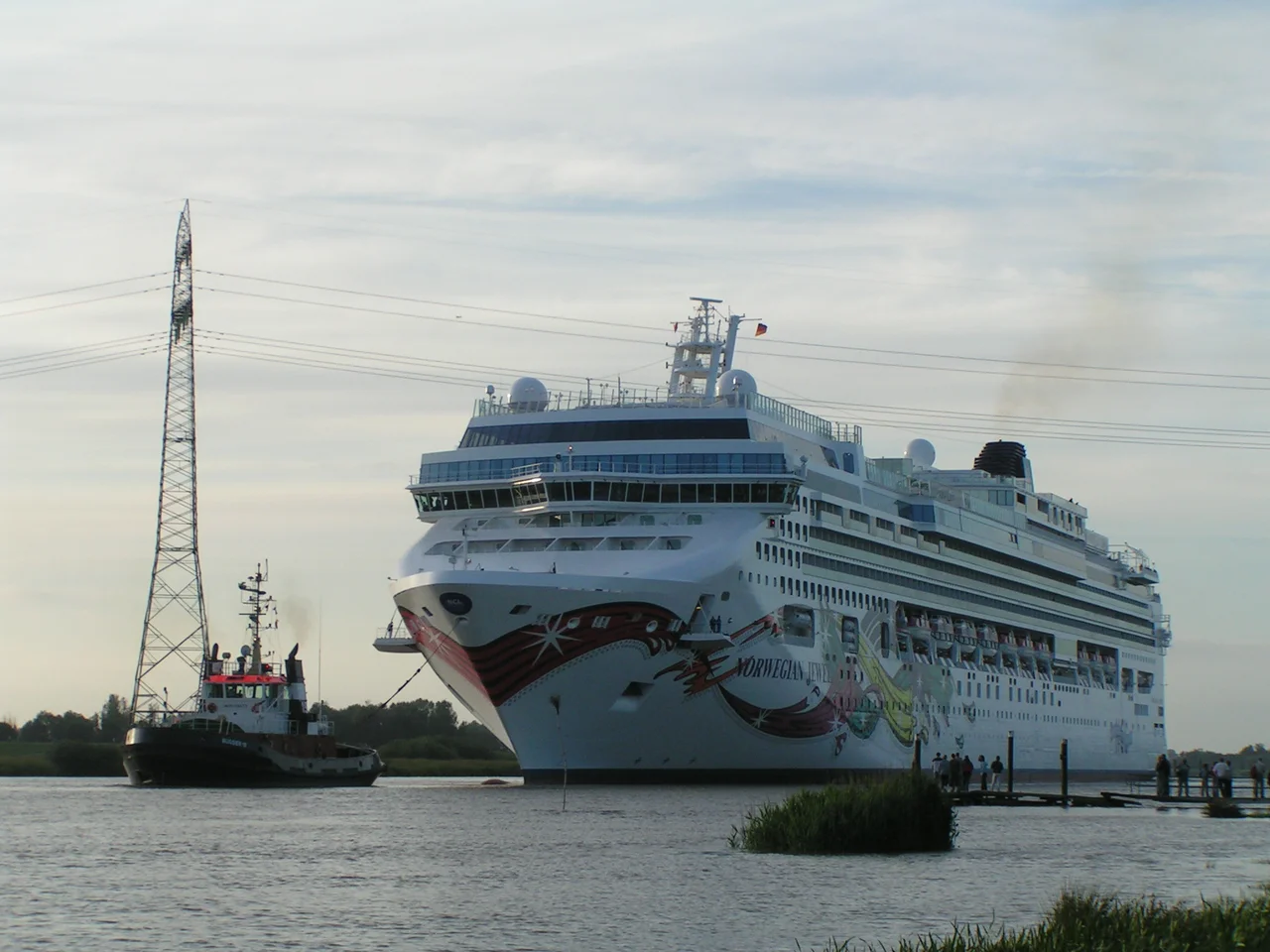
At 22:10 on Saturday, 4 November 2006, an engineer at E.ON Netz threw a switch in a control room in northwest Germany. The second circuit of a 380-kilovolt power line crossing the river Ems went dead. The line had to come down to let a cruise ship pass underneath - the Norwegian Pearl, a 294-meter hull just finished at the Meyer Werft shipyard in Papenburg, riding the river toward the North Sea with masts and funnels too tall to fit under live cables. Twenty-eight seconds later, lights began going out across half a continent. By the time the cascade stopped, more than 15 million households from Portugal to Poland had lost power. People were trapped in elevators in Paris. Trains halted in Madrid. The whole European grid had been brought to its knees by a maneuver done thousands of times before, by a switch nobody believed was dangerous.
Why a Power Line Came Down for a Ship
Meyer Werft, founded in 1795, builds some of the largest cruise ships in the world in covered halls in Papenburg. The yard sits roughly thirty-six kilometers upstream from the open sea. To get a finished ship to salt water, the hull has to be towed down the river Ems, stern-first, through a channel barely wider than the ship is long. The cruise liners are too tall to fit beneath the high-voltage Conneforde-Diele lines that span the river near Weener. So when a delivery is scheduled, the lines have to be shut off, the rest of the European grid has to be rebalanced to compensate, and the ship is eased underneath in a maneuver as familiar to local people as a parade. It was scheduled to happen at 01:00 on the fifth of November. On the third of November, Meyer Werft asked to move it earlier - to 22:00 on the fourth. E.ON Netz thought a Saturday evening would be even better than a small-hours Sunday morning. They approved the change.
The Twenty-Eight Seconds
The communication did not move as fast as the decision. By the time E.ON Netz finished its load-flow calculations at 21:29, the change had not been fully studied by the neighboring grid operators in the Netherlands, France, and beyond. A separate line, Landesbergen-Wehrendorf, was already running close to its thermal limit. When the second Conneforde-Diele circuit dropped out, power that had been flowing across it instantly looked for another path. Alarms lit up. The grid groaned but held. E.ON Netz engineers, trying to relieve the strain, closed a bus tie in a switching station - a routine move that, on this exact configuration that exact night, made things worse. At 22:10:28, the Landesbergen-Wehrendorf line tripped out under overload. The lights began going out from there.
How Far the Dark Went
What happened next was a cascading failure - the kind of event that engineers model and dread and rarely watch in real life. The European grid, then operated by the UCTE, instinctively split itself into three islands to keep from collapsing entirely. Western Europe found itself with more demand than supply and started shedding load. Most of France went dark. So did Belgium, the Netherlands, parts of Germany, Spain, Portugal, even Morocco at the southwestern tip, even Greece and parts of the Balkans on the southeastern flank. Trains stopped between stations. Hospitals went to generator power. Emergency services were buried in calls about people stuck in lifts and stalled on dark roads. The eastern island, including Poland, ran high on frequency and had to dump generation. The southeastern island took its own hit. For roughly two hours, large parts of Europe sat in the dark while operators raced to resynchronize the three pieces back into one grid.
The Lesson the Ship Carried
Nobody died from the 2006 blackout, which is in some ways more striking than if anyone had. Fifteen million European customers lost power on a cold autumn night, and the grid was reassembled in two hours by people who had never personally seen anything like it. The Norwegian Pearl, oblivious, continued downriver. She was delivered to her owners and entered service in the Caribbean a month later, carrying tourists who would never know that her trip down the Ems had switched off the lights of southern Spain. The post-mortem reports were blunt. The cross-border European grid had become tightly coupled by electricity trading liberalization, but its operating culture was still organized along old national lines. Each transmission operator watched its own backyard. Information moved slowly across borders. The N-1 criterion - the requirement that the grid survive the loss of any single component - had been assumed to be met, not actually checked, on the moment that mattered.
What the Grid Remembers
The 2006 blackout is the reason a body called ENTSO-E exists today, with binding rules for cross-border coordination and shared real-time security analysis. It is the reason European grid operators run joint training, share schedules, and treat every planned outage as a continental event rather than a local one. The Ems powerline crossing still comes down for Meyer Werft cruise ships, several times a year. The procedure is unrecognizable from the one used that night. Models are run, neighbors are notified, redundancy is checked, and only then does someone throw the switch. The river itself looks unchanged - flat brown water sliding past flat green polders, a few cyclists on the dike watching the next great white hull edge toward the sea. The line is back up. The lights stay on. And somewhere in a control room, a younger engineer than the one who flipped the switch in 2006 watches the grid hold, and exhales.
From the Air
The Ems powerline crossing sits near 53.15°N, 7.37°E, between Diele and Conneforde in northwest Germany, just east of the Dutch border. From altitude the twin pylons towering over the river Ems are visible as the tallest electricity structures in the area - the lines have to clear the masts of finished cruise ships transiting downriver. Recommended viewing altitude 3,000-5,000 feet. Nearest airports: Groningen Eelde (EHGG) about 50 km northwest, Bremen (EDDW) about 90 km east, Münster Osnabrück (EDDG) about 110 km south. Follow the river Ems north from the Meyer Werft shipyard at Papenburg to see the powerline crossing point.
Nearby Stories
- Bourtange moor 3.9 km away
- De Poll 6.7 km away
- Tjaskers in Germany 6.9 km away
- Westerbork 8.2 km away
- Zuiderduintjes 11 km away
- Jever Air Base 15 km away
- Bad Zwischenahn 18 km away
- Cloppenburg (district) 20 km away