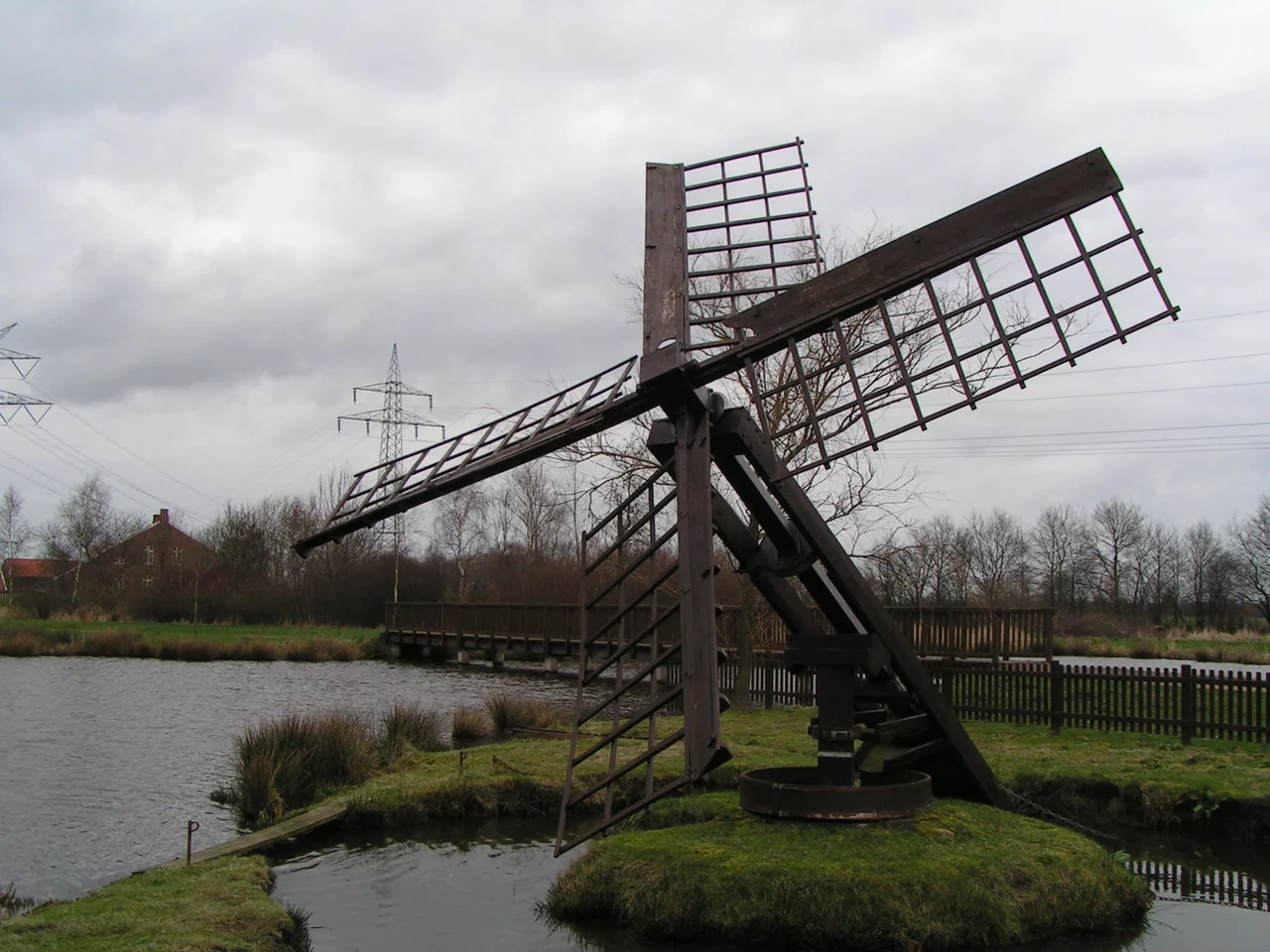

Tjaskers in Germany
A tjasker is not what most people picture when they hear the word windmill. There is no grand octagonal tower, no slow-turning grindstone, no living quarters for a miller and his family. A tjasker is essentially a tilted Archimedean screw with a windshaft and four sails bolted to one end, the whole thing mounted on a single post planted in the dirt next to a drainage ditch. When the wind blows from the right direction, the screw lifts water from a low ditch to a higher one. When the wind dies, the mill stops. There is nothing else to it. Six of these miniature machines still stand in Germany, all in Lower Saxony, and a handful continue to do real work raising the water table in protected wetlands.
Frisian Invention, Frisian Landscape
The tjasker originated in the Frisian regions straddling the Dutch-German border, where the problem of draining low-lying polders was solved at every scale - from the great smock mills that crank away on the horizon to these single-post midgets squatting beside individual ditches. The word itself comes from a Frisian root meaning to skim or scoop. The German cognate is Fluttermühle, the fluttering mill, after the staccato sound the sails make in a stiff coastal breeze. Whatever the language, the design is older than industrial pumping and survives mainly because the polders they drain still need draining, and because a working tjasker is cheap to maintain and pleasant to watch.
Bedekaspel and the Quarter-Circle Problem
The boktjasker at Bedekaspel sits beside a larger drainage smock mill called Agnes, sharing the polder's hydrology if not the labour. There is one curious limitation: the ditches around it were never dug as a complete circle, so the mill can only be wound to face wind from the south through to the west. A north or east wind, no matter how strong, leaves it idle. By 2011 the structure had fallen into disrepair, and Bedekaspel's tjasker had become more landscape feature than machine - a reminder of how thin the line is between working monument and ruin.
Built New, Built Together
Two of the six German tjaskers are surprisingly recent. The paaltjasker near the hamlet of Grotegaste, west of Ihrhove, was built in 2000 by the millwright Richard Kluin, who also constructed a sister mill at Weenermoor the same year. The Weenermoor mill is unusual: it was commissioned as a nature compensation measure for the construction of the Weenermoor wind farm, an elegant trade in which old wind technology was added back to the landscape to balance the impact of new wind technology. Both mills have four common sails. The Weenermoor sails span seven point one metres, big enough to be unmistakable from a kilometre away. The frame had to be braced with steel cables to keep the post from sagging under that load.
Münkeboe's Display Specimen
Inside the village museum at Münkeboe stands a boktjasker that has stopped working. It is a non-functional replica or model of the type once common across the marshland, complete with four symmetrical common sails that can be covered with wooden slats - a feature that lets a miller reduce sail area in heavy weather. Photographs in the Deutsche Gesellschaft für Mühlenkunde database from years ago show it with a complete circular ditch system, the canonical configuration that allows winding to any compass direction. More recent images show the mill drawing water directly from a lake, the circular ditch abandoned. The mill has become an exhibit of itself, demonstrating an idea rather than executing one.
A Mechanism You Can Read From Outside
The pleasure of a tjasker is that everything is visible. The post anchors the assembly. The angled wooden tube houses the Archimedean screw. The sails attach to the upper end and turn the screw when wind catches them. Water rises along the helix and pours out into the upper ditch. No gearing, no housing, no mystery. A child can understand it in thirty seconds, which may explain why these mills survived the era of diesel pumps and electric submersibles. They cost nearly nothing to operate, never run dry, and break in ways that a skilled local can fix with hand tools. Six of them remain in Germany - small, stubborn, still flapping at the East Frisian wind.
From the Air
The six surviving tjaskers are scattered across the East Frisian and Oldenburg marshlands of Lower Saxony. The Grotegaste/Lütjegaste paaltjasker lies near 53.18°N, 7.42°E west of Ihrhove; Weenermoor's mill is just southwest of there. Münkeboe (53.42°N, 7.43°E) and Bedekaspel (53.45°N, 7.31°E) lie between Aurich and Emden. From low altitude (500-1,500 feet) the mills appear as tiny crosses beside drainage ditches; they are difficult to spot above 2,000 feet. Nearest airfields: Emden (EDWE) for the southwestern cluster; Norden-Norddeich (EDWS) for the northern ones.
Nearby Stories
- SM U-30 3 km away
- Lewenborg 4.4 km away
- Wittmund (district) 6.2 km away
- Rheiderland 6.9 km away
- Wangerooge Island Railway 9.3 km away
- Bad Zwischenahn 20 km away
- Alpha Ventus Offshore Wind Farm 25 km away
- HVDC DolWin2 28 km away