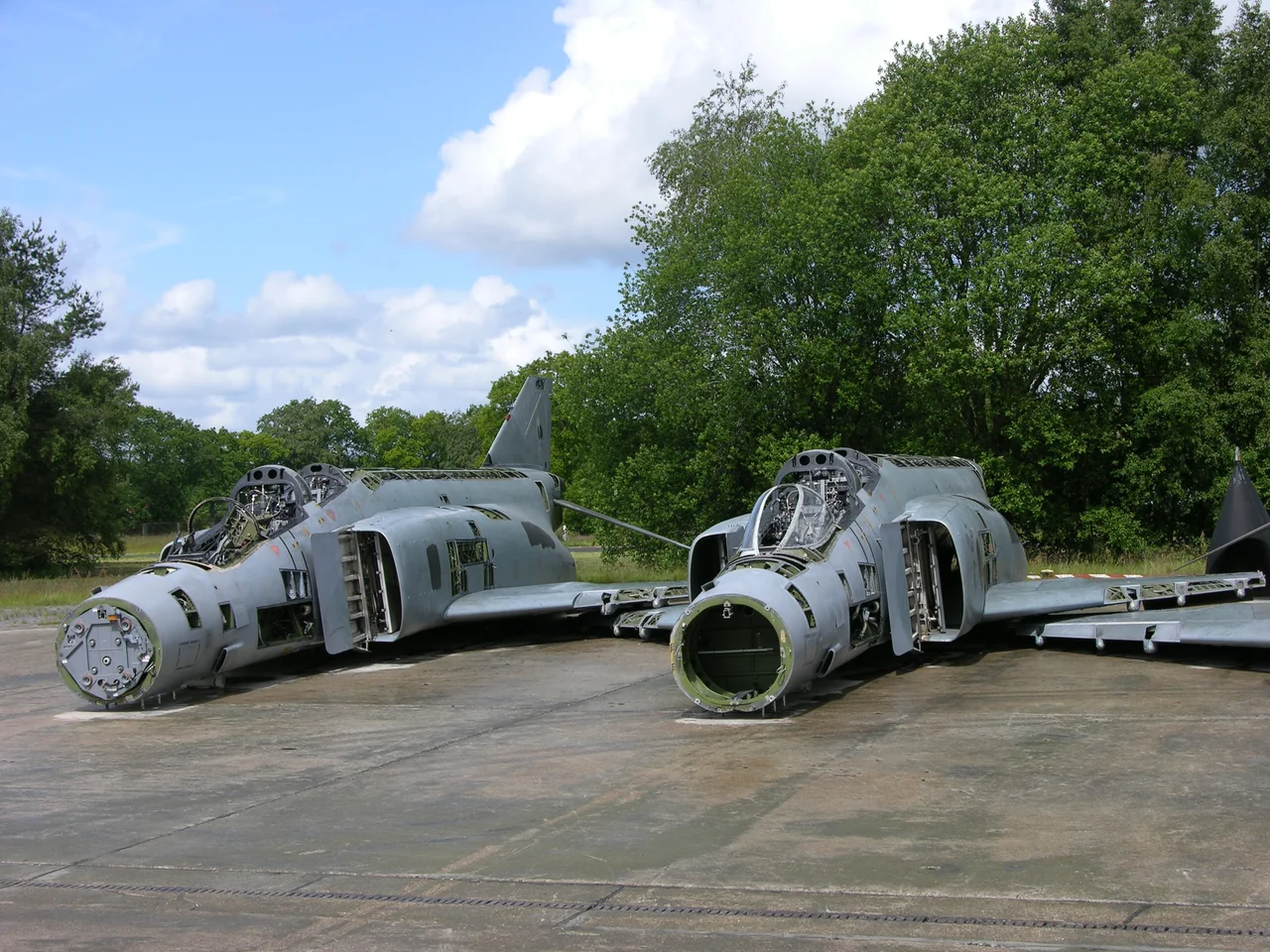

Jever Air Base
Out beyond the cabbage fields west of Schortens, the runway is still there - a long pale ribbon of concrete pointing into the prevailing North Sea wind. From cruising altitude it looks like any other decommissioned airfield, a geometry of taxiways and dispersal pans slowly being reclaimed by grass. But the silence is misleading. For seventy-seven years this strip of Lower Saxon farmland was one of the most consequential pieces of military real estate in northern Europe. The Luftwaffe trained here. The Royal Air Force fought a Cold War from here. And in a hangar at the eastern end of the field, NATO worked out how to fly into combat as a coalition rather than as a collection of national air forces.
Opened by the Luftwaffe, Lost to the British
Construction crews finished the airfield in 1936, three years after Hitler took power, as part of the secret rearmament programme that returned military aviation to Germany in defiance of the Treaty of Versailles. For nearly a decade Jever served the Luftwaffe as a fighter and training base, its proximity to the Wilhelmshaven naval anchorage making it strategically valuable for the air defence of the German Bight. The base survived the war intact. In April 1945, with the Reich collapsing, the British Army rolled in and seized the field without a fight. The RAF redesignated it Advanced Landing Ground B-117 Jever and began the slow process of converting a Luftwaffe airfield into a piece of NATO infrastructure.
Vampires, Sabres, and Hunters
From 1952 onward, RAF Jever became home to a rotating cast of fighter squadrons that read like a tour of post-war British jet design. Number 20 Squadron reformed here flying de Havilland Vampires - tubby twin-boomed jets that had been state of the art only a few years earlier. They were joined by 4 and 93 Squadrons, who progressed through the Vampire, the Canadair-built Sabre and the elegant Hawker Hunter. Number 98 and 118 Squadrons brought Hunter F.4s for two years in the mid-1950s. Number 2 Squadron showed up in 1957 with Supermarine Swift reconnaissance variants - a beautiful, troubled aircraft that never quite delivered on its promise. By 1961 the British had handed the keys back to a newly reconstituted German Air Force, and Jever became a NATO base flying the Iron Curtain's western fence.
Where Coalitions Learned to Fly
In September 1979, Jever inherited one of NATO's most important training programmes: the Tactical Leadership Programme, or TLP. Until that point, allied air forces trained largely within their own borders, with their own doctrines and call-signs. TLP brought senior pilots from across the alliance into the same airspace, gave them shared missions, and forced them to learn how to actually fight together. The course produced flight leads who could plan and execute multinational packages - a skill that proved its worth a decade later in the Gulf War. For ten years the programme ran out of Jever, sending out a steady stream of strike pilots fluent in coalition warfare. In March 1989 TLP packed up and moved to Florennes in Belgium, taking some of the base's reason for being with it.
Quiet Field, Long Echo
Military flying ended at Jever in September 2013. The German Air Force Regiment, which had been the base's primary tenant in its final decades, gradually drew down operations, and the runway fell silent. The land has not yet been fully repurposed - in the patient way of decommissioned military sites, parts are returning to agriculture while parts await some future use. But the geometry remains legible from the air, and so does the history. Three generations of fighter pilots trained here. Two German air forces and one British one called it home. And the methods that NATO refined inside its hangars now shape how coalition air power works on every continent. The runway is quiet. The echo is still travelling.
From the Air
Located at 53.53 north, 7.89 east, 4.3 km west-southwest of Schortens in Lower Saxony. The base lies about 18 km west of Wilhelmshaven and 6 km southeast of the town of Jever. From 2,500-5,000 ft on clear days the disused runway and dispersal pans are clearly visible as pale geometry against the surrounding farmland. Nearest active airports: Wilhelmshaven-Mariensiel (EDWI) about 15 km southeast, Wittmund (ETNT) Luftwaffe base about 15 km west - check NOTAMs as Wittmund still hosts active military traffic. Wind is reliably from the west across the flat coastal plain.
Nearby Stories
- Wangerooge 0.7 km away
- Aurich (district) 4.5 km away
- Rheiderland 6.4 km away
- Valentin submarine pens 6.8 km away
- Bad Zwischenahn 11 km away
- HVDC DolWin2 37 km away
- Teufelsmoor 41 km away
- Lilleø 233 km away