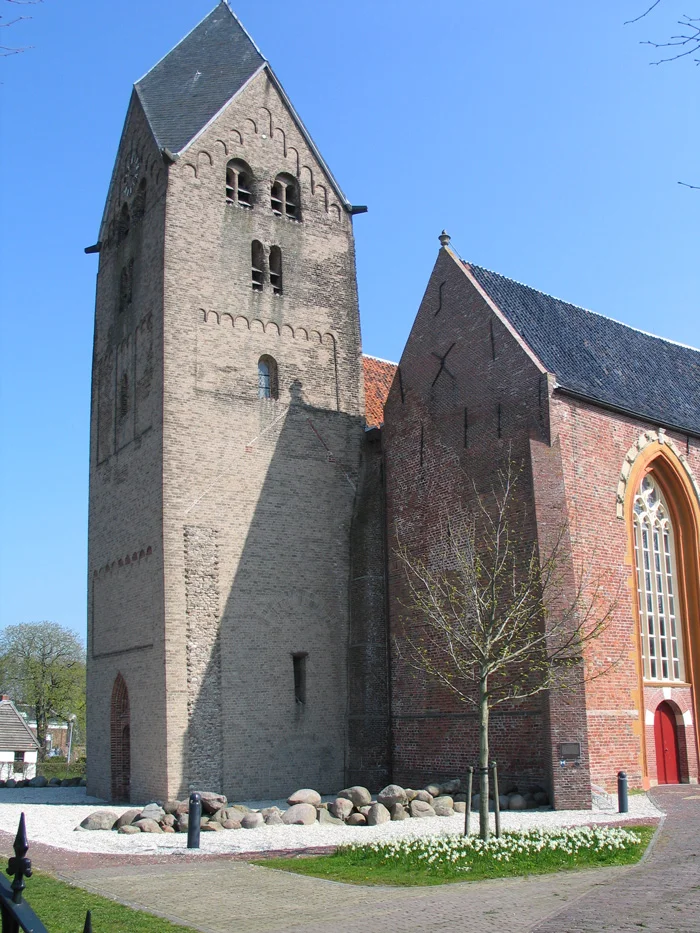

St. Walfriduskerk
Pisa gets the postcards. Bedum has the tilt. The tower of the St. Walfriduskerk - a Romanesque survivor in a quiet Groningen village - leans forward more than any other tower in the Netherlands, and since restoration straightened the famous Italian tower in the early 2000s, locals have argued that Bedum's lean exceeds Pisa's by the standard you actually care about: degrees off vertical. Reuters covered the claim in 2008. The Dutch tower has not budged. A thousand years of settling on soft soil, a long campaign of repairs, and one ingenious underground counter-weight have left Bedum with a quiet, unspectacular church and a startling tower that bends toward the road as if listening.
Two Martyrs and a Pilgrimage
Bedum became a pilgrimage site in the early Middle Ages because of the graves of two martyrs - Walfridus and his son Radfridus, killed by Norse raiders in the late tenth century. Two churches went up to honor them, first in wood and then in stone. Radfridus's chapel is gone now, nothing of it left above ground. The St. Walfriduskerk survived, though it was reduced by the slow drop in pilgrim traffic after the sixteenth century - a downturn that affected almost every regional shrine in the Protestant north. What remains is the tower, started around 1050, completed in the twelfth century, and once part of a westwork with flanking spaces that were demolished soon after they were finished. The pilgrims stopped coming. The tower kept standing, increasingly out of plumb.
Why It Leans
The ground under Bedum is soft Groningen clay - the same wet, settled, well-organized soil that grows excellent grass for excellent dairy cows but makes a punishing foundation for heavy masonry. The tower sank unevenly on the southern side and began tilting forward. By the seventeenth century the lean was alarming enough that builders propped the structure with external buttresses. Those buttresses were rebuilt around 1800, then taken down again in the 1850s, and the tower kept leaning. The lozenge-shaped pyramidal roof you see today was added during a restoration in 1953-1958, replacing a flat roof that had topped the tower ever since a 1911 fire destroyed the original spire. The same restoration finally addressed the underlying problem - not with buttresses, but with engineering.
The Counter-Weight Underground
Beneath the tower, hidden from anyone who walks past it, sits a counter-weight installed during the 1950s restoration. It was placed deliberately on the opposite side of the foundation to balance the long pull of the lean. The tower has not stopped tilting forward - it leans about 2.61 meters off vertical - but the rate of tilt has been halted and the structure stabilized. This is the moment to notice that the famous Italian tower was also stabilized, with cables and counter-weights and the removal of soil from the high side, between 1990 and 2001. Pisa's reduction of its lean is what allowed Bedum to claim a steeper angle. Whether the comparison is fair depends on what you measure - meters of offset versus degrees of tilt, height of the tower versus width of the base - and on whether you find the argument charming or pedantic. Bedum finds it charming.
The Church Around the Tower
Most visitors stop at the tower and forget that the church behind it is also worth a few minutes. The original Romanesque basilica was expanded around 1484 into a two-aisled hall church, with a new Gothic southern aisle the same height and width as the nave. A Gothic choir with an ambulatory was built in the early sixteenth century to accommodate the church's chapter - the body of clergy that ran the place - and was promptly demolished by the Protestants around 1600. Of the original twelfth-century nave, only a few pillars and a small piece of wall survive. The St. Walfriduskerk is a palimpsest of every architectural phase that crossed the Dutch north for nine hundred years. The tower steals the show. The walls hold the longer story.
From the Air
Bedum lies at 53.301°N, 6.603°E, about 10 km north of the city of Groningen on the flat agricultural land south of the Wadden Sea coast. The St. Walfriduskerk tower is the dominant feature of the village skyline - distinctly tilted forward when viewed from the south. The lean is visible to the naked eye on close approach and from the air at low altitude. Nearest airport is Groningen Airport Eelde (EHGG), about 20 km south. Best photographed in low-angle morning or late-afternoon light, which throws the tilt into stronger silhouette.
Nearby Stories
- Spinnenkop Wedderveer 2.5 km away
- Rysum Organ 3.3 km away
- Miedenmolen, Holwerd 3.9 km away
- Tynaarlo 6.4 km away
- Prinses Margriet Canal 10 km away
- Norderney 13 km away
- Schule am Meer 31 km away
- Gemini Wind Farm 47 km away