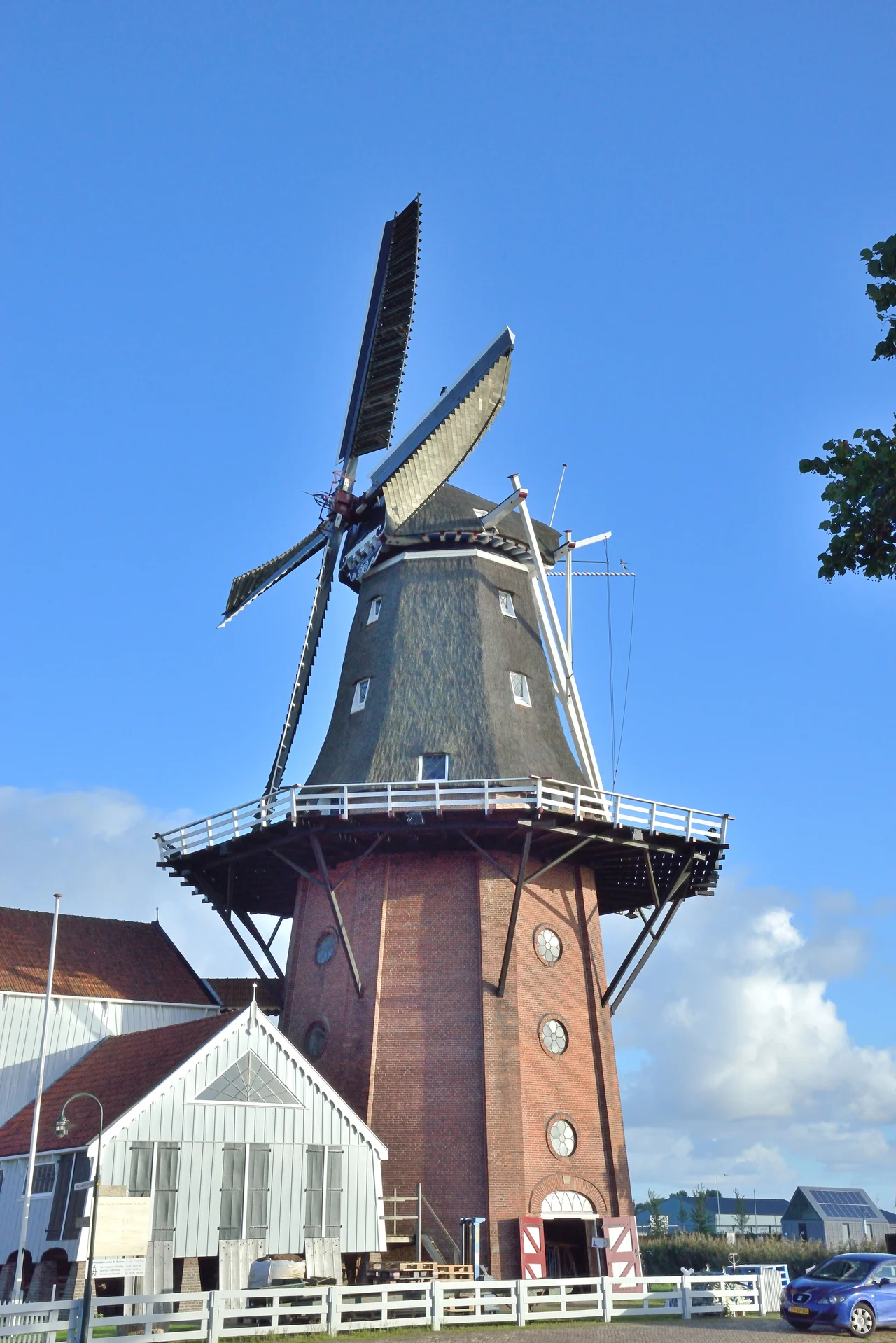

De Zwaluw, Burdaard
The flour leaving De Zwaluw is not for show. Six days a week the miller climbs the stage twelve and a half metres above the canal-side street in Burdaard, sets the four Patent sails to the wind, and grinds the grain that becomes bread in Frisian kitchens. On Saturdays the adjacent sawmill, driven by the same windshaft, joins in. The Swallow is a working business, not a museum exhibit - one of a vanishing handful of Dutch smock mills that still earns its keep at the trade it was built for in 1875.
Replacing the Desire for Wind
Before De Zwaluw there was De Windlust - The Desire for Wind - a smock mill built in 1841 for Douwe Dirks Drukker of Burum, standing twenty metres to the west of the current site. It ground corn for four decades and then was replaced. De Zwaluw rose nearby as a combined corn and pearl barley mill, commissioned by Klaas Steenhuizen and put up by the millwright G R van Wieren of Smitshuis. Steenhuizen had four sons, two of whom went to work in the mill their father had built: Paulus on the pearl barley stones, Jan running the sawmill that was eventually fitted alongside. Between 1875 and 1878 the base of a paltrok mill - a horizontal, rotating sawmill of distinctly Dutch design - was set up next to De Zwaluw and driven by it through a shared shaft. One mill, two trades.
Patent Sails, This Far North
What made De Zwaluw quietly significant in its day was the sail. Most Dutch mills of the 1880s still flew Common sails: cloth stretched by hand over wooden lattices, requiring the miller to climb out and reef them whenever the wind changed. Patent sails, invented by the Englishman William Cubitt in 1807, replaced cloth with hinged shutters that could be adjusted from inside the cap while the mill ran. De Zwaluw was among the first mills in the northern Netherlands fitted with them from new. After one of its later restorations the mill briefly carried a mismatched set - two Common, two Patent - before the Patent set was fully restored. Today all four sails span 23.60 metres, hinged shutters open and close, and the miller no longer has to climb out into the weather.
Anatomy of an Achtkante Stellingmolen
Mill people use specific words for specific things. De Zwaluw is an achtkante stellingmolen - an eight-sided smock mill with a stage. The base is brick, rising five storeys to the stage itself at fourth-floor level. Above that the smock is octagonal timber, thatched, capped with another thatched dome that the miller rotates by hand using a long tailpole and winch outside the cap. The current windshaft, the heavy iron axle that the sails turn, was cast in 1985 by the Ijzergieterij Versteeg-Ensink foundry in Hardinxveld-Giessendam. It was the first windshaft that foundry ever made. The geometry was being preserved, but the components themselves were being renewed - a typical pattern for a working monument, where everything that can wear out eventually does.
Why It Still Works
Most Dutch windmills surviving today survive because someone made the long decision to keep them running. De Zwaluw is owned by the former Gemeente Ferwerderadiel, now folded into Noardeast-Fryslân, but the daily life of the mill belongs to the miller. Through the open season, from 1 May to 1 October, visitors can climb up Tuesday to Saturday between 10:00 and 12:00 or 13:30 to 17:00, and watch the stones turn. The mill is Rijksmonument number 15585 - one of the long list of Dutch national monuments protected by law. The list is meaningful, but it is the daily grinding that keeps De Zwaluw from sliding into the silent category of beautiful objects.
The Swallow in the Skyline
From the Dokkumer Ee canal, where most of Burdaard's life still happens, the silhouette of De Zwaluw is the village's exclamation point. Together with the smaller De Olifant - the Elephant - on the other side, the two mills give the linear riverside village a sense of vertical scale that you do not find in many polder settlements. The Swallow is a name that rewards a moment of pause. Swallows are migratory birds that come back every year to the same eaves. They depend on continuity and the patience of others. The mill is a fair namesake.
From the Air
Located at 53.296°N, 5.881°E along the Dokkumer Ee canal in central Burdaard. From 1,500-2,500 ft AGL the mill reads as a tall thatched cylinder with a turning four-sail rotor on the canal's east bank. Best photographed in low side-light early morning or late afternoon when the white-painted brick base separates from the dark thatched smock. Nearest airports: Leeuwarden Air Base (EHLW) about 12 km southwest, Drachten Airfield (EHDR) about 25 km south. Mind the steady westerly winds rolling in off the Wadden Sea 10 km north - they keep the sails turning.
Nearby Stories
- Prinses Margriet Canal 1.7 km away
- De Marne 2.6 km away
- Maritime Institute Willem Barentsz 3.3 km away
- Northern Netherlands 5.1 km away
- Afsluitdijk 12 km away
- Schule am Meer 42 km away
- Gemini Wind Farm 48 km away
- West Sole Gas Field 272 km away