
Stalag VI-C
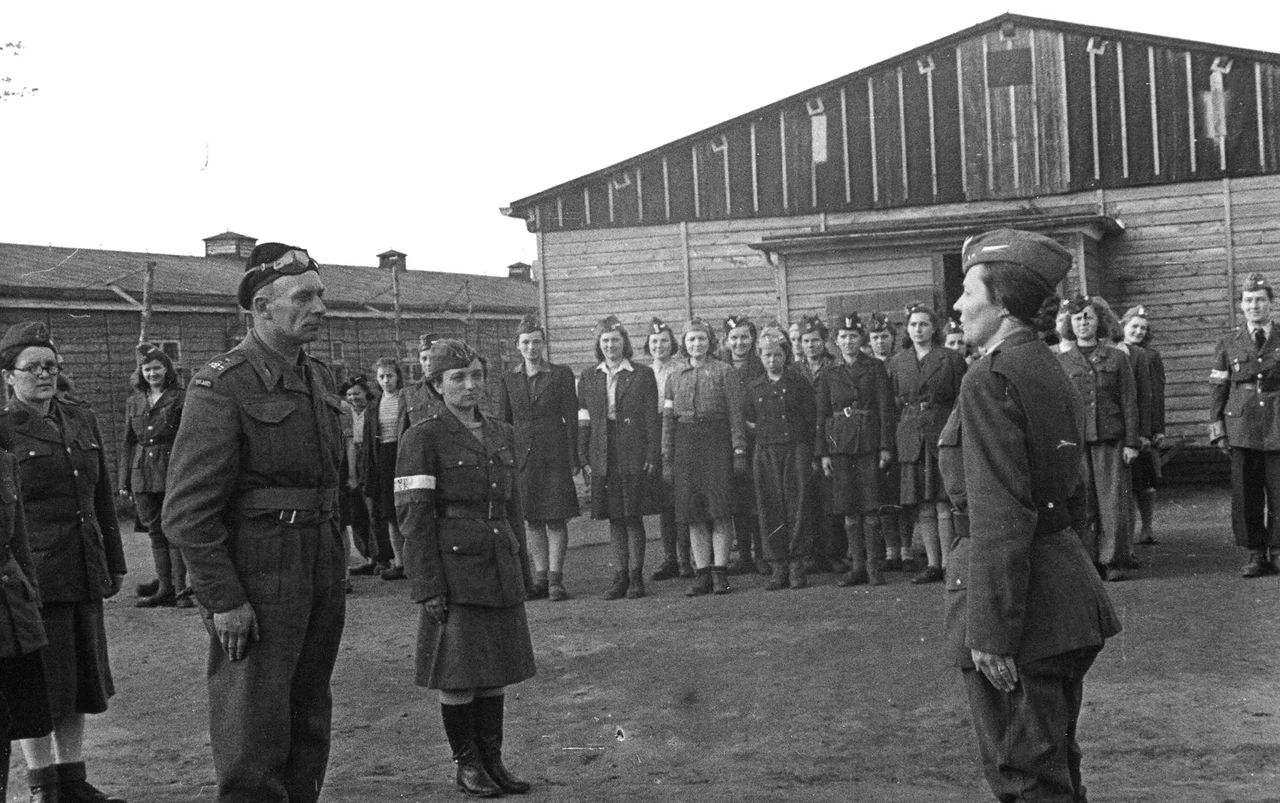
On 12 April 1945 the lead tanks of the Polish 1st Armoured Division rolled into a clearing in the Emsland bog and found 1,721 women in uniform waiting for them. The women had been told nothing. The International Red Cross had been informed the camp was closed and had no idea they were there. The tanks belonged to soldiers who had fought their way west from Falaise through Belgium and the Netherlands, and at Oberlangen they liberated their own sisters and wives and comrades - women of the Polish Home Army who had surrendered in Warsaw the previous October. The first words spoken when the tank hatches opened were in Polish. The witnesses afterwards called it the most unexpected liberation of the war.
Building the Bog Camps
Stalag VI-C was one of fifteen camps the Nazi regime built across the Emsland bogs between 1933 and 1939. The location was chosen because the wetlands were sparsely populated and easy to keep hidden. The first prisoners were Germans the regime considered politically dangerous: communists, social democrats, trade unionists, men whose names showed up on the lists drawn up after the Reichstag fire. They were put to work draining peat by hand, in conditions designed to break them. By May 1940 most of the surviving political prisoners had been transferred to the larger concentration camps elsewhere in Germany. The bog camps were then handed over to the military and turned into Stalags - prisoner-of-war camps for foreign soldiers.
The Soviet Dead
In the summer of 1941, after the German invasion of the Soviet Union, roughly 2,000 Soviet prisoners of war arrived at Stalag VI-C. They were not protected by the Third Geneva Convention - the Soviet Union had not signed it, and the Nazi leadership used this as justification to treat Soviet POWs with deliberate brutality. Conditions in the camp were appalling. Starvation rations, exposure to the wet cold of the Emsland winter, untreated epidemic disease, beatings, and the heavy forced labor of cutting peat killed prisoners in numbers the camp authorities did not bother to record carefully. The dead were buried in mass graves about a kilometer north of the camp. Across the Emslandlager system as a whole, an estimated 14,000 prisoners died, the vast majority Soviet citizens whose names were never written down. The mass graves remain. The names, in most cases, do not.
Italian Officers, Then None
In September 1943, after Italy signed an armistice with the Allies, the German military designated the combined Oberlangen-Wesuwe complex as Oflag VI-G and shipped in nearly 5,000 Italian officers. These were men who, a few weeks earlier, had been allies of Germany. Now they were prisoners. A year later, in September 1944, the German government stripped the Italian officers of their protected status under the Geneva Convention, redesignated them as internees, and shipped them out to forced-labor camps across the Reich. Some did not survive the journey. Many did not survive the labor that followed. The camp at Oberlangen was emptied to make room for what came next.
The Women of Warsaw
The Warsaw Uprising began on 1 August 1944 and was crushed by 2 October. Among those who surrendered to the Wehrmacht in Warsaw were thousands of women: nurses, couriers, signal operators, soldiers of the Polish Home Army who had fought house to house for two months. The German military, in a rare gesture, recognized them as combatants entitled to prisoner-of-war status. Most were sent to Stalag XI-B at Fallingbostel and then, in November 1944, transferred onward to a fenced-off section of Stalag VI-C Oberlangen. The camp housed 1,721 women. It was the only POW camp in Nazi-occupied Europe holding female prisoners of war. The senior officer was Lieutenant Maria Irena Mileska, codenamed Jaga, who organized lectures, secret newspapers, and the day-to-day discipline that kept the prisoners alive through the winter.
What the Liberation Meant
The Polish 1st Armoured Division had landed in Normandy in August 1944 and fought through the closing of the Falaise pocket, the liberation of Belgian cities, and the crossings into the Netherlands and Germany. When they reached Oberlangen on 12 April 1945 they were exhausted, far from home, and uncertain what their war would mean once the shooting stopped. They were also, by chance, the only liberators in Europe in a position to free a camp of Polish women soldiers. The reunion was photographed. Some of the women had brothers in the division. Many would never see Poland again - the Soviet occupation made return impossible for anyone associated with the Home Army - and the postwar diaspora that followed scattered them to Britain, Canada, the United States. The site of Stalag VI-C is now agricultural land. A small memorial marks the location. The Documentation and Information Center Emslandlager in Papenburg keeps the records.
From the Air
The camp site lies at 52.59 N, 7.04 E, approximately 6 km west of the village of Oberlangen in the Emsland bog country of Lower Saxony. From altitude the area is uniformly flat farmland and drained peat bog, with the Dutch border 8 km to the west. The site itself is unmarked from the air. Nearest airport is Münster Osnabrück (EDDG) about 100 km south, with smaller fields at Klausheide (EDWN) nearer. The memorial at Esterwegen, 15 km southwest, is the closest visitor center associated with the Emsland camps system.
Nearby Stories
- COVID-19 protests in the Netherlands 3 km away
- Westerbork Transit Camp 4.9 km away
- Schüttorf 7.4 km away
- Sellingerbeetse 8.8 km away
- Hardenberg 8.8 km away
- British Occupation Zone in Germany 11 km away
- Friesoythe 15 km away
- Quakenbrück 15 km away