
Westerbork Transit Camp
On 3 September 1944, a fifteen-year-old girl named Anne Frank boarded a train at this place. She had been here just under a month, kept in a small hut at the eastern edge of the camp with her parents and her sister Margot. The train she boarded was the last transport ever sent from Westerbork to Auschwitz. Of the 1,019 people on it, most were dead within weeks. She and Margot reached Bergen-Belsen, where they died of typhus in early 1945, weeks before liberation. There is no monument here that singles her out, because to single her out would be to dishonor the more than 100,000 others who walked the same path. But she was here. They all were.
What This Place Was Built For
Westerbork was never an extermination camp. The Dutch government built it in 1939, before the war reached the Netherlands, to house Jewish refugees fleeing Germany. Fifty hectares of land. Wooden barracks. A clinic, a school, even a stage for cabaret performances. When the German army invaded in May 1940, the Nazis inherited an existing facility, and by 1942 they had repurposed it for a single function: holding Jews, Sinti and Roma until enough of them had been gathered to fill a train east. Compared to Auschwitz or Sobibor, Westerbork was not a place of mass killing. It was a waiting room - a deliberately quiet, sometimes almost bureaucratic place, designed to keep its prisoners calm enough not to resist what was coming.
The Voices We Have
Etty Hillesum was a 28-year-old Jewish writer from Amsterdam who arrived at Westerbork voluntarily. She had taken a job with the Judenrat - the Jewish Council the Germans forced their victims to organize - for two weeks, and when the first transports began, she chose to accompany them. Her letters from Westerbork, smuggled out and discovered after the war, document the camp with extraordinary clarity and tenderness: the music in the barracks, the dread on Tuesday nights before each Wednesday's departure, the children, the rabbis, the way ordinary kindness persisted in conditions designed to crush it. She was deported with her family on 7 September 1943 and killed at Auschwitz on 30 November. Her notebooks remain one of the great testaments of the twentieth century.
A Clarinet, a Family, a Film
Hans Mossel was a Jewish-Dutch clarinetist and saxophonist who arrived at Westerbork on 9 March 1944. He played in dance bands in Amsterdam before the war. He was held for exactly two weeks before being sent to the Monowitz section of Auschwitz, where he was murdered later that year. The Sinti musician families Weiss - known to audiences as Tata Mirando - and Meinhardt lost more than two hundred relatives between them, transported from Westerbork to Auschwitz-Birkenau and never seen again. A memorial to them was finally erected at the site in May 2024. The camp photographer Rudolf Breslauer was forced to film the transports themselves, producing footage that survives today - color-restored and devastating - of human beings being loaded into freight cars by other human beings who knew what they were doing.
The Numbers and the Names
Approximately 107,000 Jews and several thousand Sinti and Roma passed through Westerbork between 1942 and September 1944. Most went to Auschwitz, many to Sobibor, others to Bergen-Belsen and Theresienstadt. Fewer than 5,000 are believed to have survived the war. Anne Frank was one transport. Etty Hillesum was another. Hans Mossel was another. The Meinhardt and Weiss children were others. Every Tuesday night a list was posted of names to be deported the next morning, and the entire camp lived for weeks at a time inside the dread of seeing a loved one's name on that paper. The German commander Albert Konrad Gemmeker, who oversaw the deportations from late 1942, was tried after the war and sentenced to ten years. He died in 1982, free.
What Stands Now
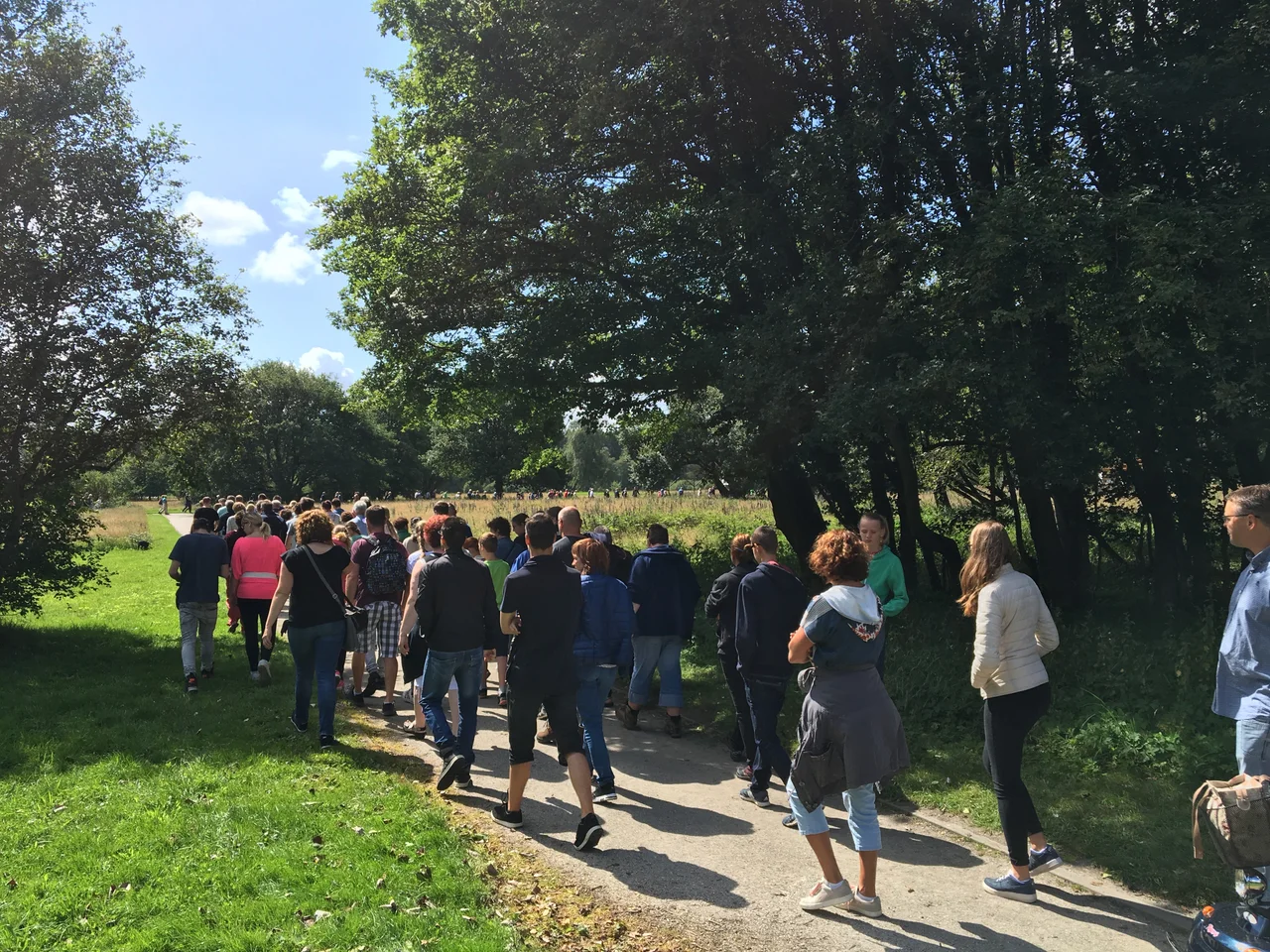
The camp was dismantled in the 1960s. Where the barracks stood, there is now grass. Where the deportation track once led east into the woods, there is a sculpture: a section of railroad torn from the ground, twisted upward, broken in the middle, set in place so the tracks can never carry anyone away again. On the Appellplatz where prisoners once stood for roll call, 102,000 small stones have been placed - one for each Jewish person deported from here who did not return. Smaller groupings mark the Sinti and Roma. The memorial center sits 2.7 kilometers from the camp itself, and visitors walk the distance on foot through a quiet wood, partly because of the radio telescope arrays nearby, partly because of what the walking does. There is no good way to come to a place like this. The path through the trees is the closest thing there is.
From the Air
The Westerbork transit camp memorial sits at 52.92 N, 6.61 E in the municipality of Midden-Drenthe, roughly 10 km north of Westerbork village and 2 km east of Hooghalen. Cruise at 1,500-2,500 feet for the clearest view; the site is unmistakable from the air thanks to the immediately adjacent Westerbork Synthesis Radio Telescope - fourteen 25-meter dish antennas standing in a long east-west row across grassland. The memorial center, the camp footprint with its grass markers, and the broken-rail sculpture all lie within a few hundred meters of the array. Nearest airport: Groningen Airport Eelde (EHGG) about 30 km north. The surrounding country is flat, agricultural, Class G airspace. Approach this place from the air, as from the ground, with the quiet it has earned.
Nearby Stories
- Hoogeveen 3.2 km away
- Onstwedde 4.2 km away
- Wetsinge 4.7 km away
- Abe Lenstra Stadion 5.2 km away
- De Zwaluw, Burdaard 7.4 km away
- Dollart 8.7 km away
- Twist, Germany 11 km away
- IJssel 19 km away