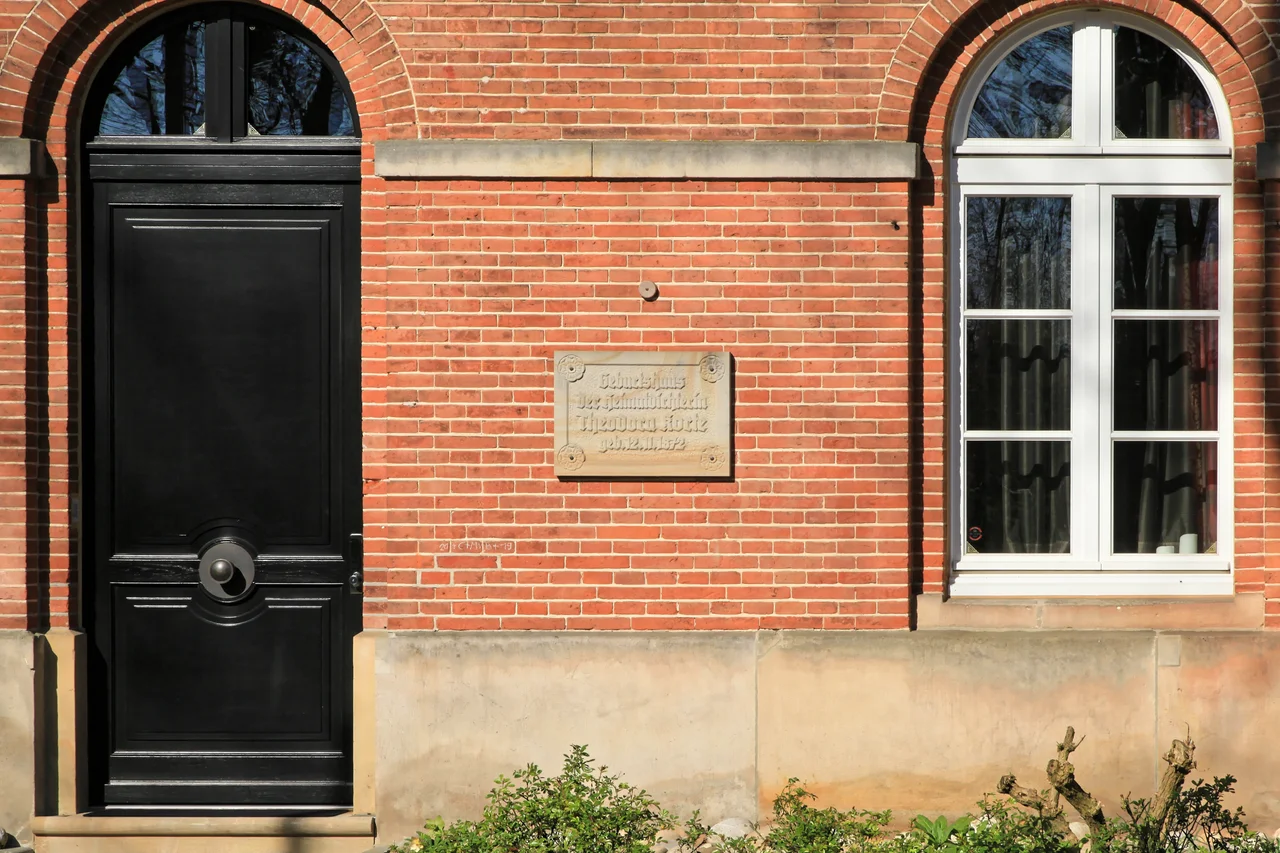

Nienhaus
Even the corners of the building are a lie. They look like sandstone but they are painted brick. The architect Josef Niehaus saved real sandstone for the parts you might touch - the windowsills, the columns, the foundation - and used a careful coat of paint on the rest. Between 1832 and 1836 he built the Amtshaus Nienhaus on the foundations of a vanished castle outside Aschendorf, a working office for the governor of a small Hanoverian district that within forty years would no longer exist as a country.
Five Governors and a Vanishing Country
Between 1828 and 1889, five men held the office of Amtmann in Aschendorf. Lambert Cordes occupied the post from 1828 to 1832, before the new house was even finished. Wilhelm Christian Carl von Dincklage took over in 1832 and was the first to move in. Claus Jurgen Melchior von Issendorf served from 1838 to 1848. Anton Niehaus - probably a relative of the architect - held the position from 1848 to 1860. The last, Johann-Heinrich Felix Korte, served the longest term: 1860 to 1889. The country they served when the work began was the Kingdom of Hanover. By 1866, Prussia had annexed Hanover and absorbed Aschendorf and its 20,000 inhabitants into a province. By 1871 there was no separate Prussia either, only a German Empire. The walls of the Nienhaus did not change. The flag above it changed twice.
The Architecture of Quiet Authority
Niehaus designed an austere late-neoclassical block with two floors, a grand exterior staircase, and a single ceremonial portal between Doric columns. Above the columns an architrave runs flat beneath a triangular fronton - the standard vocabulary of nineteenth-century government buildings across northern Europe, applied here at the scale of a small district. The arched ground-floor windows borrow a detail favored by Georg Ludwig Friedrich Laves, the Hanoverian court architect and Niehaus' professional contemporary. The vestibule behind the main entrance leads straight to the main office on the upper floor. Visitors arrived, climbed the staircase, passed between the columns, and stood before the governor. Every architectural decision pushed in the same direction: this is a place where decisions get made and recorded.
Born in the Governor's House
In 1872, during Johann-Heinrich Felix Korte's long tenure, a daughter was born in the upstairs rooms of the Nienhaus. She was named Theodora. Her father was the governor; the house was his official residence as well as his office. Theodora Korte would grow up to become an author, and a plaque outside the building now commemorates her birth there. She lived until 1926. The detail is small but worth lingering on: the building was designed as machinery for administering a district, but for one girl it was simply home. The same staircase that brought petitioners to her father's desk also brought a child running down to the garden. The rooms that drafted regulations were also the rooms where she learned to read.
The Office Moves On
In 1899, ten years after Korte's retirement, the governor's office for Aschendorf was relocated to a different building, the Haus Altenkamp. The Nienhaus stopped being a workplace and became simply a house, then a monument, then a historical curiosity. Its parade of governors had lasted seventy-one years. The institution they represented - first the Kingdom of Hanover, then the Province of Hanover, then the German Empire - had reorganized itself faster than the building could be repurposed. Today the Nienhaus survives as an example of provincial neoclassical architecture in the Emsland region near Papenburg, listed in Georg Dehio's standard handbook of German art monuments. The painted-brick corners are still doing their work, still convincing visitors at a distance that the building is solid stone.
From the Air
Located at 53.0367 N, 7.3244 E in Aschendorf, a district of Papenburg in the Emsland region of Lower Saxony, Germany. The Nienhaus sits in flat polder country near the Ems river estuary. Nearest commercial airport is Bremen Airport (EDDW), about 110 km east; Groningen Airport Eelde (EHGG) is about 70 km west across the Dutch border. The town of Papenburg is famous for the Meyer Werft shipyard, where cruise liners are built; large ship hulls floating down the Ems toward the sea are sometimes visible from altitude. Best viewed at low to medium altitudes in clear conditions.
Nearby Stories
- Dollart 4.3 km away
- St. Walfriduskerk 6.7 km away
- Meppen 7.5 km away
- 2011 CPISRA Football 7-a-side World Championships 7.6 km away
- Friesoythe 8.7 km away
- Hoogeveen 15 km away
- Quakenbrück 16 km away
- Lordship of Gödens 29 km away