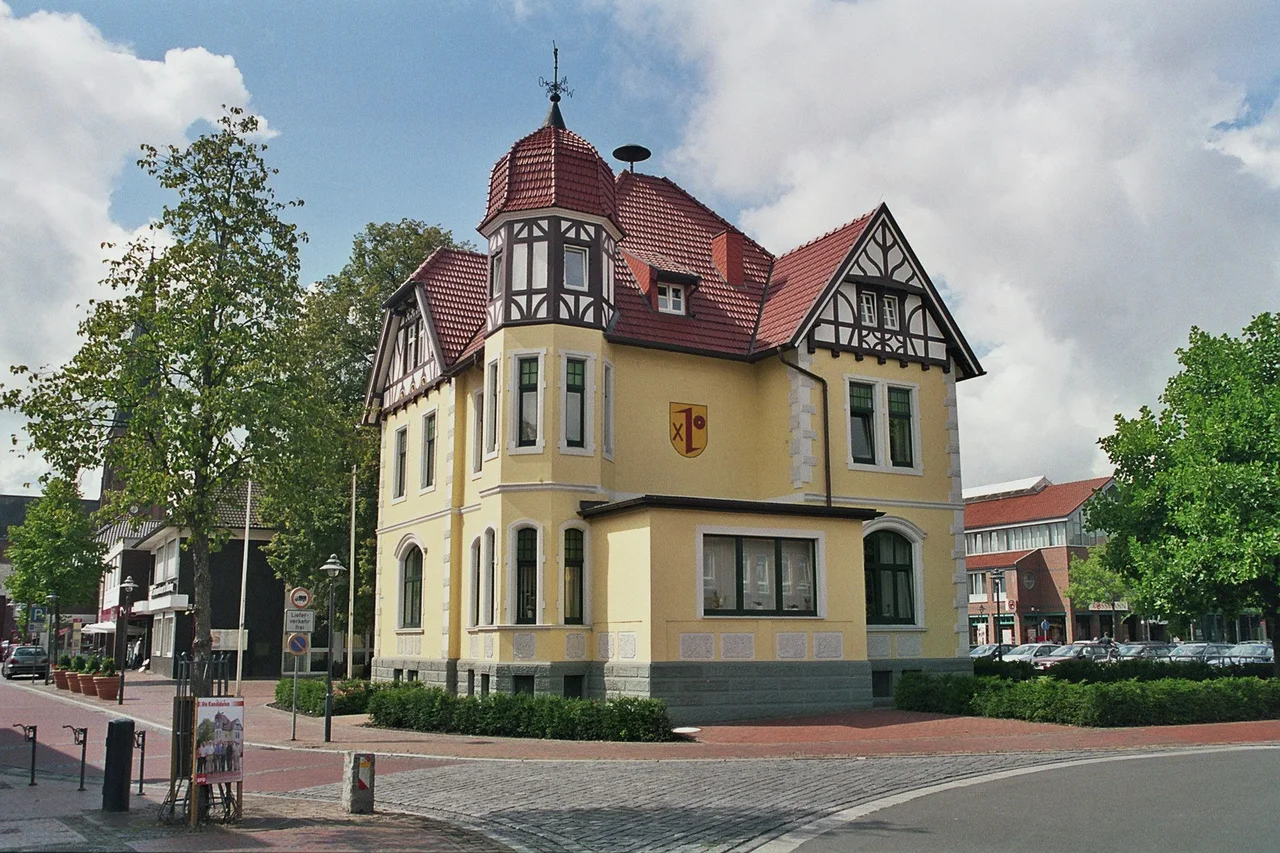

Dinklage
In 1949, a German count gave a castle to a community of nuns. It was not a romantic gesture. Burg Dinklage — the Dietrichsburg, a moated Renaissance fortress that had passed through the hands of the Lords of Dincklage, the Ledebur family, and finally the von Galens — was handed over by Christoph Bernhard Graf von Galen to the Benedictine order, and it has been a working abbey ever since. The chapel of that abbey was originally a barn, commissioned in 1614 by Magdalene von Dincklage-Ledebur, a widow consolidating her late husband's estate. Almost everything about Dinklage works like this: the layers are still visible, and the people who shaped them are still named.
Four Castles, One Survivor
Around 980, a count from a nearby village built a castle on the lowlands between Bremen and Osnabrück. By 1374, the bishop of Münster had it destroyed for getting too ambitious. The Lords of Dincklage rebuilt — not once, but four times — raising the Hugoburg, the Herbordsburg, the Dietrichsburg, and the Johannsburg in different corners of their inherited estates. Only the Dietrichsburg survives, and only because a thrifty noblewoman kept expanding it through the early 1600s while the others crumbled, burned, or were torn down for stone. The Hugoburg fell in 1840. The Herbordsburg came down in 1677. Where the Johannsburg once stood, no one any longer knows. The Dietrichsburg is now a Benedictine abbey, and the cycle of building, ruin, and reuse that defines Dinklage has paused for the moment in its favor.
The Cardinal Born in the Castle
In 1878, in a room of Burg Dinklage, Clemens August Graf von Galen was born. He grew up in the castle, joined the priesthood, and in 1933 became Bishop of Münster — the year Hitler took power. From the pulpit of Münster cathedral, von Galen would later denounce the Nazi euthanasia program in sermons so blunt that the regime considered hanging him and then decided the political cost was too high. He outlasted the Third Reich. Pius XII made him a cardinal in 1946, weeks before he died. Today the von Galen family no longer owns property in Dinklage — they lost their last holdings in the 1980s after the collapse of the SMH Bank — but their name is on the streets, the schools, and the parish history. The boy born in the castle became one of the few German bishops the Nazis genuinely feared.
A Catholic Town in a Mostly Protestant Region
Lower Saxony is overwhelmingly Protestant — except for a wedge of country called the Oldenburg Münsterland, where Catholicism has hung on since the seventeenth-century Counter-Reformation. Dinklage sits squarely inside that wedge. About 56 percent of its 13,600 residents are Roman Catholic; only 15 percent are Protestant. The numbers are dropping, as they are across Germany, but the Catholic infrastructure is everywhere: St. Catharina's parish church, built between 1875 and 1884 to replace older sanctuaries; the Benedictine abbey on the castle grounds; the elementary schools that the diocese helped establish in the late nineteenth century. The town's faith was forged by force — the bishop of Münster used soldiers and civil pressure to re-Catholicize the region after the Thirty Years' War — but it has long since become simply the local way of being German.
The Industrial Twist
Dinklage looks agricultural and largely is: pigs, cattle, broiler chickens, barley, sugar beets. But hidden among the farms is a cluster of surprisingly specialized industries. The Bröring Group is one of the largest animal feed companies in northern Germany. Oldenburger Interior outfits the cabins of yachts, ships, and aircraft from a small town an hour's drive from the coast. Hilgefort processes steel; Heller makes tools; Alwid builds the filling and sealing machines that other companies use to package food, chemicals, and pharmaceuticals. The pattern goes back to the 1830s, when Dutch brothers named van der Wal opened a mechanical weaving mill on the Mühlenbach stream and the miller Bernhard Holthaus started building farm machinery that sold across the German states. Small town, narrow specialty, national reach — the formula has not really changed.
The Bog Refuge
Northeast of town the land turns into peat: the Südlohner Moor, the Diepholzer Moor, the Goldenstedter Moor — three names for variations on the same wet, dark landscape that once covered far more of this region than it does today. Closer in, the Burgwald Dinklage protects 126 hectares of oak-beech forest, wet woodland, and small ponds, where great crested newts breed and kingfishers hunt. The reserve has been formally protected since 2017, but its water table is fragile — industrial parks press up against its edges, threatening the ecological connections that kept the place alive for centuries. It is the kind of small, half-saved wilderness that exists almost everywhere in this part of Germany, where the countryside is never very far from the next warehouse, and the next warehouse is never very far from a place worth protecting.
From the Air
Coordinates 52.66 N, 8.13 E, in the flat Oldenburg Münsterland of southwestern Lower Saxony. View from 3,000 to 5,000 feet — the town sits in the Dinklage Basin, an extensive lowland about 60 miles south of the North Sea coast. Burg Dinklage (the Benedictine abbey) is visible as a moated complex in the central town. Nearest interchange is exit 65 (Lohne/Dinklage) on the A1 Hansalinie. Nearest airports: Bremen (EDDW) about 70 km north, Münster/Osnabrück (EDDG) about 80 km south. Terrain is uniformly flat, under 35 meters elevation; visibility is normally excellent in the prevailing northwesterly maritime climate.
Nearby Stories
- Wildeshausen Geest 8.1 km away
- Osnabrück (district) 8.6 km away
- Ibbenbüren 12 km away
- Esterwegen concentration camp 13 km away
- Minden 13 km away
- Schnoor 18 km away
- Emsland Railway 29 km away
- Minden Aqueduct 39 km away