
1st Panzer Division (Bundeswehr)
On 1 July 1956, West Germany handed itself a new army, and the 1st Panzer Division was its very first operational unit, stood up on the same day the Bundeswehr officially came into being. Seven decades later the division still answers from Oldenburg, but its order of battle now reads like a small NATO directory. A Dutch mechanized brigade reports to its German commander. Polish, British and Lithuanian officers walk its corridors. The division born to stop Soviet armor in the Fulda Gap has spent the last generation reinventing what a national division even means.
First Off the Line
The Bundeswehr had a paper existence for months before it had soldiers, and the 1st Panzer Division was the unit that turned the paperwork into an army. Originally raised as the 1st Grenadier Division, it carried the German Army's first operational colors into the new NATO structure as part of I Corps, slotted under the Northern Army Group and Allied Forces Central Europe. In 1981 the division shed its grenadier identity and went fully armored, trading boots-on-the-ground emphasis for tanks at the tip of the spear. From its Oldenburg headquarters it became the formation NATO planners turned to when they imagined the worst case for the North German Plain.
The Dutch in the Den
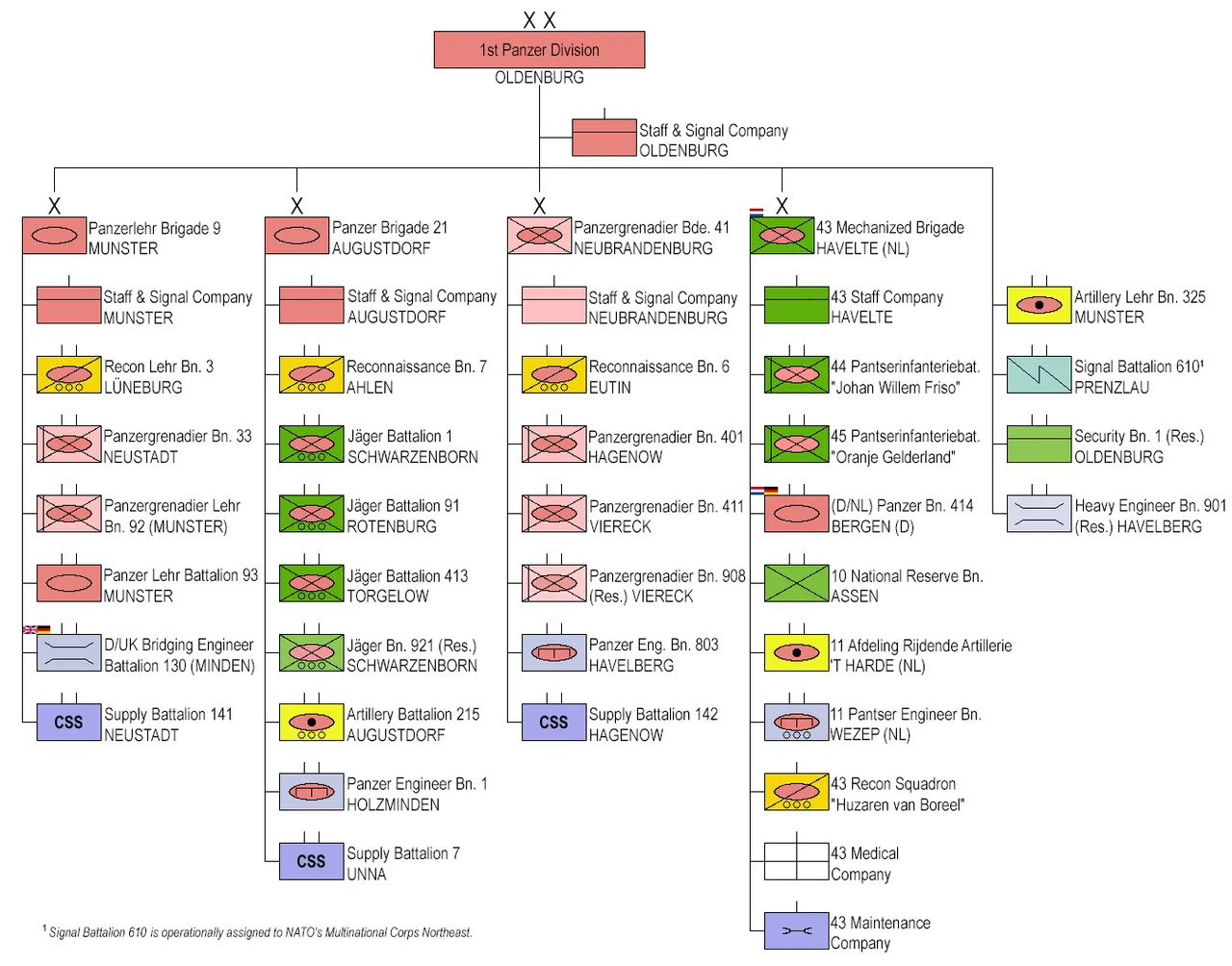
Modern armies talk about interoperability. The 1st Panzer Division does it for real. Since 2016 the Royal Netherlands Army's 43rd Mechanized Brigade, based in Havelte, has been integrated directly into the division's chain of command, a Dutch unit answering to German generals as a matter of routine. The brigade joins three German formations under Oldenburg's flag: the 9th Panzerlehr Brigade in Munster, the 21st Panzer Brigade in Augustdorf, and the 41st Panzergrenadier Brigade in Neubrandenburg. The arrangement is one of the deepest binational integrations in NATO and quietly answers a question Europeans have been chewing on for decades: what does post-national defense actually look like? Here, it looks like Dutch tank crews drilling under a German divisional staff.
From the Fulda Gap to the Hindu Kush
The division was conceived to stop Soviet armor, but its real deployments have tracked the strange shape of post-Cold-War security. Its troops served in the Balkans through the 1990s, then in Afghanistan, then across a string of peacekeeping rotations. Closer to home, the division has been the German government's heavy lift in civil emergencies. When the North Sea drowned Hamburg in 1962, its troops were there. When wildfires tore through Northern Germany in the 1970s, they came. When the Elbe broke its banks in the 2002 floods, the division turned out again. The 28th Infantry Division of the United States Army has been its formal partner across the Atlantic, and exercises like Allied Spirit X at Hohenfels in 2019 routinely place its headquarters in command of multinational forces; in that case, 5,630 soldiers from fifteen countries.
A Headquarters in Oldenburg
Most great armies hide their tank divisions in remote training estates. Germany puts one of hers in the middle of a quiet Lower Saxon city of 170,000 people. The Staff and Signal Company keeps the lights on at the Oldenburg headquarters, with Security Support Battalion 1 standing reserve nearby. Outlying units stretch from Prenzlau on the Polish border, where Signal Battalion 610 reports operationally to NATO's Multinational Corps Northeast, to Havelberg, where Heavy Engineer Battalion 901 holds in reserve. It is a thoroughly modern division, designed for the EU Battlegroups and the NATO Response Force, and most of the German troops earmarked for those rapid-reaction formations come from this unit.
The Flag Above the Plain
There is something quietly historical about an armored division headquartered in Oldenburg. The grand dukes who once ruled this town raised regiments here long before the Bundeswehr existed, and the soldiering tradition of this corner of Lower Saxony runs deeper than the new federal army sometimes likes to admit. The 1st Panzer Division wears its 1956 birthday proudly, but Oldenburg has been hosting soldiers for a great deal longer. From cruising altitude over the flat green fields between the Weser and the Hunte, the city looks like any other northern German town. The division's flag, planted there since the founding, is the part you can't see from the air.
From the Air
Headquartered in Oldenburg at 53.09 N, 8.22 E, on the flat North German Plain between the Weser and Ems rivers. Recommended viewing altitude 5,000-10,000 feet for the surrounding green countryside. Nearest airports include Bremen Airport (EDDW) about 25 nautical miles east-southeast, and the former Oldenburg Air Base (closed 1993) just north of the city. Visibility is usually excellent in summer, frequently hazy or low-overcast in winter coastal weather coming off the North Sea.
Nearby Stories
- Marcardsmoor 3.7 km away
- Jade Bight 6 km away
- Stickhausen Castle 7.8 km away
- Visbek 9.3 km away
- Worpswede 11 km away
- Hümmling 14 km away
- Ahlden House 54 km away
- Lilleø 240 km away