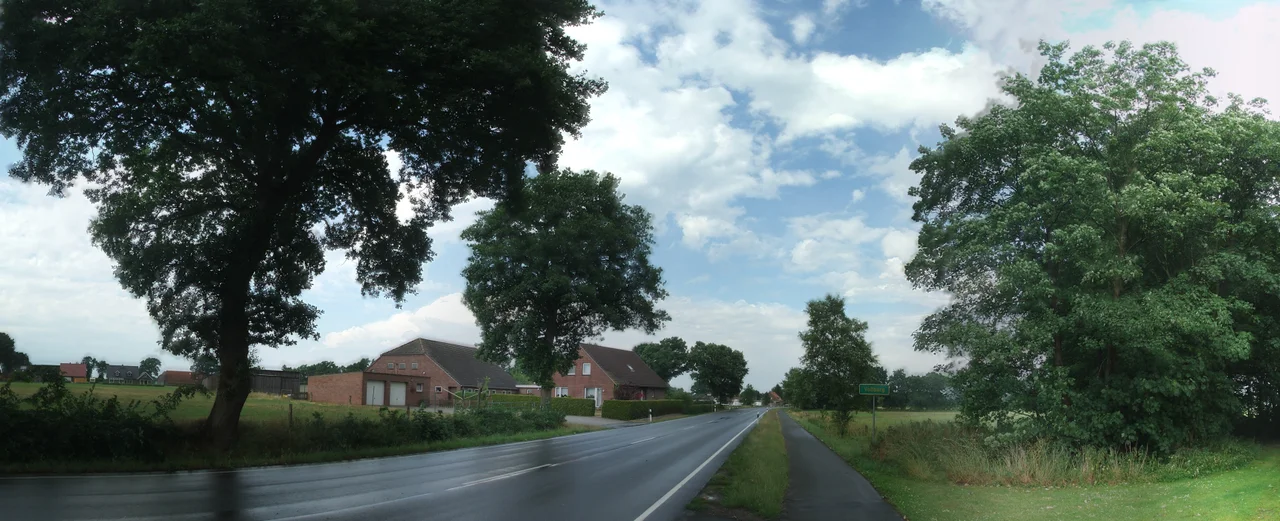

Vossbarg
Two years of legal argument bought Rencke Janssen about 1.5 hectares of moor. It was 1780, Prussia had just issued a reclamation edict inviting settlers into East Frisia's empty bogs, and Janssen wanted his share. He got it after a fight — three Diemat of raised peatland with no canal, no neighbors, and no obvious way to make a living. Other settlers followed: Claas Janssen, Otto Christoffers, January Focken, Harm Habben. Seven years later, in 1787, these scattered moor farms cohered into a place called Vossbarg, a row village strung along a single road in nothing but pasture and peat. Almost everything that has happened in Vossbarg since has been a continuation of that founding bargain: take the marginal land nobody else wanted, and try to make it pay.
The Settler's Bargain
Frederick the Great's reclamation edict was a piece of high-modernist eighteenth-century state policy: clear the wastes, plant the population, generate the taxes. East Frisia received its share of new colonists, and the moorlands south of Wiesmoor filled with row villages laid out in the strictest possible geometry — single street, narrow strips of land running perpendicular to it, the same width per family. Vossbarg began this way. The first settlers tried wheat. The peat soil tolerated it briefly. They dug peat for their own fuel, but with no canal to ship it out, the surplus could not become income. Around 1824 a handful of craftsmen drifted in — carpenters, bakers, shoemakers, a few barkeepers — and Vossbarg looked, for a moment, like a village that might thicken into a real economy.
The Long Slide
It did not. The moor soil, worked too hard, gave less and less each season. The village that had begun in 1780 with such administrative optimism began to experience real poverty by the middle of the nineteenth century. The heads of households hired themselves out as day laborers to the bigger peat operations in Spetzerfehn and Großefehn. Others went west to the Dutch marshes for harvest work, walking to the Netherlands and back for a season's wages. And eventually, between roughly 1850 and 1900, a great many Vossbargers simply left — for America, drawn by relatives who had already crossed and were writing home with reports of land and pay that the moor could not match. The 1780 land grants had created a village; the next century slowly emptied it.
A Power Station as Rescue
What pulled Vossbarg back from full collapse was, of all things, industrial peat. By the end of the nineteenth century artificial fertilizers had finally raised crop yields enough to keep farmers solvent, and then in 1909 Dr. Eberhard Ramm's plan with Siemens to build a peat-burning power station at neighboring Wiesmoor came online. Vossbarg suddenly had wage labor at its doorstep. Men and women from the village worked at the bog face cutting and drying peat, then loading it for the boilers. The Wiesmoor power plant employed roughly 1,200 people at its peak in the 1950s, and many of them came from villages like Vossbarg, which had finally found a way to convert its surrounding moor into cash without having to ship the peat anywhere. The peat went up the smokestack instead.
Two Hundred Years on a Single Road
In 1972 a Lower Saxony district reform absorbed Vossbarg into the jurisdiction of Wiesmoor, making it formally one of the satellite quarters of the larger town. The administrative change did not redraw the village; the row of houses along the original eighteenth-century road is still the village. In 1987 the residents celebrated Vossbarg's bicentennial. Heinz Saathoff, the village manager, published an anniversary booklet written by Richard Ahlrichs, a Vossbarg-born schoolteacher who had spent years collecting old photographs and documents from the families that had stayed. The whole village was spruced up festively for the occasion, the booklet records. Standing on that single road today, on what was once 3 Diemat of contested moor awarded to one Rencke Janssen, you can see in compressed form what most of East Frisia's small moor colonies are: a quiet, slightly humbled answer to an old Prussian question about what to do with the bog.
From the Air
Vossbarg lies at 53.386 N, 7.684 E, a small linear village within the town of Wiesmoor in the Aurich district. From altitude look for the characteristic moor-colony pattern: a single straight road with narrow rectangular fields running perpendicular, set in the broad flat former bog south of Aurich. The Nordgeorgsfehnkanal cuts east-west through Wiesmoor a few kilometers north. Nearest airports: Wilhelmshaven (EDWI) about 25 km north, Bremen (EDDW) about 70 km southeast, Emden (EDWE) about 40 km west. Light aircraft can use Leer-Papenburg (EDWF) about 30 km southwest. Spring and summer give the best contrast between the dark cultivated peat fields and the green pastures.
Nearby Stories
- Wilhelmshaven LNG Terminal 3.5 km away
- Veenkoloniën 6.1 km away
- Varel 6.2 km away
- Juist 7.6 km away
- Delfzijl 7.8 km away
- Dornumersiel 9 km away
- Esterwegen concentration camp 10 km away
- Hatten 19 km away