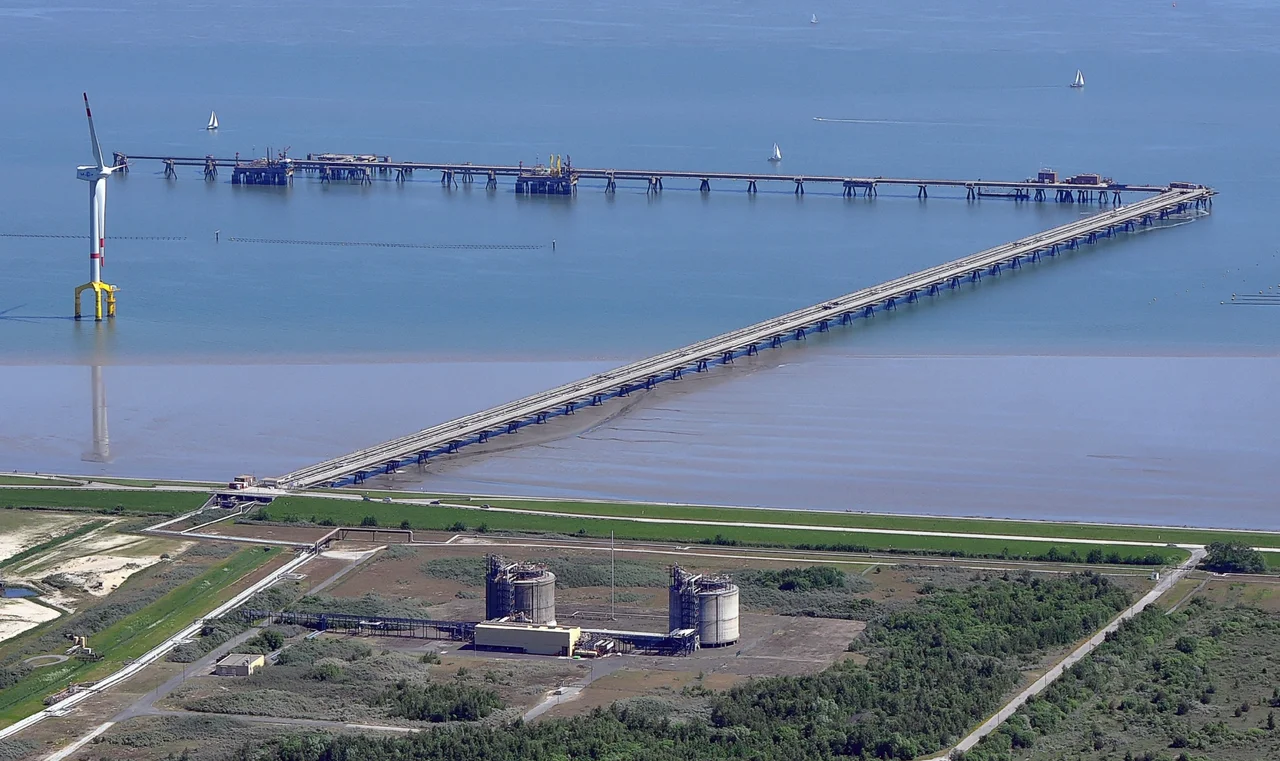

Wilhelmshaven LNG Terminal
The plan had been sitting on a shelf since the mid-2010s. There would be an LNG import terminal at Wilhelmshaven. There were studies, hearings, environmental reviews, opposition. Years passed. Russian natural gas flowed cheaply through the Nord Stream pipelines and the idea of paying more for tankered American gas felt like a luxury Germany did not need. Then on 24 February 2022, Russia invaded Ukraine. Three days later, Chancellor Olaf Scholz stood in the Bundestag and announced that Germany would build LNG terminals quickly, one of them here. Nine months later, on 17 December 2022, the first ship arrived. What had been impossible for years was suddenly built.
The Slow Decade
Talk of an LNG facility at Wilhelmshaven dated back to at least October 2015, when industry trade press reported that planning had restarted after earlier stalls. The economic case was thin. Pipeline gas from Russia, delivered via Nord Stream 1 from 2011 and contracted for further expansion via the controversial Nord Stream 2, was simply cheaper than gas frozen to minus 162 Celsius, hauled across an ocean in specialized ships, and warmed back into vapour at the destination. Environmental groups opposed locking in another fossil-fuel import chain. Regulatory processes stretched. By early 2022, Germany still had no operating LNG import capacity of its own, despite being one of the largest gas consumers in Europe. The country imported roughly half its natural gas from Russia.
Nine Months
Scholz's announcement on 27 February 2022 set off one of the fastest infrastructure projects in postwar German history. Robert Habeck, the Green Party economy minister responsible for energy and the environment, made an unusual public concession: environmental impact assessments would be explicitly skipped. Habeck argued the alternative was worse. Ensuring Germany was no longer blackmailable by Putin, he said, had to take priority. Construction at Wilhelmshaven began in May 2022. By November the work was done. The terminal is built around a floating storage and regasification unit, or FSRU - a 300-metre tanker leased to the German government and converted to receive, store, and regasify LNG aboard. The lease cost about €200,000 a day. The FSRU docked at a jetty that had been built back in 1982 for an earlier energy project that never quite happened.
First Cargo From Louisiana
On 17 December 2022, the terminal was inaugurated by Scholz and Habeck; the LNG carrier Maria Energy, loaded at Calcasieu Pass in Louisiana, arrived with the first full cargo on 3 January 2023 - roughly 170,000 cubic metres of liquefied natural gas. Olaf Scholz and Habeck were both present for the official opening that day. The terminal can process the equivalent of about 80 tanker shipments a year, replacing up to half of the gas Germany's largest gas trader Uniper had previously imported from Russia - roughly eight percent of Germany's total gas demand as of early 2023. Three weeks later, in mid-January 2023, a second of the rushed German LNG terminals opened at Lubmin on the Baltic, and on 20 January the regasification ship for a third facility, at Brunsbuettel on the Elbe estuary, arrived on station.
A Coastline Re-imagined
The terminal sits along the southwestern shore of the Jade Bight, the same deep-water inlet that justified building Wilhelmshaven in 1869 as a Prussian naval base. The Jade is what made everything here possible - the warships of two German navies, the failed grand-port ambitions of the JadeWeserPort container terminal, and now a re-orientation of European energy geography conducted in months instead of decades. From the air the FSRU looks more like a moored ship than a fixed industrial plant, which is its strength: floating terminals can be relocated, replaced, scaled. Whether Germany ultimately treats this as a bridge to renewables or a long-term anchor for natural gas remains the harder question. What is not in doubt is what was done here in 2022. A country that had spent years debating whether to build the thing turned around and built it before the next winter set in.
From the Air
Coordinates: 53.64 N, 8.11 E. The terminal sits on the western shore of the Jade Bight, north of central Wilhelmshaven and south of the JadeWeserPort container terminal. From altitude the FSRU appears as a long ship moored at a jetty extending east into the bight. Recommended viewing altitude 2,000 to 4,000 feet for the jetty and approach channel. Nearest airport: JadeWeserAirport Wilhelmshaven-Mariensiel (EDWI). Bremen (EDDW) about 100 km southeast. Shipping traffic in the channel is heavy; expect AIS-active LNG carriers approaching from the north.
Nearby Stories
- Wiesmoor 4.2 km away
- Battle of the Heligoland Bight (1939) 7.2 km away
- Stadland 7.6 km away
- Spiekeroog 8.2 km away
- Teufelsmoor 19 km away
- Tiefwasserreede 21 km away
- Stalag X-B 40 km away
- Lilleø 203 km away