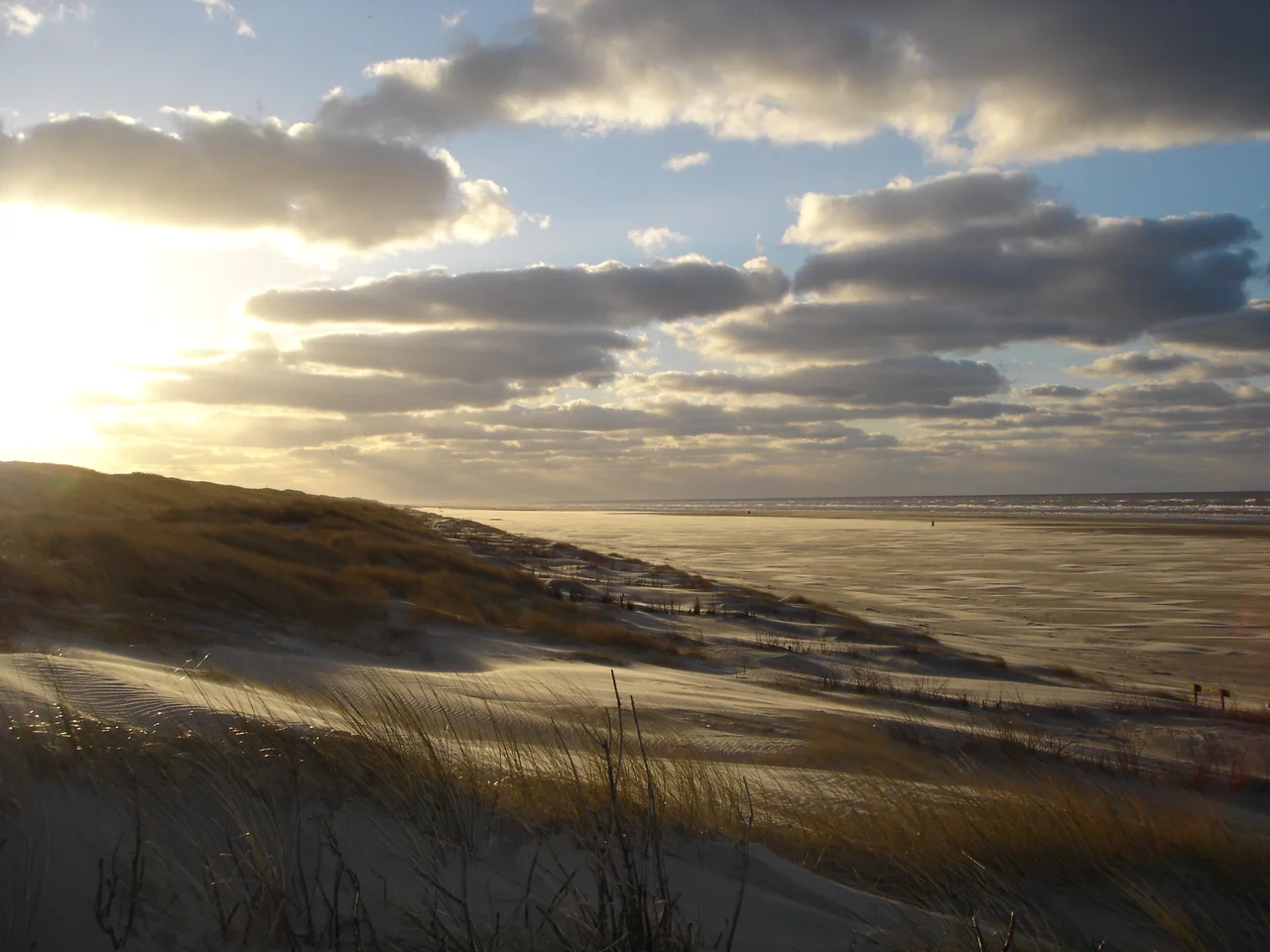

Juist
On Juist, the main road sound is hoofbeats. Horse-drawn carriages clop down the sand-dusted streets of the main village, ferrying luggage and tourists from the harbor to the hotels. A single fire truck and a few medical vehicles are permitted on the island. Everything else is bicycle or boot or wagon. The islanders refer to their home as Töwerland - Magic Land in the local Frisian dialect - and they mean it. This sliver of East Frisian dune and beach, seventeen kilometers long and at most one kilometer wide, has spent the last century deliberately holding the twentieth century at arm's length.
A Sandbar in Constant Motion
Juist is one of seven East Frisian Islands strung along the Lower Saxon Wadden Sea coast, sitting between Borkum to the west, Memmert to the southwest, and Norderney just east across the Norderneyer Seegatt channel. The island is so narrow that on foggy mornings you can sometimes hear surf on both sides at once. In the seventeenth and eighteenth centuries, storm tides repeatedly cut Juist in half, sluicing salt water through breaches up to two kilometers wide. Around 1770, the southern breach was finally closed with a built-up dune dike. The northern one was not properly sealed until 1928. By that time the seawater trapped in Lake Hammersee - the freshwater lake on the island's western third - had flushed itself fresh. The dunes are still moving. The edge of the dune front in the western section of Juist shifts about five meters south every winter, a slow retreat that no amount of human engineering has managed to stop.
The Rule Against Cars
Juist is famous in Germany for what it does not have. No private cars. No taxis. No delivery vans. The exceptions are tightly enumerated: the volunteer fire department, the German Red Cross ambulance, and a handful of doctors. Even tractors require a special island license. Luggage gets moved by horse-drawn cart, parcels by bicycle or by hand. Around a hundred working horses live on the island, woven into the rhythm of daily life in a way that is almost unimaginable on the German mainland. Most residents and most visitors get around on bikes. The peace this creates is striking. You hear bird calls. You hear the wind through marram grass. You hear children's voices carrying across a beach that runs the full length of the island. In 2014, DHL chose Juist as the test site for the first authorized drone delivery in Europe - a little parcelcopter humming across the Wadden Sea from the mainland at Norddeich, carrying urgent medications to the island pharmacy. The choice was no accident. Where there are no roads, drones suddenly make sense.
Tourism and the Old Tower
The two villages on Juist - the main settlement also called Juist, and the smaller Loog at the western end - run almost entirely on visitors. Almost every building rents rooms, and the island's hotels, pensions, and youth hostel together carry tens of thousands of summer guests every year. The skyline, such as it is, is dominated by two structures visible from the North Sea: the island water tower and an old hotel. There is a lighthouse on Juist as well, though it has been decommissioned and stands today as a landmark rather than a working aid to navigation. From 1990 to 2000, Juist maintained a sister-island relationship with Hiddensee in the Baltic Sea - two car-free German islands, one in each sea, comparing notes on how to keep modernity at bay. The arrangement quietly lapsed. The Billreef sandbank at the western tip of the island remains one of the great migratory stopovers for dunlins, grey plovers, and red knots, hundreds of thousands of them passing through each spring and autumn.
Three Lives From Juist
Magic Land has produced its share of unusual biographies. Martin Luserke, a progressive educator from Berlin, founded the Stiftung Schule am Meer foundation in 1924 and the Schule am Meer boarding school itself in 1925, opening a famously open-air, co-educational, democratic institution that lasted until the Nazis shut it down in 1934. Curt Bruns, born on Juist in 1915, took a darker path: a German officer in the Second World War, he ordered the execution of two American-Jewish prisoners of war and was himself executed by the Allies in 1945, one of the first Nazi war criminals put to death in occupied Germany. And in the 1980s, Ma Anand Sheela - the former personal secretary to the Indian guru Rajneesh and the central figure in the Oregon poisoning case at Rajneeshpuram - was deported to West Germany after her release from a U.S. federal prison in 1988, eventually settling in Switzerland near Basel, an unexpected coda for one of the strangest American legal sagas of the era. Three lives. One narrow island. The wind and the carriages keep going regardless.
From the Air
Coordinates 53.68°N, 7.00°E, second from the west in the East Frisian Island chain. Recommended viewing altitude 1,500-3,500 ft for the full 17 km length of the island and its relationship to neighboring Norderney and Memmert. The decommissioned lighthouse and water tower make easy visual landmarks. Juist has its own small airfield (EDWJ) served by FLN Frisia Luftverkehr from Norden-Norddeich (EDWY) on the mainland - the strip is grass and short, suitable mainly for light aircraft. Tides matter for the ferry service from Norddeich. Marine haze is common; cold winter days give the clearest views of the Wadden Sea to the south and the open North Sea to the north.
Nearby Stories
- East Frisian Islands 4.2 km away
- HVDC DolWin2 4.7 km away
- Sandwater 8 km away
- Zoutkamp 11 km away
- Delfzijl 12 km away
- Tiefwasserreede 13 km away
- Schiermonnikoog National Park 24 km away
- Gemini Wind Farm 25 km away