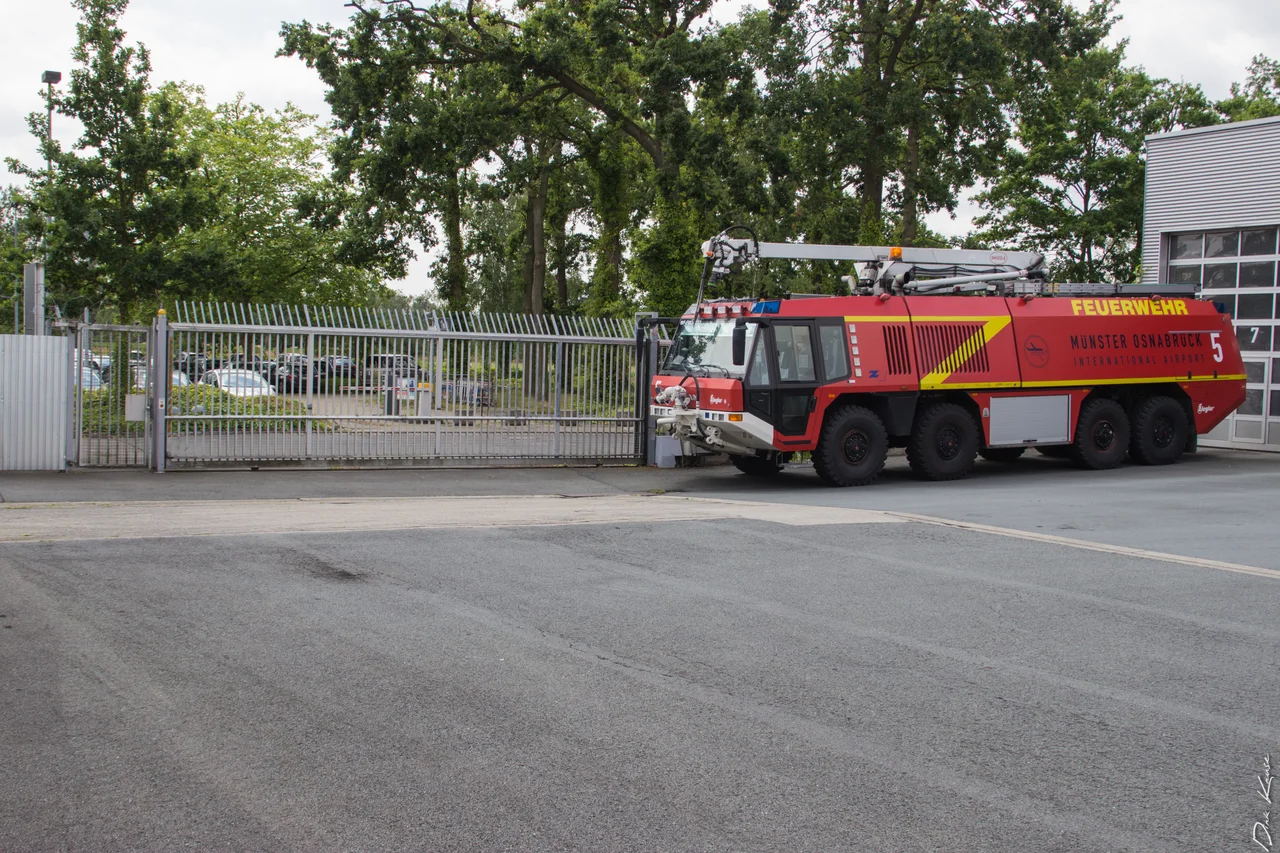

Münster Osnabrück Airport
In the spring of 1968, German engineers came to a swampy, wooded patch of land near Greven and concluded what locals had long suspected: the place might be full of unexploded bombs. The Dortmund-Ems Canal ran just a few hundred metres away, and Allied aircraft had hammered it relentlessly during the Second World War. So the German authorities did something quietly unusual for a country building its own airport. They asked the British Army to do the work.
An Airport Built by an Old Adversary
What followed was one of the stranger jobs the British Army of the Rhine ever took on. In April 1968, 16 Field Squadron of the Royal Engineers arrived at Greven, with reinforcements from 43 Field Support Squadron and other units pulled from across BAOR. Their task was almost geological in scale: clear and level a strip 2,120 metres long and up to 500 metres wide, then lay down a 1,520-metre base of clean sand for a runway capable of taking Tridents and BAC 1-11s. They finished the ground levelling and apron, the runway grew to 2,000 metres (later extended to 2,170 metres), and on 30 June 1969 the project came in within a few days of schedule. The Germans, for their part, gave the regiment a Schleicher Ka 7 glider and honorary membership in the Greven Gliding Club - a thank-you that was almost touchingly understated, given who had built what.
A Slow Climb to International
The official opening came on 27 March 1972, after five years of construction. The first charter flight took off the following year, bound for Palma de Mallorca - the timeless German pilgrimage to sunshine. Real maturity arrived on 29 October 1984, when British Airways began flying BAC One-Elevens between Berlin and Münster/Osnabrück: the airport's first scheduled jet service. International status followed in 1986, a new terminal in 1995, and Terminal 2 in 2002. Today the apron has five jet-bridge stands able to handle aircraft up to the Boeing 757. It is not a vast operation, but it threads neatly into a region that includes the northern Ruhr, parts of Lower Saxony, the Emsland, Westphalia and the bordering Netherlands.
The Runway That Never Grew
For years, FMO dreamed bigger. Plans approved in 2004 would have stretched the runway first to 3,000 metres, then eventually to 3,600, opening the door to intercontinental flights at a projected cost of around 60 million euros. But the proposed expansion ran straight through the Eltingmühlenbach, a protected natural area, and Naturschutzbund Deutschland sued. In May 2011, the Higher Administrative Court in Münster ruled against the project, citing procedural errors in the Planfeststellungsverfahren that defined the expansion. A separate plan to donate around 500 acres of nearby land for airport-related business ran into similar resistance, this time over the Hüttruper Heide heath. In 2023 the airport quietly rebranded, dropping the word International from its name. The runway is now 2,170 metres long - extended from the 2,000 metres the Royal Engineers originally laid out more than half a century ago, but never stretched further toward the intercontinental ambitions the expansion plans had promised.
Threads to the Wider World
The wider road network now does what the longer runway never did. The Bundesautobahn 1 connection opened in November 2010, joining FMO to the motorway grid via Exit 75; from the west the A 30 leads in via the Ibbenbüren exit. Around 7,500 parking spaces sprawl across the site, two of them stacked into multi-storey decks. Buses link the airport to Münster Hauptbahnhof and to Osnabrück, the latter via a coach shuttle that takes about forty minutes. It is, in the end, a regional airport for a regional purpose - shuttling Westphalians toward Mediterranean beaches and a small, evolving network of European cities, from a strip of cleared sand that began as a favour between former enemies.
From the Air
Münster Osnabrück Airport (ICAO: EDDG, IATA: FMO) sits at 52.13°N, 7.68°E, near Greven in North Rhine-Westphalia, 25 km north of Münster and 35 km south of Osnabrück. The single runway runs roughly NE-SW at 2,170 m and is suitable for aircraft up to Boeing 757 size. The Dortmund-Ems Canal is a useful visual reference just to the east. Typical pattern altitudes apply; check current AIP VFR online charts and DFS notices for traffic patterns, restricted heath areas, and noise abatement procedures.
Nearby Stories
- Battle of the Teutoburg Forest 3.9 km away
- Dissen, Lower Saxony 8 km away
- Epe, North Rhine-Westphalia 9 km away
- Lembeck Castle 13 km away
- Neuenhaus 14 km away
- Nordkirchen Castle 14 km away
- Liesborn Abbey 20 km away
- Siege of Lingen (1597) 23 km away