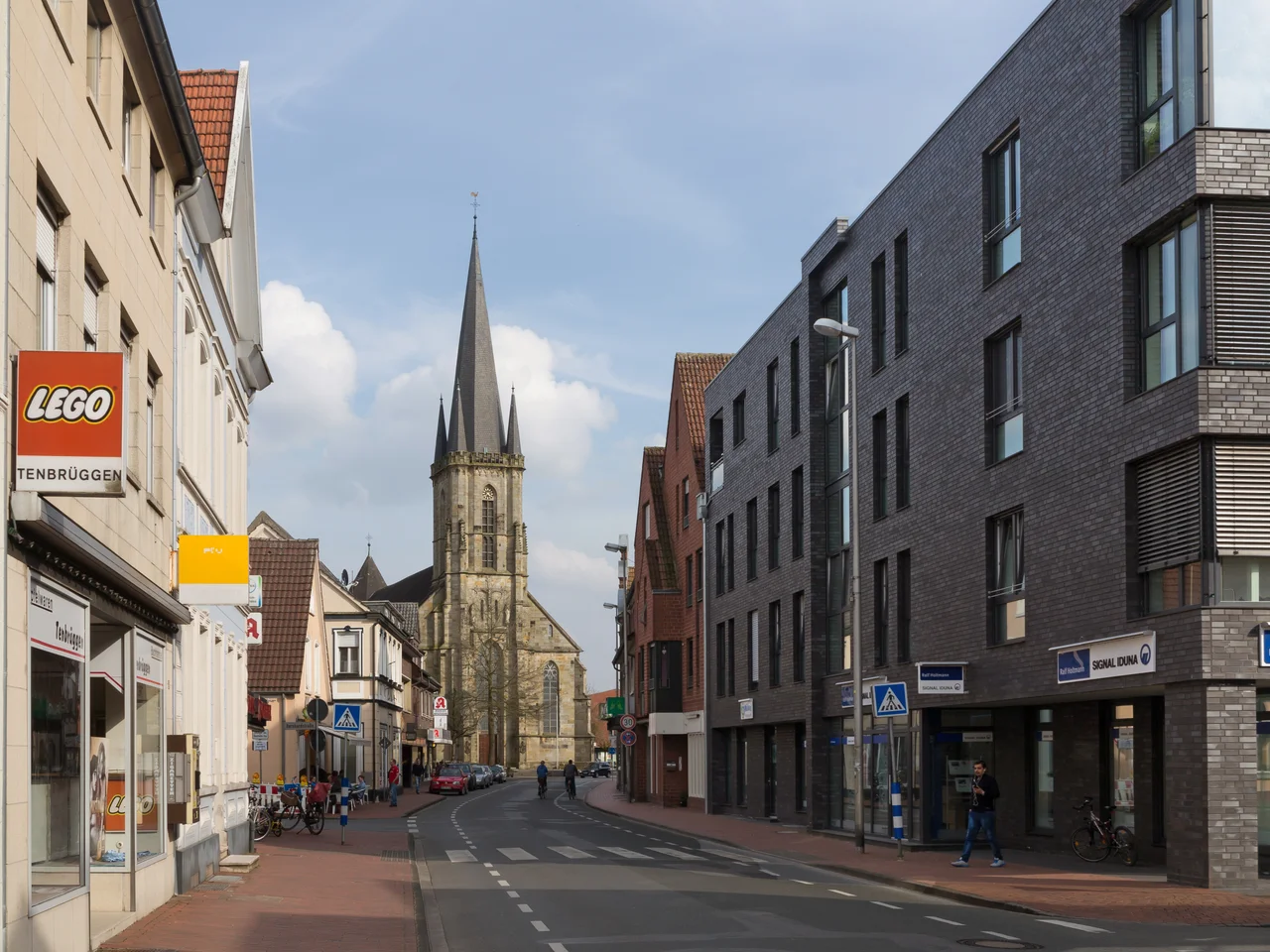

Epe, North Rhine-Westphalia
From the surface, Epe looks like exactly what it is: a village of around 16,000 people in the Borken district of North Rhine-Westphalia, ten kilometers east of the Dutch border city of Enschede, set on the gentle banks of the Dinkel. There is a park, a few churches, the brick remains of textile mills that closed decades ago, and a town twin across the border with an exact Dutch namesake. None of which prepares you for what is happening 900 to 1,500 meters beneath the surrounding farmland.
An Old Name for an Old Place
Settlement here goes back to the late Neolithic. Weapons, jewelry, and pottery dated between 2000 and 1700 BC have been found in the area, and now sit in a museum in Münster. The village itself first appears in the historical record in 1188, when Count Hendrik van Dale of Diepenheim listed property in the place among his goods, including a one-third share in the patronage of the local church. The name Epe comes from the Ur-Germanic Apa, meaning a place at the river - the river in question being the Dinkel, which still threads through the village today. A stone church stood here around 1175, and its baptismal font has somehow survived the eight and a half centuries since. The medieval manor house Droste Wüllen Epe enters the record in 1325. In 1380, Heinrich von Wüllen was enfeoffed with the court of Epe. The political owners changed - Salm-Horstmar in 1803, Napoleon's Grand Duchy of Berg in 1806, the French Empire itself by 1811, Prussian after the Congress of Vienna in 1815 - but the village kept its name.
The Looms and the Spinning Mill
In 1875 the railway arrived, connecting Epe via Gronau to Dortmund. Six years later, the Laurenz brothers from Ochtrup built the first textile factory in town - a weaving mill with 500 mechanical looms. In 1897, the Jannink family from Enschede founded the Germania Epe cotton spinning mill, drawing on the Dutch industrial network just across the border. A second Germania plant opened in 1910, employing up to 700 workers. The German textile boom carried Epe through the turn of the century. It also carried the village's population upward, and several Catholic schools, a Protestant school, and a Protestant church were built in the years that followed. The first textile factory closed in 1967. The Germania mill held on until 1992. In February 2009, a fire broke out at night in the empty Germania II building and burned the whole structure to the ground.
A Memory the Village Maintains
On the night of 9 to 10 November 1938 - the night the Nazi regime called Reichskristallnacht - the synagogue on Wilhelmstrasse was desecrated and set on fire. The Jewish families of Epe - the Pageners, the Eichenwalds, the Lebensteins, the de Wittes, the Rothschilds, the Andriesses - were eventually deported to the extermination camps and murdered. The Jewish cemetery in the Eilermark district, in use since 1828 for the communities of Gronau, Epe, and Nienborg, still holds 54 surviving grave monuments. The town municipality maintains it. In 2008 and 2009, small brass Stolpersteine - stumbling stones, each one inscribed with a name - were set into the pavement of Oststrasse and Merschstrasse in front of the houses where those families had lived. The synagogue building itself was protected as a historical monument in 2018. A volunteer society, the Foerderkreis Alte Synagoge Epe, is working to reopen it as a place of remembrance and learning.
The Caverns Below
Geology, as much as history, defines modern Epe. Beneath the village lies the Lower Rhine salt pan, and since the mid-twentieth century the Salzgewinnungsgesellschaft Westfalen - a joint venture of Solvay, Vestolit, and Bayer - has used a technique called solution mining to extract more than two million tons of salt every year. Water is pumped down, brine is pumped up, and the brine flows by pipeline to chemical plants in the Ruhr at Marl, to Solvay's site at Rheinberg on the Lower Rhine, and across the Belgian border to Jemeppe-sur-Sambre. What is left behind, after the salt is gone, is empty space: enormous cavities dissolved out of solid rock, each one shaped like a stretched balloon. There are roughly 75 of them now, southwest of the village in the Kottigerhook and the Amtsvenn area, at depths of 900 to 1,500 meters.
What Is Stored There
Those caverns have a second life. Together they hold over 2.5 billion cubic meters of working gas, making the Epe complex one of the largest underground natural gas storage facilities in Europe. Uniper, the former E.ON Ruhrgas, runs the largest share. Innogy, the former RWE, runs another. Trianel, the Dutch utility Nuon, KGE, and Eneco store gas here as well. The gas itself comes from the Netherlands, the North Sea, and Russia; the supply network that pulls from these caverns stretches from Hamburg to Frankfurt and west into the Netherlands. On a winter night when household heating demand spikes across northwest Europe, some of the methane warming kitchens in Cologne or Utrecht is rising out of the salt below Epe. The village above goes on as villages do. The Dinkel still runs through it. The town is twinned with Epe in the Netherlands - and there is, in fact, a different Dutch town called Epe, in Gelderland, which is not the same place.
From the Air
Epe sits at 52.20 N, 7.02 E, on the German side of the Dutch border about 10 km east of Enschede in the Borken district of North Rhine-Westphalia. Nearest airports: Twente Airport (EHTW) just across the border to the west, Münster-Osnabrück (EDDG) about 50 km south, Niederrhein/Weeze (EDLV) about 100 km southwest. The village itself is unremarkable from altitude; what is striking is the surrounding landscape of cleared fields with no visible industry, despite the salt caverns and gas storage infrastructure hidden 900 to 1,500 meters below. The Dinkel valley snakes northwest into the Netherlands.
Nearby Stories
- Vorden 2.3 km away
- Raalte 3.6 km away
- Raesfeld Castle 10 km away
- Emsdetten school shooting 11 km away
- Moyland Castle 13 km away
- Neuenhaus 15 km away
- Nordkirchen Castle 17 km away
- Osnabrück Canal 39 km away