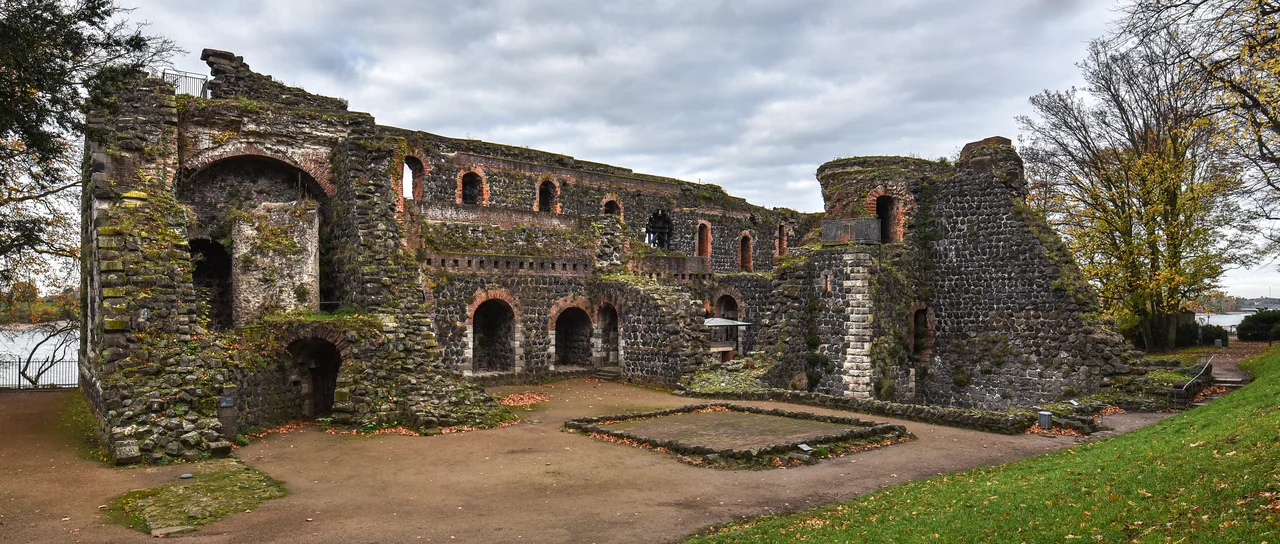

Kaiserpfalz Kaiserswerth
Twelve thousand cannon shots — that is the count that came out of the siege of Kaiserswerth in the spring of 1702. Troops from Brandenburg, the Netherlands and England had laid the imperial palace under fire, and on June 15 they took it. Almost every house in the town was destroyed; the great Bergfried, the central keep, had walls four and a half meters thick and still came down. On August 9, by order of the Duke of Jülich-Berg, what was left of Frederick Barbarossa's fortress was deliberately razed and blown up. The ruin on the Rhine north of Düsseldorf is what remains. At low tide, large chunks of masonry are still visible in the gravel by the riverbank.
The Island the Emperor Built
Long before any emperor saw it, the site was a Rhine island, formed by an old arm of the river circling back on itself. Around 700 AD, the Frankish ruler Pepin of Herstal and his wife Plectrude gave the island to the Anglo-Saxon monk Suitbert, who founded a monastery on what was already a fortified Frankish Fronhof — earth wall, moat, palisades. The name Kaiserswerth comes from the Middle High German werth, meaning island. Imperial island. The location was perfectly chosen: the Rhine itself was the highway, and two old trade routes met right at the spot — the Hellweg running east into Germania, and the Roman road between Xanten and Neuss running north–south. By 1016, the documents record a castle here. By 1050, Emperor Henry III had turned that castle into a royal palace and was holding court in it. The first palace is entirely gone, but the choice of site never changed.
The Coup of 1062
Henry III died in 1056, leaving a six-year-old son — Henry IV — and a regent mother, Agnes of Poitou. The princes of the Holy Roman Empire did not approve of the arrangement. In 1062, Archbishop Anno II of Cologne led a group of conspirators in seizing the young king during a visit to Kaiserswerth. They abducted him to Cologne and put him under Anno's influence. The Coup of Kaiserswerth is the name historians give it, and Henry IV's relationship with the Church was poisoned for the rest of his life by what happened on this island. He returned to the palace exactly once after the abduction, for the Assembly of Princes in 1101. The walls he walked between still partly stand.
Barbarossa's Toll, Barbarossa's Stone
In 1174, Emperor Frederick Barbarossa moved the Rhine toll from the Dutch town of Tiel to Kaiserswerth, planting the imperial revenue exactly where his power could collect it. He ordered the palace expanded into a serious fortification. The work was probably not finished by 1184, as is sometimes claimed, but by 1193 under his son Henry VI. The complex that resulted — and whose surviving west wall still rises 14 meters above the Rhine — was a three-storey palas with a mighty Bergfried in the center and a semi-circular curtain wall protecting the land side. The west front is six meters thick. The Latin stone that once topped the main entrance to the Klever Tower carries Barbarossa's voice: "In the year 1184 after the incarnation of our Lord Jesus Christ, Emperor Frederick increased the empire with this ornament, willing to consolidate justice and that peace may reign everywhere." After 1702 the stone was hauled to Düsseldorf as spoils of war and sat in the courtyard of Schloss Benrath for 150 years. Today it is back on the grounds where it was carved.
The Trick of the River
Kaiserswerth's whole defensive logic depended on being an island. In 1215, Count Adolf VI of Berg discovered the obvious counter-move. He had been trying, repeatedly and unsuccessfully, to free his friend Otto I, the captured Count of Oldenburg and Prince-Bishop of Münster, held prisoner in the Kaiserpfalz by Otto IV. Five attacks from the water had failed. On the sixth attempt, Adolf simply diverted the artificial arm of the Rhine that made the island an island. The riverbed drained. The Palatinate could now be approached on foot from the land side, and the Bishop walked out. The Rhine eventually shifted course on its own, and Kaiserswerth has not been an island since. But the trick worked.
Quarry, Memorial, Sculpture Garden
After the 1702 demolition, the ruins served as a stone quarry for the townhouses of Kaiserswerth for almost two centuries. By the mid-19th century the eastern side of the complex was gone down to the foundations. A flood dam built in 1884 cut straight through the grounds and destroyed more. During the Third Reich, the Hitler Youth used the ruin for nightly torchlight rallies and installed a memorial to the Freikorps figure Albert Leo Schlageter — a propaganda fixture that has since been removed. Restoration came between 1997 and 2001, for Kaiserswerth's 1300th anniversary. The west wall, the staircase, the marked footprint of the keep, the cylindrical brick cistern that once rose to the second floor — all of it is now accessible. In 2014, the sculptor Peter Schwickerath placed a single steel slab on the site, called Im Kontext, with a Romanesque round arch cut through it for visitors to walk under. Nine hundred years of palace, ruin and memory, and the steel arch is the newest stone.
From the Air
Coordinates 51.30°N, 6.73°E. The Kaiserpfalz sits on the right (east) bank of the Rhine in the Kaiserswerth district of northern Düsseldorf, about 10 km north of the city center and immediately north of Düsseldorf International Airport (EDDL). The ruin is visible as a substantial wall structure right at the water's edge, with the historic Stiftskirche St. Suitbertus a few hundred meters inland. Best viewing 1,500–3,000 ft on approach to or departure from EDDL; the Rhine here makes a noticeable westward bend, and the Kaiserswerth town center occupies the inside of the curve. Florence Nightingale's nursing school — Kaiserswerther Diakonie, founded by Theodor Fliedner in 1836 — lies just to the south.
Nearby Stories
- Lindenstraße 0.4 km away
- German Football Museum 5.4 km away
- Diamond Interchange: How a Simple Idea Reshapes Towns Like Julich 7 km away
- Gladbeck 12 km away
- Hagen Open-air Museum 12 km away
- Homburg Castle 13 km away
- RAF Bruggen 15 km away
- Weeze 16 km away