.jpg)
Battle of Tolhuis
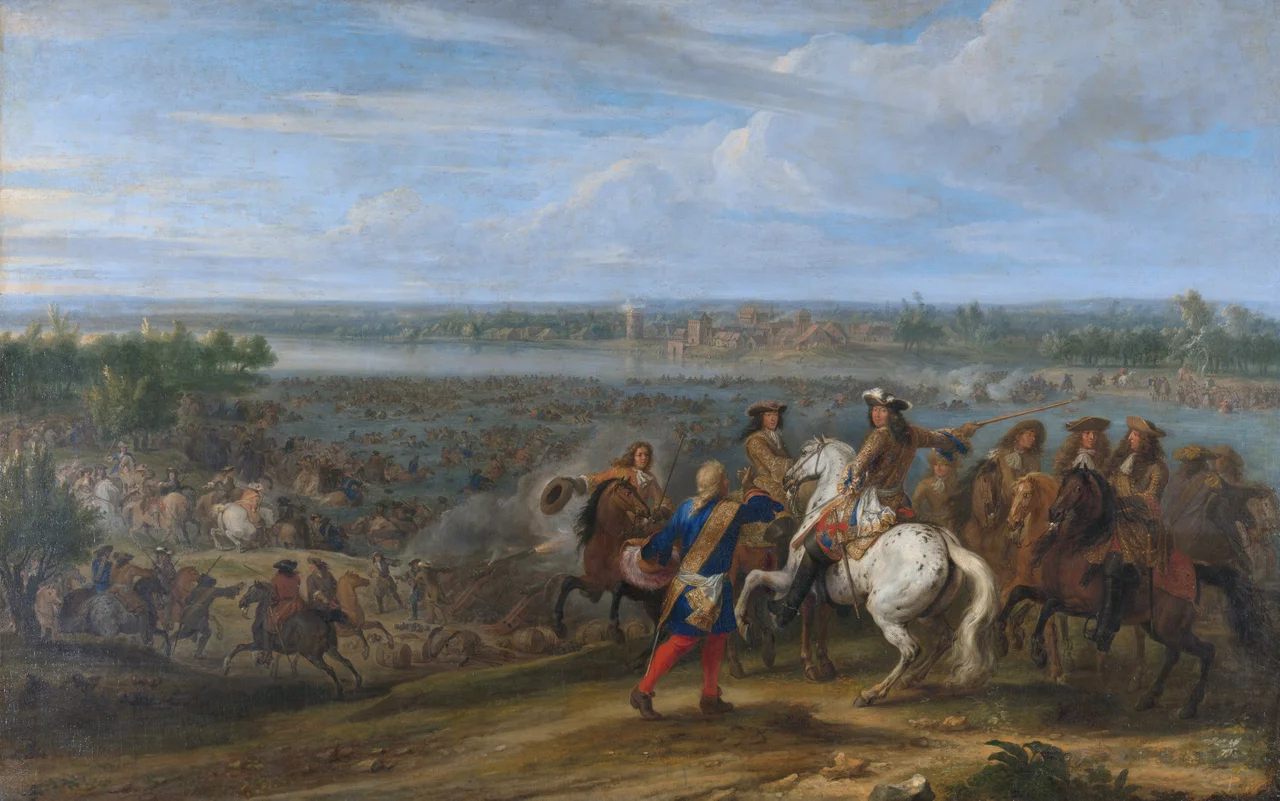
On the night of June 10, 1672, a farmer named Peters did the French army a favor. He pointed out, in the dark, a shallow place where the Rhine could be crossed near the village of Lobith. The next morning the river that had defended the Dutch Republic since its founding was no longer a defense. Within two days, eighty thousand French troops under the personal command of Louis XIV were on the wrong bank. The Dutch called the year that followed the Rampjaar - the Disaster Year. The people, said one Dutch chronicler, were senseless, the government distraught, the country lost. It all began at a place called Tolhuis, where a Sun King and a helpful farmer changed the map of Europe.
The Wrong Assumption
The regents who ran the Dutch Republic had spent years preparing for the wrong war. They expected, if it came, that the French would invade from the south and waste months besieging Maastricht. Louis XIV's own commanders considered exactly that approach. The king chose otherwise. He marched his army of 130,000 east through the Electorate of Cologne, leaving 20,000 troops behind to blockade Maastricht as the regents had predicted, and then turned his main force northwest toward a stretch of Rhine that almost nobody was watching. The Dutch field army, under the young William of Orange, was only 19,000 strong. A French officer in Dutch service, Jean Barton de Montbas, had been ordered to defend the river at Schenkenschanz - and after only a few days at his post, for reasons that have been argued about ever since, he marched his men away. The Rhine lay open.
Twelve Cannons and Three Companies
Word reached Arnhem of where the French were. William sent Field Marshal Paul Wurtz with what he could spare - three companies of cavalry and a regiment of Frisian infantry with their guns. Wurtz reached the river on June 12 to find the French army already drawn up in battle order on the opposite bank. He placed his cavalry at the crossing point and his Frisian infantry a few hundred meters away at the small fortress called Tolhuis. The French had no such constraints. A battery of twelve cannons opened on the Dutch position. A pontoon bridge was being thrown across the river. The Comte de Guiche led two thousand cuirassiers into the water. Some of the heavily armored Frenchmen lost their footing in the current and drowned in their breastplates. Those who reached the Dutch bank were charged by Wurtz's cavalry and driven back into the shallows.
The Maison du Roi Crosses
The French regrouped in the shallows and crossed again, in larger formations that broke the river's current and held together. Conde, Louis's commander-in-chief, came across in a barge. The king himself moved up to the bank to be seen by his troops. The Maison du Roi - the gilt-armored household cavalry, the highest nobles of France - rode through the water in gold and silver. By the time six thousand French horsemen had assembled on the Dutch side, Wurtz's three companies had no chance. They fled. The Frisian infantry, still at Tolhuis castle and now without cavalry support, watched their position collapse around them. Conde, with the practiced authority of a marshal of France, rode up to the infantry and ordered them to lay down their arms. They were ready to do so. The day might have ended with a French victory bought almost without French blood.
Longueville's Wine
Then a young nobleman named Charles Paris d'Orleans, Duke of Longueville, drunk and looking for glory, spurred his horse straight into the surrendering Dutch infantry. He fired his pistols into them, shouting that no man would be spared. The Dutch foot soldiers, who had been lowering their muskets, raised them again and opened fire. Longueville died in the volley along with several other French nobles. Conde, riding up to restore order, was attacked by a Dutch officer and shot through the wrist - a wound that would keep him out of the rest of the campaign and rob Louis of the commander he had relied on. The Dutch infantry's resistance lasted only minutes longer before French cavalry overran them. Around fifteen hundred Dutch soldiers died. The French lost roughly three hundred. The army of one of Europe's most powerful republics had been broken in an afternoon by a river crossing that wasn't supposed to be possible.
Rampjaar
The strategic effect of Tolhuis was catastrophic. With the French across the Rhine, the entire IJssel defense line was outflanked overnight. The States of Holland made the wrenching decision to abandon the eastern provinces entirely and to fall back on a final defense built around the great inundation - the deliberate flooding of farmland to drown the approaches to the heart of Holland. Cities surrendered. Mobs killed the de Witt brothers, the republic's leading politicians, in The Hague that August. William of Orange was raised to stadtholder. The republic survived only because Louis hesitated long enough to let the Hollandic water line be opened. At Versailles, still half-built, the king had himself painted in the War Room as a Roman horseman trampling Germanic soldiers, glory frozen on a wall. He was not satisfied. Conde had drawn too much attention by getting shot, and Louis resented him for it. The painting got the iconography. The farmer Peters and his shallow path got the war.
From the Air
The Battle of Tolhuis took place at approximately 51.86 N, 6.12 E near the village of Lobith on the Dutch-German border, at a place where the Rhine narrows as it enters the Netherlands and historically offered shallow crossings. The nearest commercial airports are Weeze (EDLV) 35 km south and Dusseldorf (EDDL) 100 km southeast. Recommended viewing altitude 3,000-5,000 ft to take in the river's bend at Lobith, the flat Lower Rhine farmland on both banks, and the line of the old Schenkenschanz fortress to the west. The Rhine here is the same river crossed in 1672 - flatter and channelized now, but still wide, slow, and tellingly easy to imagine 6,000 cavalrymen riding across.
Nearby Stories
- Winterswijk 3.6 km away
- St Nicholas Church, Deventer 5.1 km away
- Putten 5.8 km away
- Weeze 6.6 km away
- Twickel Castle 7 km away
- Assault on Nijmegen 8.4 km away
- Sint-Oedenrode 17 km away
- Landschaftspark Duisburg-Nord 23 km away