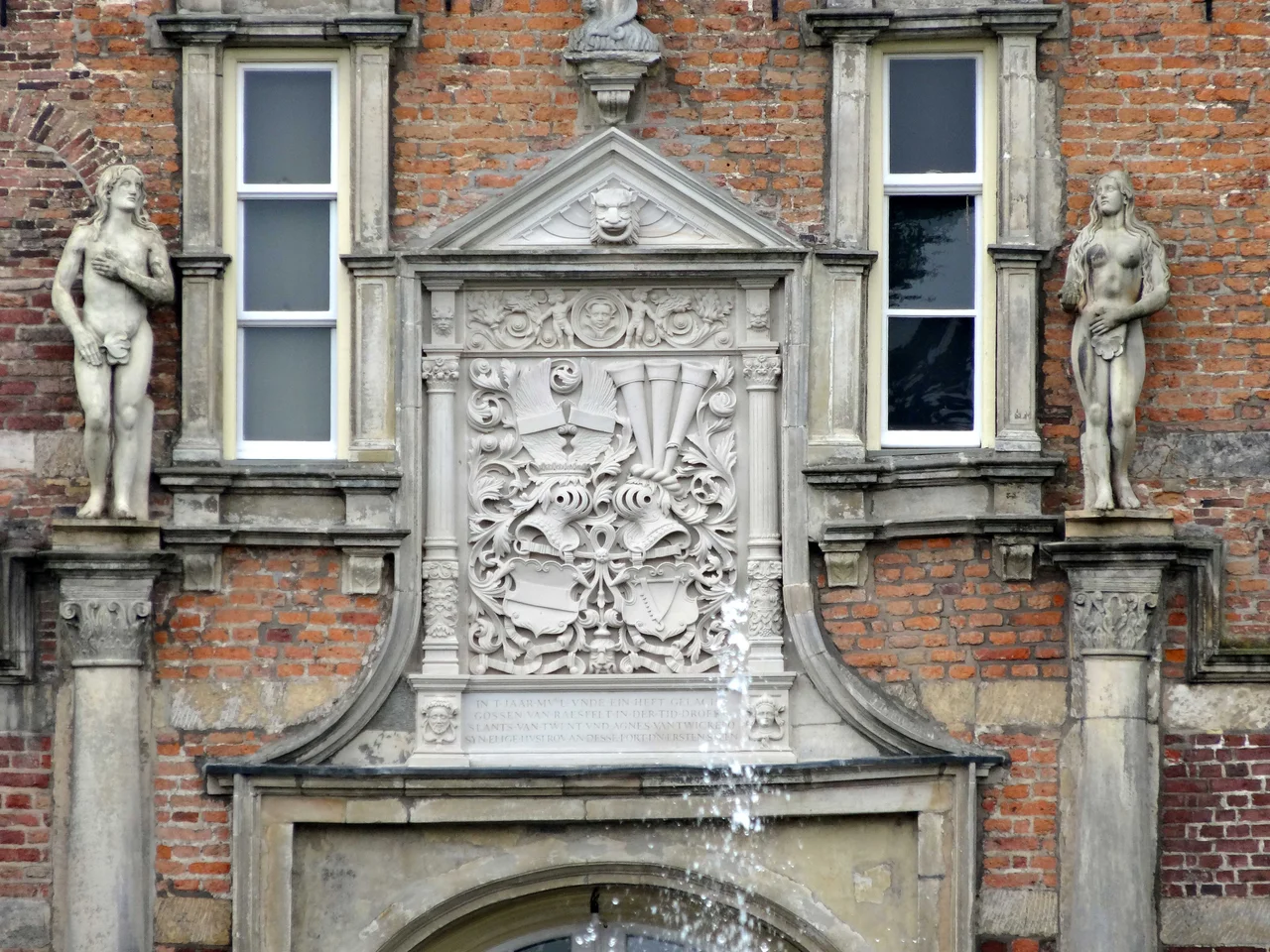

Twickel Castle
In 1953, a baroness in her seventies made a decision few of her peers ever made: she gave it all away. Twickel had been in the family for centuries, an estate of woods, farms, gardens, hunting lodges, an orangery, and a 16th-century moated castle at the centre. Marie Amelie baroness van Heeckeren van Wassenaer signed the lot over to a new foundation, with one condition. After her death, the castle had to stay lived in. No museum freeze, no roped-off rooms. Someone, ideally a relative, had to keep waking up in it.
The First Eysinck
Twickel begins in 1347, when a man named Herman van Twickelo bought a house called Eysinck near the small town of Delden, in what is now Overijssel. The family that took its name from the place stayed for two centuries. Then came the Van Raesfelts, then the Van Wassenaer Obdams, then the Van Heeckeren van Wassenaers; the chain runs almost unbroken into the present. The current castle's oldest stones date from around 1551. A facing brick above the entrance carries that date, alongside an early Renaissance gable and a sandstone heraldic panel showing the arms of Goossen van Raesfelt and his wife Agnes van Twickelo, flanked by carved figures of Adam and Eve under a Tree of Knowledge. The south wing followed in 1643. A north wing arrived in 1847, designed by the English architect Robert Hesketh. Around 1900, another Englishman, William Samuel Weatherley, oversaw a final restoration that quietly added modern conveniences. Since then, very little inside the walls has changed.
Gardens Built in Layers
If the castle is a palimpsest, the gardens are an archive. The earliest known layout, from the mid-1600s, was a formal geometric parterre with trellised tunnels and orchards held inside an outer moat. Then an early-18th-century baroque garden rose behind the castle, with ponds and a wildlife track running north of the outer canal. By the late 1700s fashion had turned again, and the whole baroque grid was softened into an English landscape garden. In 1830 the great Dutch garden designer Jan David Zocher reshaped it once more, building the current orangery. At the end of the 19th century, Hugo Poortman laid out a new formal garden around that orangery; Eduard Petzold handled the surrounding park and the Twickelerbos forest. The 20th century added a rock garden, planted by the last baroness herself. In 2008, landscape architect Michael van Gessel began carrying out yet another set of designs. A small surviving relic of the gardens is the English lavender variety lavandula angustifolia 'Twickel Purple', said to have come from the beds here and still popular with modern growers.
The Condition of Inhabitance
The baroness's foundation was unusual in 1953 and would be unusual now. Most great Dutch country houses passed to museums, the state, or were quietly subdivided and sold. Twickel went into a single legal entity charged with preserving it as both nature reserve and cultural monument, with the explicit aim of keeping it open to hikers, nature lovers, and art lovers. After she died in 1975 the rest of her private estate followed. The right to live in the castle passed to her great-nephew, Christian Graf zu Castell-Rüdenhausen, who moved in during 1982 and stayed until his death in January 2010. The right then passed to his son, Roderik, who lives in part of the building with his family. The arrangement is quietly radical: a baroque inheritance held by a foundation, with a count and his children doing the dishes upstairs.
An Estate You Can Walk
Twickel's land runs to thousands of hectares of forest, farmland, and water around the castle, making it the largest privately held estate in the Netherlands. You can recognize the farms that belong to it by the shutters, white with black edges. Some of the products grown on those farms are sold in the estate shop. The woods are open all year and threaded with paths. The European long-distance route E11, known locally as the Marskramerpad after the medieval peddlers' road it follows, runs straight through. Since 1997, the Twentsche Golfclub has had its course on estate land, and since 2010, a 70-kilometre signposted mountain bike route loops the property, ten kilometres of which run on single-track built especially for it. The castle gardens are open daily in season for a fee; the vegetable gardens open on Wednesdays and Fridays in summer; the castle interior itself can be toured under supervision during two weeks in August, when its inhabited rooms briefly become visitable ones.
From the Air
Twickel sits at roughly 52.27 degrees north, 6.71 degrees east, just outside Delden in the municipality of Hof van Twente. From the air it shows as a moated rectangle in a sea of dark forest, with formal garden geometry just to the south. The nearest commercial-class airport is Enschede's Twente Airport (EHTW), about 20 km east; Eindhoven (EHEH) and Schiphol (EHAM) are the usual entry points for visitors. The estate's deep canopy and surrounding farmland make it a distinctive landmark on the otherwise open Twentse landscape.
Nearby Stories
- Eastern Netherlands 2.9 km away
- Rheine 3.7 km away
- Den Hulst 4.7 km away
- Battle of Stadtlohn 6.4 km away
- Doetinchem 7.8 km away
- Stalag VI-C 13 km away
- Münster 18 km away
- Börger 39 km away