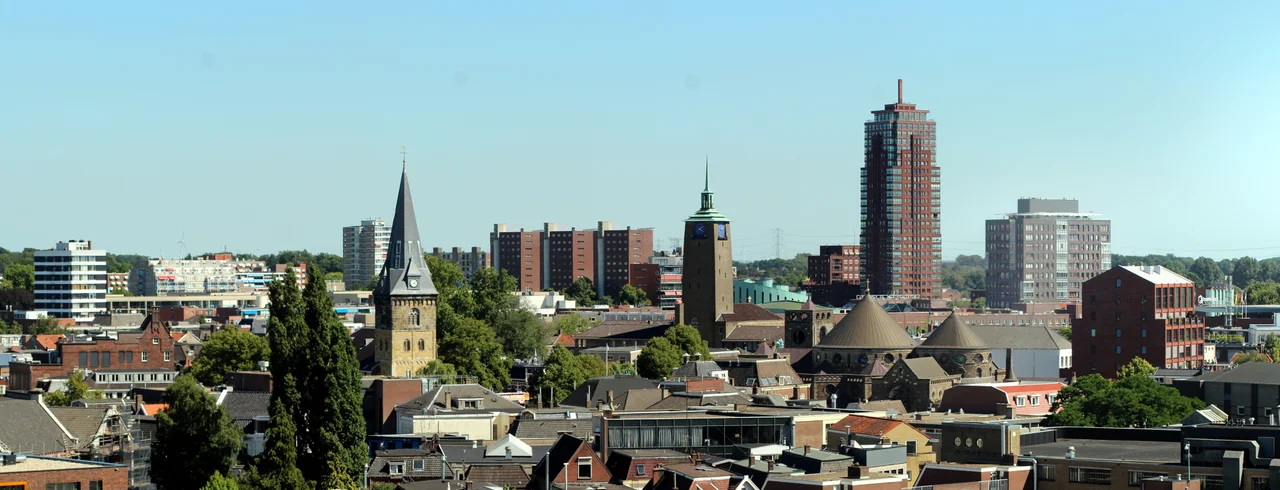

Eastern Netherlands
There is a desert in the Netherlands. Not a metaphor - actual drifting sand, dunes that march across heath in the wind, patches large enough that you can stand in the middle and see no green at all. It is called the Kootwijkerzand, it sits in the Hoge Veluwe National Park, and it is one of the largest active sand drifts left in Europe. This is not the country of stereotype. The Eastern Netherlands keeps its own weather, its own language, its own pace - and it keeps a Van Gogh collection in a museum most visitors have never heard of.
Six Hanseatic Cities, One River
From around the 13th century until the silting of the IJssel ended their golden age, six cities along this river - Deventer, Doesburg, Hattem, Kampen, Zutphen, and Zwolle - grew rich as members of the Hanseatic League, the trading confederation that ran the Baltic. Each of them still wears the architecture of that wealth: gabled merchant houses, weighing scales on the market square, stone churches with towers built tall enough to be seen from approaching ships. Zwolle is home to one of only two restaurants in the Netherlands holding three Michelin stars. Deventer hosts Europe's largest book fair every August. Kampen has the country's first town to receive city rights. The river that built them all still bends quietly past their old quays, smaller now than the boats it once carried.
The Forest, the Desert, and the Hidden Van Goghs
The Veluwe is the great forested heart of the eastern Netherlands - heathland and pine, sand and stream, with patches of genuine drift desert that look transplanted from a different continent. Inside the Hoge Veluwe National Park, hidden among the trees, sits the Kroller-Muller Museum. It owns one of the world's largest collections of Van Gogh paintings - second only to the Van Gogh Museum in Amsterdam - and a sculpture garden filled with Rodin, Moore, and Dubuffet. Most international visitors to the Netherlands never make it here. The locals know. On weekends, white free-use bicycles wait at the park gates for anyone who wants to ride the trails.
Low Saxon, Slow Pace
Listen closely in a village cafe in the Twente or Achterhoek regions and you may hear something that is not quite Dutch. Low Saxon - Nedersaksisch - is spoken alongside Dutch across much of the east, a regional language that links these communities more closely to northern Germany than to the Hague. The accent is softer, the vowels rounder, the pace unhurried. Outside the cities, this is farm country - dairy cattle, orchards, the brick-red barns of Salland and the green-and-gold patchwork of the Achterhoek. Many traditional dishes here grew from what was cheap and filling: humkessoep, a Twente bean-and-potato soup served with sausage and bacon; and the Deventer koek, the spiced honey cake that has been made in the same city for more than five centuries.
An Annual March, a Bridge Too Far
Each July, Nijmegen - the country's oldest city, dating back to Roman times - hosts the Vierdaagse, a four-day hiking event that draws roughly 45,000 walkers from around the world. They cover 30, 40, or 50 kilometers a day for four straight days. The streets fill with music. The blisters become national news. Nijmegen sits in the south of the region; Arnhem, its smaller rival to the north, holds a different kind of history. Operation Market Garden, the failed Allied airborne assault of September 1944, came to its tragic end here at the Arnhem road bridge - the eponymous bridge of A Bridge Too Far. Today the Airborne Museum at Hartenstein keeps the story. Down in Arnhem itself, Burgers' Zoo and the Netherlands Open Air Museum sit a tram ride from the rebuilt center.
The Easiest Place to Bike in Europe
The Eastern Netherlands rewards travelers willing to slow down. The bike paths are a national engineering achievement: dedicated lanes, color-coded signage, route numbers you can follow without a map. Every train station of any size has a cycle rental counter. Veluwe trails wind through pine forest and sudden sand. Hanseatic city lanes give onto the IJssel quays. The Dickens Festival in Deventer, the weekend before Christmas, turns the medieval streets into a Victorian set piece. The Bevrijdingsfestival in Zwolle floods the city with free music on May 5, Liberation Day. None of this gets crowded the way Amsterdam does. That, more than anything, is the eastern Netherlands' best-kept secret.
From the Air
The region centers roughly on 52.3 degrees north, 6.3 degrees east, covering the provinces of Overijssel, Gelderland, and parts of Flevoland. Schiphol (EHAM) is the nearest major airport, about 80 km west. Smaller airports include Lelystad (EHLE), Twente (EHTW) near Enschede, and Weeze (EDLV) just across the German border. From cruising altitude, the IJssel river forms the dominant north-south visual reference; the Veluwe shows as a large green forest plateau west of the IJssel, with visible patches of pale sand drift.
Nearby Stories
- Twickel Castle 4 km away
- Putten 4.3 km away
- Winterswijk 7.6 km away
- Den Hulst 9.7 km away
- Liemers 9.8 km away
- Urk 12 km away
- Coevorden 13 km away
- Assault on Nijmegen 17 km away