
Ratingen
In 1783, Richard Arkwright's mechanized cotton mill at Cromford, Derbyshire, was the closely guarded crown jewel of the British Industrial Revolution. Britain had laws against exporting the machinery, the plans, even the trained workers. A Bergisch industrialist named Johann Gottfried Brugelmann smuggled the technology to a tributary of the Dussel river east of Dusseldorf anyway, named his new venture after the English town he had copied, and in 1784 opened the first mechanized factory on the European continent. The building is still there. You can walk through it. The room where the spinning frames first turned at water-power speed is now part of the Rhine Industry Museum.
City Rights in 1276
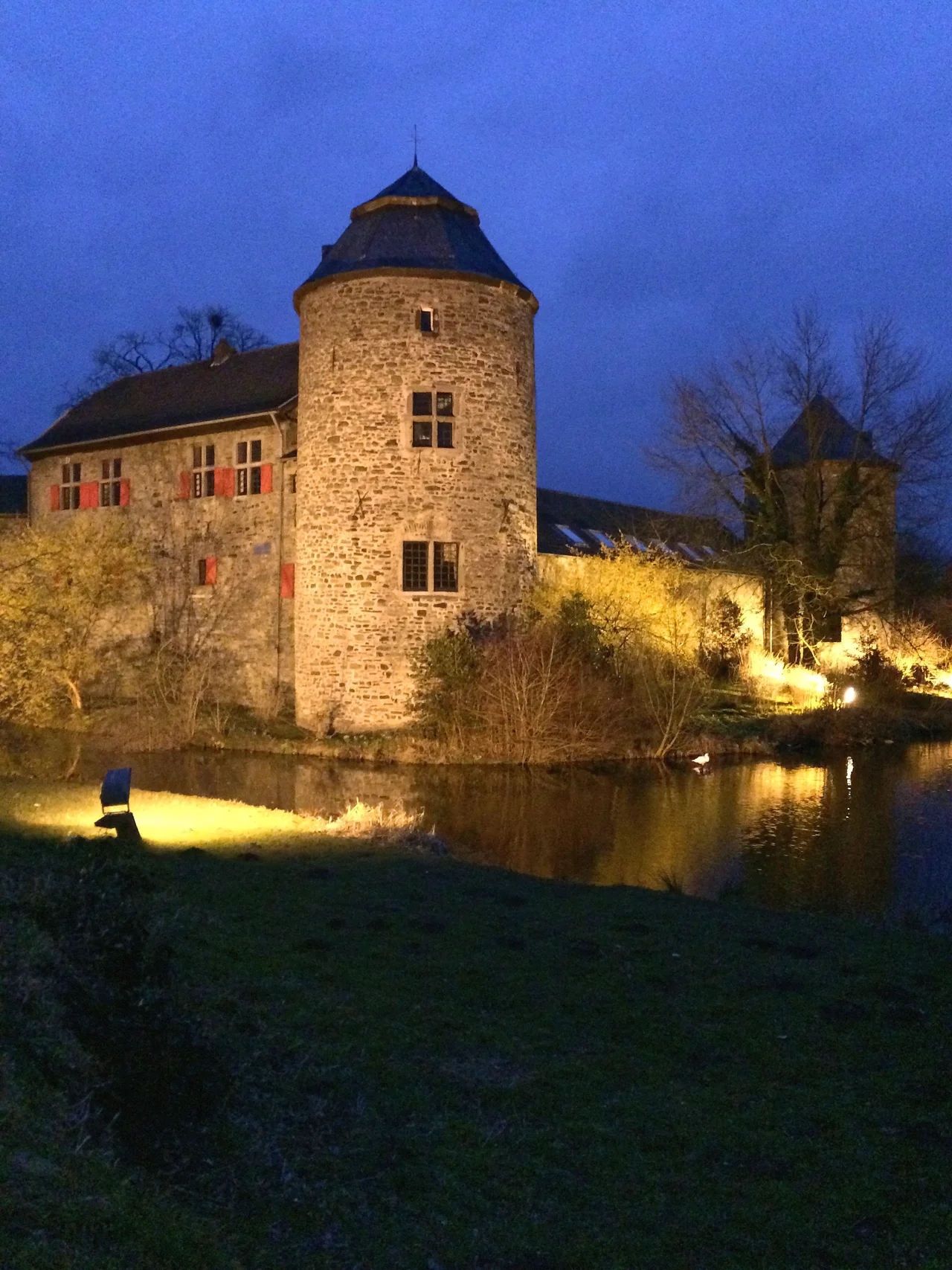
Ratingen had been around for a long time before the Industrial Revolution found it. The first documentary mention dates from 849. On 11 December 1276 the settlement received formal city rights, making it one of the four major towns of the Duchy of Berg - the others being Wipperfurth, Lennep, and Dusseldorf itself, which was still a small place at that point. Ratingen flourished in the late Middle Ages on the trade routes between the Lower Rhine and Westphalia, slowed during the Thirty Years' War like nearly every German town, then settled into the comfortable obscurity of a regional market center. The walled old town - the Altstadt - retains its medieval street plan, with the parish church of St. Peter and Paul anchoring the historic center.
The Cromford Mill
What Brugelmann built in 1784 was not just a factory but a model. He took the entire Arkwright system and translated it: the multi-story stone building with water-powered shafts, the disciplined work-force housed on site, the careful separation of carding, drawing, and spinning into discrete rooms - the factory floor as choreography. He named the operation Cromford after his English original, an act somewhere between homage and trolling. Within a generation, similar mills had sprouted across the German states. Within a century, the cotton industry was the largest manufacturing sector in continental Europe. The Cromford works in Ratingen was eventually rolled into the Textilfabrik Cromford, then preserved as a historic site. Today it operates as the Cromford Industrial Museum under the umbrella of the LVR's Rheinisches Industriemuseum - one of six sites across the Rhineland telling the story of how a corner of Germany went from agriculture to global manufacturing in a single century.
From Prussia to Now
Napoleon absorbed the Duchy of Berg into his Grand Duchy in 1806, and Ratingen with it. After Waterloo the Congress of Vienna handed the whole Rhineland to Prussia, which brought efficient bureaucracy, military conscription, and a steady investment in roads and railways. The 1929 communal reorganization left Ratingen as an independent town - it managed to avoid being swallowed by Dusseldorf, a fate that befell many of its neighbors. World War II spared the town center from the worst of the Allied bombing that flattened the nearby industrial cities. In 1970, before the next round of municipal mergers, the population crossed 50,000. The 1975 reform added the formerly independent districts of Breitscheid, Eggerscheidt, Hosel, and Lintorf, pushing the city to its current size of roughly 90,000.
A Marshal in the Woods
In the closing days of the war, Field Marshal Walter Model - the commander of Army Group B, trapped in the Ruhr Pocket as the American Ninth Army closed in - walked into a forest just outside Ratingen and shot himself. The date was 21 April 1945. He was 54. Model had been an extraordinarily capable defensive commander, called "the Fuhrer's fireman" for his record of stabilizing collapsing fronts. He was also, by the end, complicit in the worst of what his army did. He left no note. His son later found and buried the body. The exact spot in the Wittlaer forest, which the family kept private, is unmarked. The town does not commemorate it. Some history is best left without a monument.
Headquarters Country
Modern Ratingen is, improbably, a corporate hub. Vodafone Germany maintains a major operational campus here. ASUS, Hewlett-Packard, SAP, CEMEX, and Esprit all maintain major German operations in the city. Trading Hub Europe, the operator of the unified German natural gas market, was incorporated in Ratingen in June 2021. The reasons are practical - good rail and Autobahn connections, proximity to Dusseldorf Airport, lower commercial real estate costs than the big city next door - but the result is a slightly surreal experience of walking from a half-timbered 16th-century house in the old town to a glass corporate tower in fifteen minutes. The town also hosts the Mehrkampf-Meeting, an annual decathlon and pentathlon meet that has been one of the top events on the European athletics calendar since 1997.
From the Air
Located at 51.300 N, 6.850 E, about 12 km northeast of Dusseldorf and on the eastern fringe of the Rhine-Ruhr conurbation. The historic center sits north of the Anger river, with the Cromford mill complex on a tributary feeding the Dussel. Nearest airport: Dusseldorf International (EDDL), 5 km southwest - the airport's northern runway extension actually borders Ratingen city limits. From cruise altitude, look for the distinctive medieval street pattern of the old town set against the surrounding industrial parks and the wooded ridge to the east.
Nearby Stories
- Lindenstraße 0.4 km away
- German Football Museum 5.4 km away
- Diamond Interchange: How a Simple Idea Reshapes Towns Like Julich 7 km away
- Gladbeck 12 km away
- Hagen Open-air Museum 12 km away
- Homburg Castle 13 km away
- RAF Bruggen 15 km away
- Weeze 16 km away