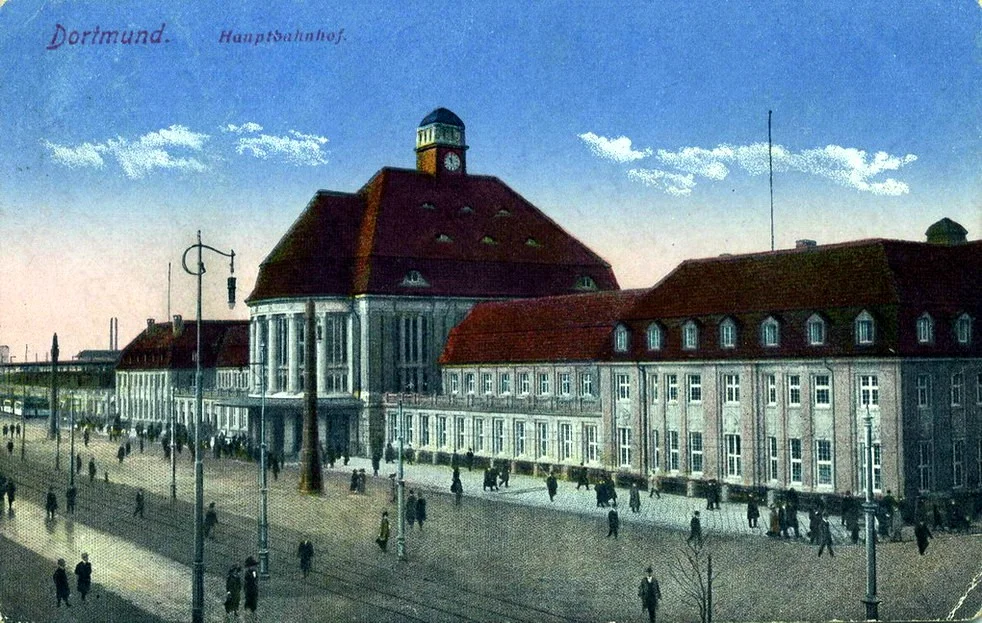

Dortmund Hauptbahnhof
The stained-glass windows above the concourse show a blast-furnace worker, a coal miner, a brewer, a butcher. They were installed in 1952, when the hall was rebuilt over the ruin of an Allied air raid, and they depict the trades that Dortmund expected to have forever. Two of those four are gone now. The windows remained, because nobody had the heart to take them down, and so 190,000 commuters a day pass beneath portraits of jobs the city no longer does.
Three Stations on One Spot
The first Dortmund station opened on 15 May 1847, a modest brick affair built north of the medieval centre by the Cologne-Minden Railway Company. It sat on an island reached through the old castle gate, and within a decade the level crossings around it had become a notorious obstacle to traffic on the salt roads. The solution was radical. On 12 December 1910 a brand-new station was inaugurated on raised embankments at the current site, and at its opening it was one of the largest stations in the German Empire. It received the formal name Dortmund Hbf on 1 October 1912. That second station survived the First World War, the French occupation of the Ruhr, the Weimar inflation, and the first years of the Second World War. It did not survive the bombing of 6 October 1944.
The Sober Replacement
What rose from the 1944 ruin was not an attempt at imperial grandeur. The new hall, completed in 1952, is a plain shed in the contemporary West German style: long, flat, glazed, functional. The stained-glass windows that depict the city's then-common professions were the one concession to ornament. For decades the station did its job competently and inconspicuously, fed by lines from Cologne, Soest, Duisburg and the Ruhr collieries. By the mid-1990s it was carrying more passengers than ever and falling apart at the same time. Plans for replacement followed plans, like a queue of misfiring locomotives.
The UFO and the 3do
In 1997 came the first redevelopment proposal: an 80,000-square-metre residential structure shaped, locals said, like an oversized UFO. Deutsche Bahn, the state of North Rhine-Westphalia, and Westdeutsche Immobilien Bank signed a memorandum in October 1998 to fund the 850-million-Deutschmark project. Within three years the UFO had been quietly grounded. A Portuguese investor, Sonae Imobiliaria, stepped in with a 1.2-billion-Deutschmark plan called 3do, mixing 36,000 square metres of retail with 26,500 of entertainment. The Federal Railway Authority approved the design on 3 February 2006. Thirteen months later, on 28 February 2007, Sonae walked away. Two grand reconstructions in nine years had collapsed without a single shovel turned. Meanwhile commuters waited under windows showing miners who had stopped mining.
Working Around the Problem
By summer 2009 Dortmund Hauptbahnhof admitted it could not wait for visionaries any longer. The federal government, the state, and Deutsche Bahn pooled 23 million euros for a phase-one rehabilitation. Workers gutted the station building while the ticket office, a fast-food outlet, the federal police post, and the Bahnhofsmission railway charity all moved into shipping containers parked outside. Phase one finished on 17 June 2011. Phase two, addressing the pedestrian tunnels and platform access, was still rolling toward its 2024 target as one of the last big German stations without full step-free access to every platform. The work feeds into the long-promised Rhine-Ruhr Express, the network meant to give North Rhine-Westphalia something closer to a true regional rapid-rail system.
Hub of a Region That Doesn't Sleep
Today the station is the third-busiest long-distance junction in Germany. Thalys high-speed trains run through to Brussels and Paris; Flixtrain and Deutsche Bahn ICE and Intercity services fan out across the country; Regional Express and S-Bahn lines stitch together the Ruhr cities. Underneath the main hall, four Stadtbahn lines, the U41, U45, U47 and U49, carry locals to the suburbs and beyond. On Borussia Dortmund match days a special station, Westfalenstadion, opens just for the stream of yellow-shirted fans heading south. The U45 then bypasses its usual terminus to deposit them at the ground. Above all of it, the 1952 windows still glow. The mine they show closed in 1987. The trains they watched over have not stopped since the day they were lit.
From the Air
Dortmund Hauptbahnhof sits at 51.5175 degrees north, 7.4589 degrees east, at the north edge of the city centre. From the air the long, low platform shed is easy to pick out beside the elevated tracks running west-to-east through the city. Dortmund Airport (EDLW / DTM) is 13 km east; Düsseldorf International (EDDL / DUS) is 60 km southwest. The station is the third-busiest long-distance hub in Germany and the central node of the Ruhr S-Bahn. Recommended viewing altitude 1,000 to 2,000 metres.
Nearby Stories
- Gladbeck 4.1 km away
- Altena Castle 8.7 km away
- Mettmann 9.8 km away
- Museum of Lacquer Art 12 km away
- RAF Gütersloh 17 km away
- Liesborn Abbey 18 km away
- Battle of Stadtlohn 19 km away
- Dillenburg 68 km away