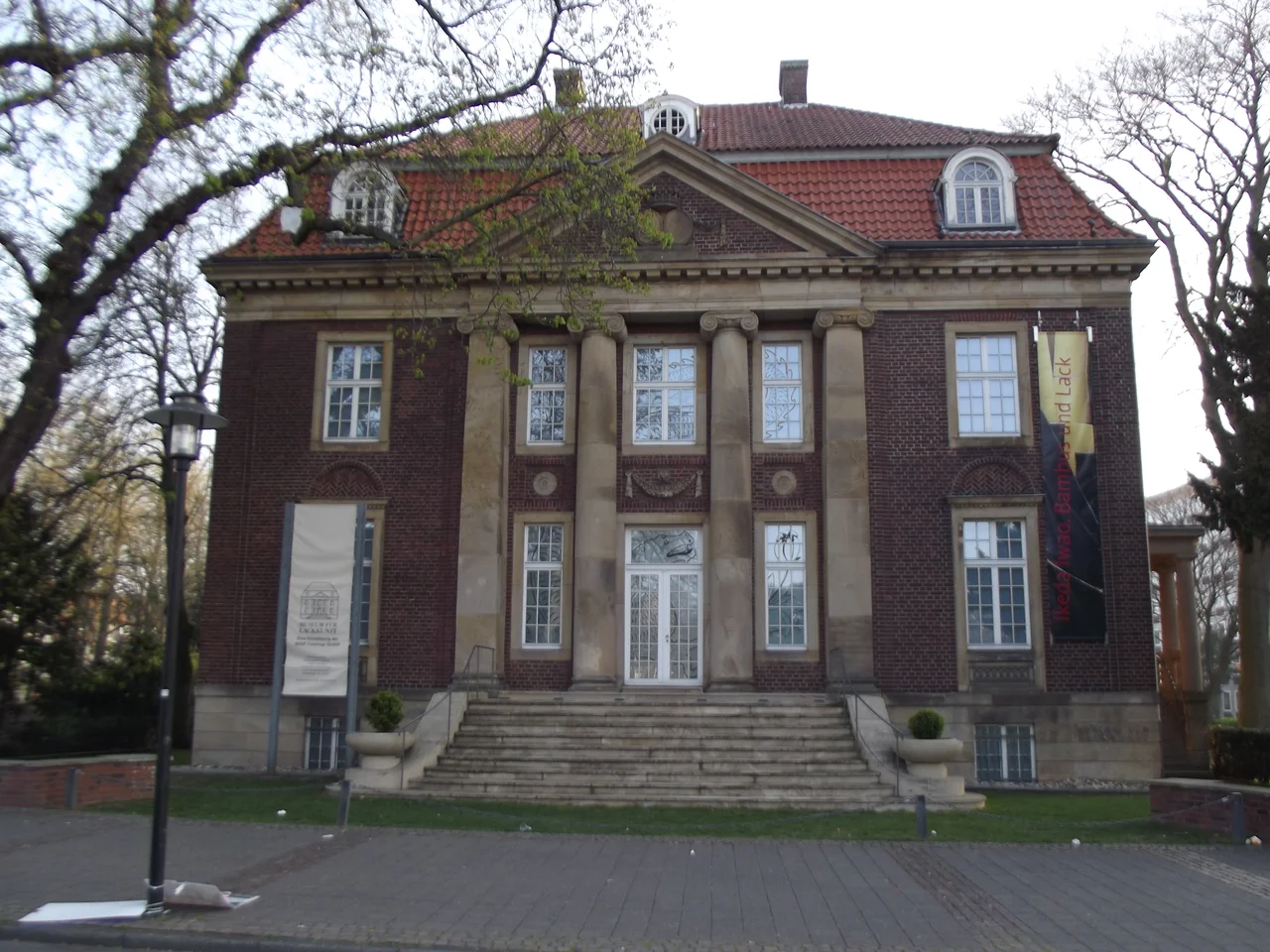
_Museum_f%C3%BCr_Lackkunst.jpg)
Museum of Lacquer Art
Two thousand years ago, somewhere in what is now China or Korea, a woodworker tapped the bark of Toxicodendron vernicifluum and collected the milky sap that ran out. Cured in damp air, the sap hardened into a coating so durable that the objects it covered could be buried, dug up, and still gleam. The only museum in the world devoted to that craft sits in a Münster villa, owned by a paint company, holding around a thousand pieces that trace 2,000 years of human obsession with making things shine.
How a Paint Company Ended Up in the Art Business
The Museum of Lacquer Art exists because two German lacquer chemists were also serious collectors. Erich Zschocke worked at the Herbig-Haarhaus paint factory in Cologne from the mid-1920s and became fascinated with the company's own products. In 1955 he founded the Herbig-Haarhaus Lacquer Museum, anchored by work attributed to Shibata Zeshin, often called the last great Japanese lacquer master. Kurt Herberts, founder of a competing firm, started his own collection in the 1930s; most of it was destroyed in the Second World War, and he began rebuilding from 1949. In 1968 BASF bought the Herbig-Haarhaus factory and inherited the museum. In 1982 BASF Coatings took over the Herberts collection too. The combined holdings moved into a renovated villa in Münster in 1993, opened to the public under curator Monika Kopplin, and have been there ever since. The director today is the art historian Gudrun Bühl. It is the only institution of its kind in the world.
The Asian Collection
The oldest objects in the museum come from China and Korea, where lacquer decoration was already a sophisticated craft in the 4th and 5th centuries BC. The galleries cover the major Chinese techniques: carved red Schnitzlack, where dozens of layers of cinnabar-pigmented lacquer are built up and then incised down into a relief; lacquer painting on furniture; and the slow, exacting work of inlaying mother-of-pearl into a black ground. The Japanese galleries focus on urushi, the broad term for Japanese lacquer work, and especially on maki-e, the scattering technique perfected by the 9th century in which gold and silver powder are sprinkled from small tubes onto still-damp lacquer to draw images that look like they are floating just under the surface. The Korean galleries include Goryeo and Joseon work decorated with mother-of-pearl, technically related to Chinese inlay but pursued in Korea with a particular delicacy.
Europe's Lacquer Detective Story
Asian lacquer first reached Europe in significant quantities in the late 16th century, arriving on the same Portuguese and Dutch ships that brought porcelain and spices. Demand was instant and impossible to satisfy. The sap of the Asian lacquer tree could not survive the voyage, so European craftsmen had to invent substitutes from oils, resins, and binders. In the 17th century they copied Asian motifs onto European furniture; in the 18th they invented their own. The collection's centrepiece is a cabinet made around 1715 by Martin Schnell, a Dresden court painter often credited with introducing the maki-e scattering technique to Europe. Another remarkable European piece is the panorama of the Great Road over the Simplon Pass, made around 1820 in the Stobwasser factory in Brunswick: 24 painted lacquer views of Napoleon's Alpine engineering achievement, scrolling around a single coordinated object.
The Russian and Islamic Galleries
Russian lacquer arrived late but developed in a distinctive direction. The earliest pieces in the collection date from the start of the 19th century, when Russian workshops imitated European ornamentation. From around 1850, they pivoted decisively toward Russian subjects: troika scenes, peasant life, folk tales, and the saints' stories of the Orthodox calendar. The Palekh school of lacquer miniatures, originally icon painters who lost their religious commissions after 1917 and adapted, is represented in the museum's special exhibitions. The Islamic galleries are a quieter surprise. Lacquer book covers and pen boxes from Persia, Turkey, and the broader Islamic world appear from the late 15th century, decorated with watercolour and shell gold, then sealed under layers of clear lacquer. The recurring motif is the rose and the nightingale, a Persian poetic image of the lover and the beloved that became a standard subject for centuries of court craftsmen.
Why It Is Worth the Detour
Lacquer is a slow art. A single object can carry dozens of layers, each of which has to harden in humid darkness for days. A complex Chinese carved piece might represent two years of cumulative work; a major Japanese maki-e cabinet might represent five or ten. The museum's argument, made object by object, is that this slowness produced a peculiar continuity across cultures. The same care that goes into a 4th-century BC Chinese cup goes into a 17th-century Japanese inrō hung from a samurai's belt, into a Dresden cabinet, into a Persian pen box, into a Palekh miniature painted by a recently unemployed icon master. The museum's rotating special exhibitions add depth: Vernis Martin French lacquer, Korean mother-of-pearl from the Goryeo dynasty, contemporary Korean artists working with traditional techniques. It is a small institution in a quiet city, and it is the only place on Earth where you can walk through two millennia of this craft in a single afternoon.
From the Air
The Museum of Lacquer Art is in central Münster at 51.96°N, 7.63°E, a few minutes' walk from the cathedral and St. Lambert's. Cruise at 2,500-3,500 ft AGL for an overview of the old town and the surrounding ring of Promenade parkland that traces the line of the former city walls. Münster/Osnabrück (EDDG) is 12 nm north.
Nearby Stories
- Cappenberg Castle 3.5 km away
- Bundesautobahn 30 4.2 km away
- Losser 6.3 km away
- Jagdgeschwader 72 9.5 km away
- Battle of Stadtlohn 10 km away
- Versmold 12 km away
- Gladbeck 13 km away
- Warsteiner 34 km away