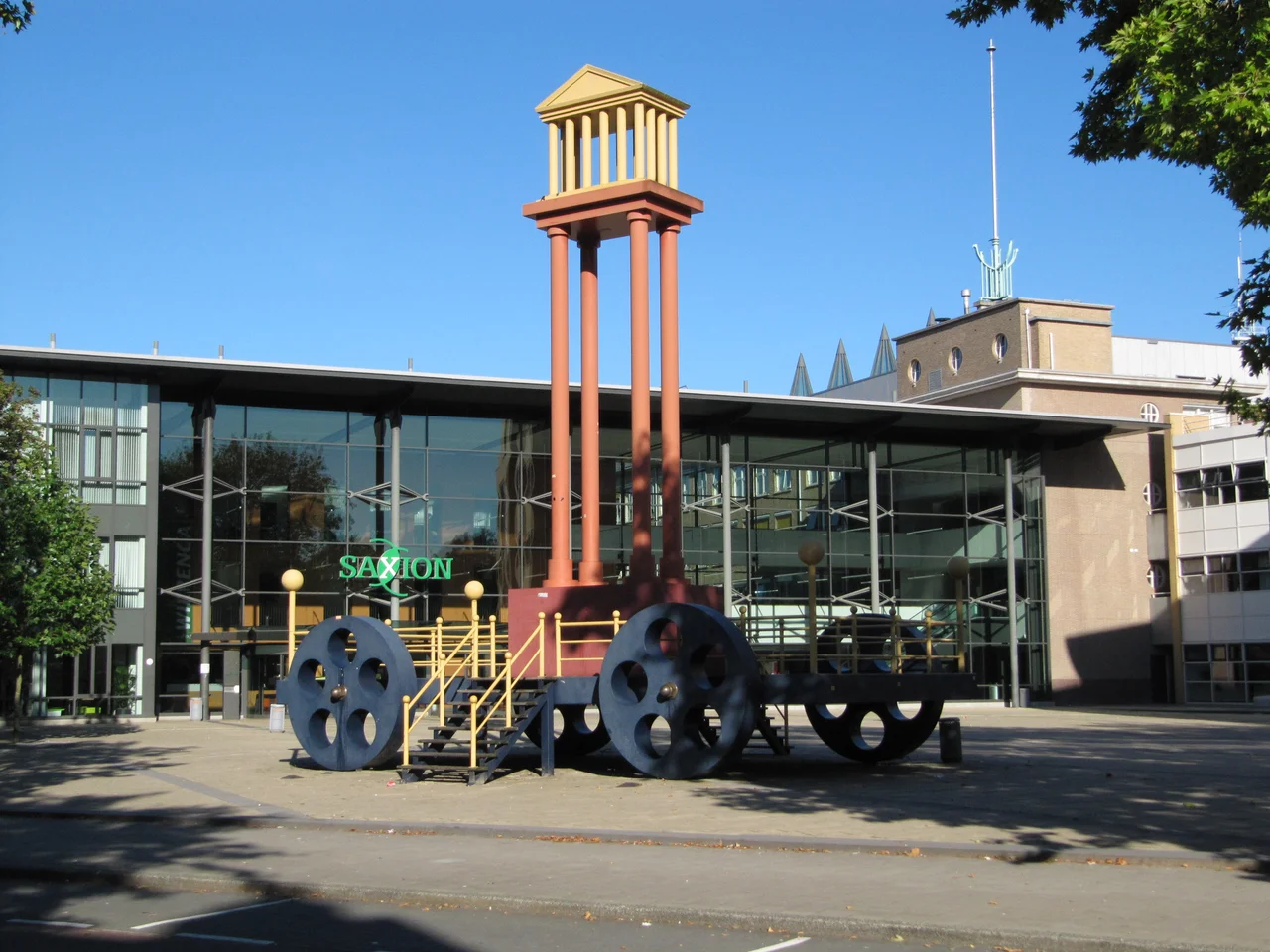

Saxion University of Applied Sciences
Sometime in the late 1470s a young boy from Rotterdam named Desiderius Erasmus walked the streets of Deventer on his way to lessons. He would later become the most influential humanist scholar of his era and one of the foundational minds of the European Renaissance. The schools he attended in Deventer were part of a centuries-long tradition of learning in this east Dutch book city, and the line from those medieval classrooms runs - thinly, but recognizably - to Saxion University of Applied Sciences, today a 27,000-student institution with campuses in Enschede, Deventer, and Apeldoorn. Saxion's actual founding date is 1998, when two existing hogescholen merged, but the institution's official history reaches back through Deventer's 17th-century Athenaeum Illustre to the medieval schools that taught Erasmus his Latin.
A City of Books
Deventer earned its reputation as a Dutch city of books slowly, over centuries. It became a major Hanseatic trading center in the medieval period and an early printing town, and the schools that grew around its churches drew students from across northwestern Europe. The Athenaeum Illustre, founded in the seventeenth century, offered academic education at a level just below a full university and produced generations of clergy, magistrates, and scholars. When Saxion's institutional historians draw a line from medieval Deventer to the modern campus, they are honest about how distant the precursor is - but they are also acknowledging that the eastern Netherlands has been a serious place to study for nearly a millennium, and that Saxion sits in that long tradition.
Textile Money, Technical Schools
Twente's other contribution to Saxion's DNA comes from industry, not scholarship. The Twente Industrial and Trade School was founded in 1864 with money from the region's textile barons - the families who had built fortunes on cotton mills clustered around Enschede and Hengelo and who understood, in the way industrialists sometimes do, that their fortunes would not survive without trained engineers. They financed the schools, sat on their boards, recruited the teachers, and offered internships in their own factories. The Hogere Textielschool De Maere followed in the same spirit. When Twente's textile industry collapsed in the second half of the twentieth century, the schools survived - retooling toward engineering, design, and applied science - because their roots were broader than any single industry.
The 1998 Merger
Saxion in its present form was born on 1 January 1998, when the Hogeschool Enschede and the Rijkshogeschool IJselland merged under the management foundation Stichting Hogescholen Oost-Nederland. The new institution took the name Saxion in 2000 - a reference to the Saxons, the Germanic people who once inhabited this corner of the continent. In 2001 the university expanded to Apeldoorn, completing the three-campus footprint that defines it today. The Enschede campus became the first true City Campus in the Netherlands, a deliberately urban design with pavilions for different schools, communal study landscapes, and a five-minute walk to the city center for coffee or a beer. Architecturally and culturally it broke with the older Dutch tradition of monastic, isolated campuses.
Living Technology
Saxion's research focus is captured in a phrase the institution uses repeatedly: living technology. The idea is technology that integrates with the human body, the built environment, and the natural world - smart textiles, medical devices, sustainable construction materials, sensors that listen to soil. It is a focus shaped by the region's history: a place where textile innovation once meant the difference between solvency and bankruptcy is well placed to think about what materials and electronics can do next. Eleven academies cover everything from hospitality and social work to electrical engineering and creative media, and an international bachelor program spanning eleven study tracks pulls students from 89 nationalities into the eastern Dutch classroom.
Three Cities, One School
Each campus has its own character. Deventer's Saxion building, designed by the Dutch architect Paul Dirks, sits a few minutes from the old town and the city's arts district - a striking modern structure dropped near streets where Erasmus may once have walked. Apeldoorn's campus is the smallest and the most experimental, with a wine bar and a restaurant partly run by hotel management students learning their trade in real time. Enschede is the flagship, the city campus where most international students land, with housing for first-year non-EU students built into the institution's promise. About 3,500 international students from 89 countries study across the three sites at any given time. The Saxons would not recognize the place. Erasmus, given the chance to wander through, might.
From the Air
Coordinates of the Enschede campus 52.2203 N, 6.8864 E. Saxion has three campuses spread across the eastern Netherlands: Enschede (main), Deventer (about 70 km west), and Apeldoorn (about 80 km west-northwest). Recommended viewing altitude 2,500 to 5,000 feet. Nearest airport to Enschede is Twente Airport (EHTW), roughly 4 nautical miles north. From altitude over Enschede, look for the city's compact urban core and the green of the University of Twente campus to the west of Saxion. Visibility is generally good year-round outside winter fog mornings.
Nearby Stories
- Eastern Netherlands 2.9 km away
- Rheine 3.7 km away
- Den Hulst 4.7 km away
- Battle of Stadtlohn 6.4 km away
- Doetinchem 7.8 km away
- Stalag VI-C 13 km away
- Münster 18 km away
- Börger 39 km away