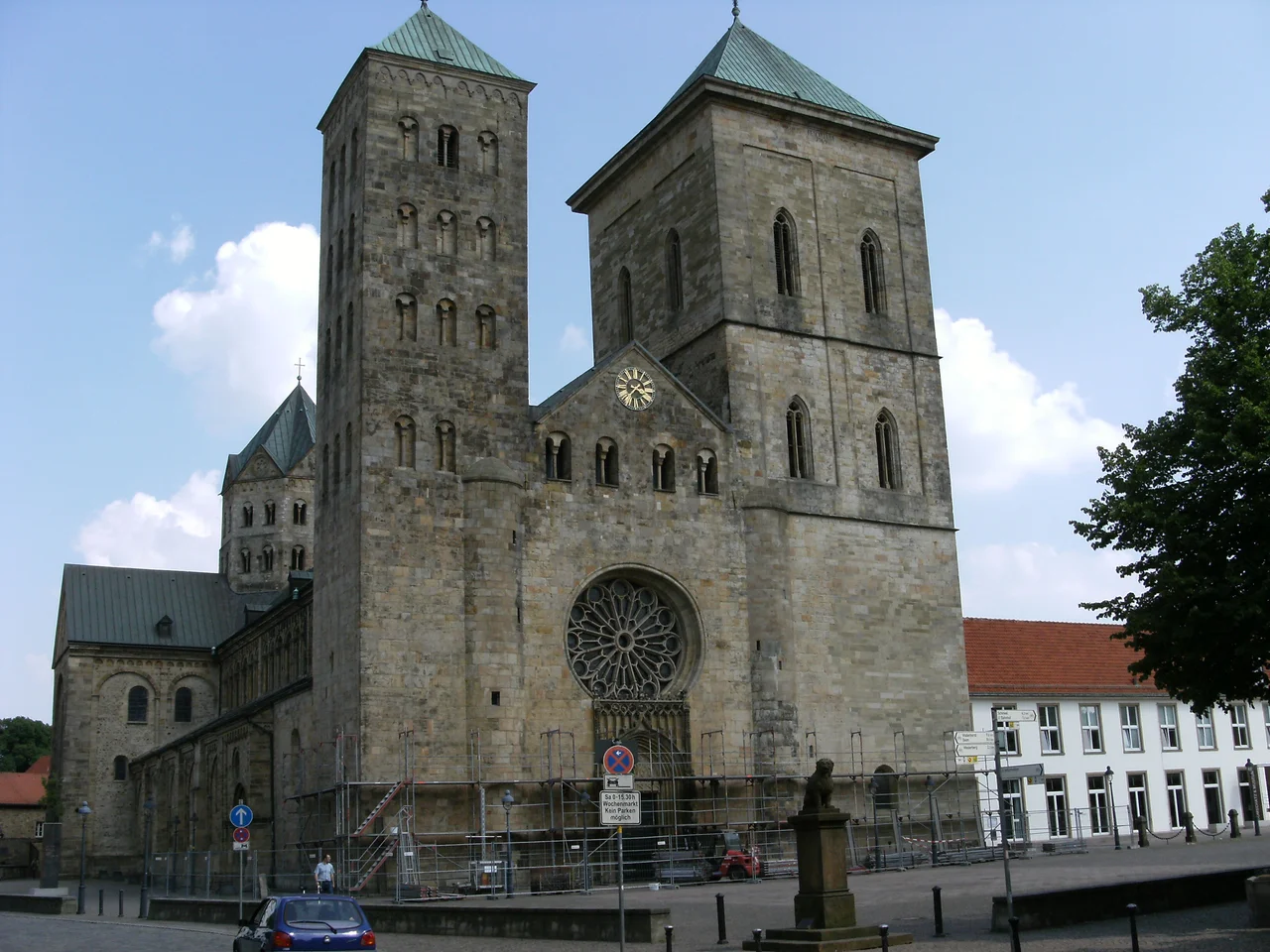

Prince-Bishopric of Osnabrück
In 1764, the Prince-Bishopric of Osnabrück elected a new bishop. He was a Protestant member of the British royal family, a son of King George III, and he was six months old. His name was Prince Frederick, later Duke of York and Albany, and his election was not a constitutional accident - it was the working out, more than a century later, of one of the strangest clauses ever written into a European peace treaty. The 1648 Peace of Westphalia, signed partly in Osnabrück itself, had decreed that the bishops of this small ecclesiastical state should alternate, in perpetuity, between Catholic and Protestant officeholders. It is hard to think of a more original solution to a religious civil war.
Founded by Charlemagne
The diocese itself goes back to 772, when Charlemagne, in the middle of his three-decade conquest of Saxony, founded the see at Osnabrück as a base for forced conversion. It is the oldest episcopal see Charlemagne established - older than Münster, older than Bremen. From those modest beginnings, the bishopric accumulated land and rights over centuries. The temporal protectorate over the see, originally exercised by lay nobles of the Amelung family and then by the Welf dynasty, eventually passed through several feudal hands until, in 1236, the Count of Tecklenburg was forced to surrender all jurisdiction over the town of Osnabrück. The bishops were now civil rulers as well as spiritual ones. By the early thirteenth century, they had absorbed the holding of fairs and markets, rights of toll and coinage, forest and hunting rights, mining royalties and fortresses - the whole catalog of royal prerogatives transferred, item by item, into clerical hands.
The Reformation Comes Calling
When Protestantism arrived, Osnabrück swung. Bishop Franz of Waldeck, in office from 1532 to 1553, allowed an evangelical service in Osnabrück from 1543 onward, then on his deathbed received Lutheran communion - but in 1548 he had also promised to suppress the Reformation. He was, in the polite phrase, ambivalent. After his death, three successive Protestant-minded bishops swept much of the diocese into Lutheranism. The Counter-Reformation pushed back hard. Cardinal Eitel Frederick of Hohenzollern brought in the Jesuits in 1624; his successor Franz Wilhelm von Wartenberg purged the city council, gave the Augustinian convent to the Jesuits, and founded a university at Osnabrück in 1631. Two years later the Swedes arrived, shut the university down, and ran the bishopric themselves until 1651.
The Alternating Bishops
The Thirty Years' War ended at the conference table in Osnabrück and the nearby city of Münster, and the Treaty of Osnabrück - one half of the Peace of Westphalia - did something extraordinary. Rather than declare the bishopric either Catholic or Protestant, the treaty stipulated that the prince-bishops would alternate between the two confessions. Protestant bishops would be chosen from the cadets of the House of Brunswick-Lüneburg. Catholic status of the bishopric itself would not be prejudiced, and the Archbishop of Cologne would retain his rights as metropolitan. The result was a working laboratory of confessional coexistence. From 1648 onward, every change of bishop meant a change of religion at the top, and the cathedral and city had to make space for both. Ernest Augustus of Hanover, a Lutheran, succeeded the Catholic cardinal Wartenberg in 1662. Charles Joseph of Lorraine, a Catholic, succeeded him in 1698. The pattern held until the bishopric's dissolution in 1803.
The British Prince
The most curious of the alternating bishops was Prince Frederick of Great Britain, second son of George III. Elected Bishop of Osnabrück in 1764 at the age of six months, he became the last prince-bishop and held the office, in absentia, for nearly four decades - a Protestant ruler of a German Catholic-Protestant principality, who almost never visited the place. His great-great-grandfather King George I had died in the Osnabrück bishop's palace in 1727 while visiting his own brother, the then prince-bishop Ernest Augustus, Duke of York and Albany. The connection between the British crown and this small Westphalian bishopric was unusually intimate, a quirk of the personal union between Hanover and Britain that very few of either country's subjects ever thought about.
Dissolution and Afterlife
In 1803 the German Mediatisation swept away the Holy Roman Empire's ecclesiastical principalities, and the Prince-Bishopric of Osnabrück was absorbed into the Electorate of Hanover. The chapter, the convents, and the Catholic charitable institutions were secularized. The territory then passed through one of those bewildering Napoleonic-era sequences: Prussia in 1806, the Kingdom of Westphalia in 1807, Napoleonic France in 1810, and back to Hanover in 1814. The diocese itself survived as a purely spiritual entity. Klemens von Gruben, titular Bishop of Paros in Greece, was made vicar apostolic to look after Catholic affairs. The ordinary Roman Catholic episcopacy was restored in 1824, but the bishops never again held temporal power. Today, the two great residences of the prince-bishops remain in use: Iburg Castle is a museum and local court, and the baroque Bishop's Palace in Osnabrück houses the University of Osnabrück.
From the Air
The historical Prince-Bishopric centered on Osnabrück at approximately 52.28°N, 8.15°E, in present-day Lower Saxony. Its territory closely matches the modern Osnabrück district and city combined, covering roughly 2,200 km² ringed by hill ranges - Teutoburg Forest and Wiehen Hills to the south, the North German Plain stretching north. Key surviving sites: the baroque Bishop's Palace in central Osnabrück (now the University of Osnabrück), and Iburg Castle in Bad Iburg roughly 15 km south. Nearest major airport: Münster Osnabrück (ICAO: EDDG). Best appreciated at altitude that shows the relationship between the Iburg hilltop fortress and the cathedral city to its north.
Nearby Stories
- Ibbenbüren 2.3 km away
- Münster-Handorf Airfield 4 km away
- Diepholz 9.2 km away
- Minden 9.7 km away
- RAF Gütersloh 12 km away
- Hermannsdenkmal 14 km away
- Emsland Railway 31 km away
- Ahlden House 56 km away