
Münster-Handorf Airfield
The first Luftwaffe airfields had to be built fast. In 1935, when the reborn German Air Force needed somewhere to train pilots, Fliegerhorst Münster-Handorf was one of the first to open - a flight school five miles east of Münster, with Arado Ar 66 trainers droning in slow circles over the flat Westphalian fields. Within four years, those trainers would be replaced by Heinkel He 111 bombers and Messerschmitt Bf 109 fighters, and the slow circles would become the patrol patterns of a war.
Cradle of the Luftwaffe
When the field opened in 1935, Germany was still officially honoring the Treaty of Versailles. Officially. In practice, the Luftwaffe was being reconstituted in plain sight, and Handorf was one of the first places its new pilots learned to fly. Flugzeugführerschule A/B 12 set up here with Arado Ar 66 biplanes - the kind of forgiving trainer a beginner could survive misjudging. By September 1939, the school days were over. Kampfgeschwader 54 arrived with He 111P medium bombers. Three Bf 109E fighter wings - Jagdgeschwader 3, 51, and 21 - rotated through during the Phoney War. JG 27 and KG 1 were formed here from scratch. The grass field that had been a classroom became a launching pad, pointed west toward France and Britain.
Pinned to the Ground
By 1944, Handorf was a target. American Eighth Air Force B-17s and B-24s worked the airfield over with 500-pound bombs in no fewer than ten heavy bomber attacks between December 1943 and March 1945. The strikes were timed cynically: hit Handorf hardest exactly when those same heavy bombers were within interception range of German fighters. If the Bf 109s couldn't get airborne, they couldn't shoot down the bombers. The Luftwaffe pilots assigned to Handorf spent more and more of their war dodging cratered runways and burning hangars. By the time the Americans actually arrived on the ground in late March 1945, the airfield was a moonscape.
Y-94 Handorf
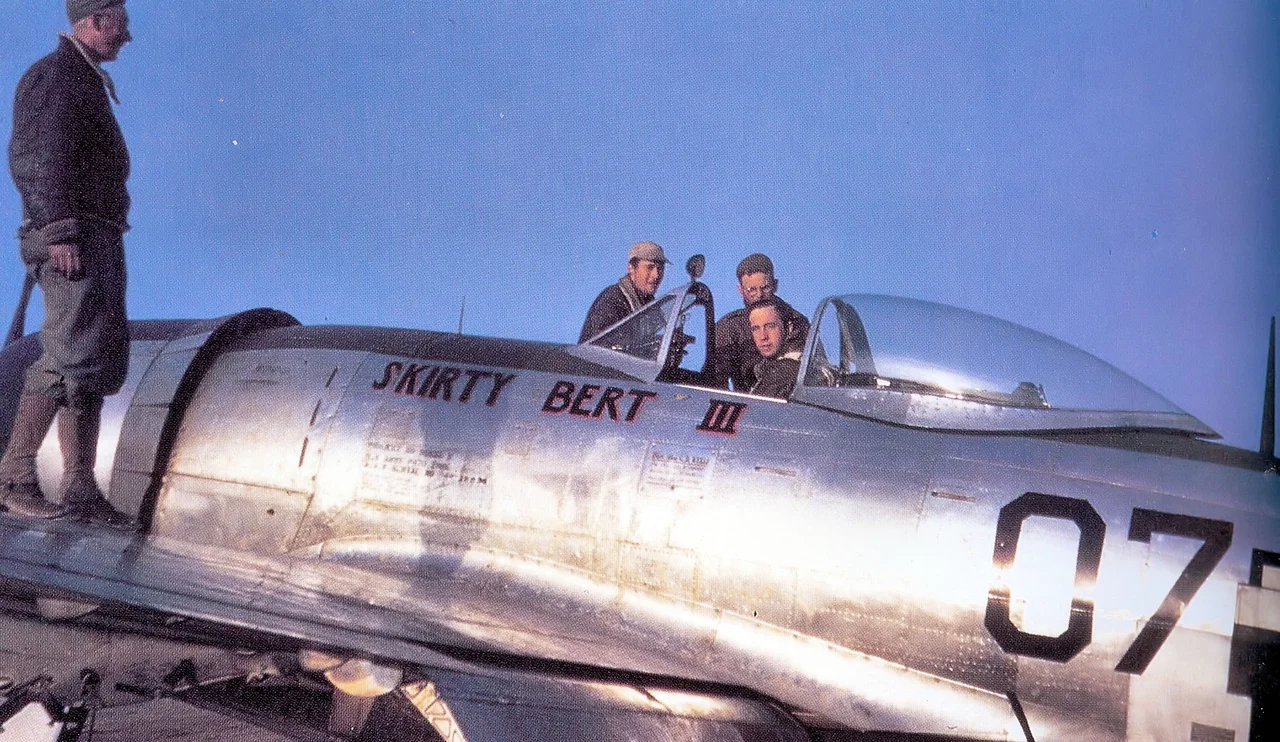
On 5 April 1945, the IX Engineer Command's 852nd Engineer Aviation Battalion rolled in and started patching. It took a week of filling craters and laying 5,000 feet of asphalt over the Luftwaffe's old concrete runway before Handorf was reborn as Advanced Landing Ground Y-94. The 366th and 406th Fighter Groups flew their P-47s in and immediately went back out, this time pressing the German forces trapped in the closing Ruhr Pocket. Within weeks, more than 300,000 German troops would surrender there - the largest single capture of German forces in the war. Handorf's P-47s had helped hammer them into submission. When the shooting stopped on 7 May, the Air Technical Service Command moved in to sort through the mountains of surplus Allied aircraft funnelled here for return, sale, or scrap.
The Dutch Nike Year
The RAF took the field in December 1945 and quickly decided the runways were too smashed up to be worth repairing. It served as a garrison for the British Army of Occupation until 1949, then went quiet. Most of the airfield was carted away in the 1950s as West Germany rebuilt. Then, briefly, the Cold War borrowed Handorf back. In 1960 and 1961, the Royal Netherlands Army installed a temporary Nike anti-aircraft missile site here while their permanent base was being built. For about a year, the rural Westphalian fields hosted surface-to-air missiles pointed up at the Soviet bomber threat. When the permanent site opened in 1961, the Dutch packed up and the land went back to Germany - and to agriculture.
Reading the Concrete
Walk the fields east of Handorf village today and you can still read the airfield in the ground. The main runway is gone, but a thick line of vegetation traces where it ran. Round concrete pads connected by single-lane roads mark the old Dutch Nike launch positions. Cracked dispersal areas hide in the underbrush where Bf 109s once parked under camouflage netting. A few destroyed buildings stand as rubble in the trees. Northeast of the airfield, the old Luftwaffe ground station - later used by the British - still has its barracks and administrative buildings and a parade-ground sized lawn where other buildings once stood. The agricultural fields have not quite forgotten what they were.
From the Air
Münster-Handorf Airfield sits at 51.995°N, 7.732°E, about 5 miles east-northeast of Münster city centre. Recommended viewing altitude 2,000-3,000 feet AGL to pick out the vegetation lines of the former runways and the round Nike missile pads. The nearest active airport is Münster Osnabrück International (EDDG/FMO) 6 miles to the north-northwest. RAF Gütersloh (ETUO, now Princess Royal Barracks) is 30 miles east-southeast. Watch for VFR traffic operating from the small civilian portion of the field.
Nearby Stories
- Cappenberg Castle 3.5 km away
- Bundesautobahn 30 4.2 km away
- Losser 6.3 km away
- Jagdgeschwader 72 9.5 km away
- Battle of Stadtlohn 10 km away
- Versmold 12 km away
- Gladbeck 13 km away
- Warsteiner 34 km away