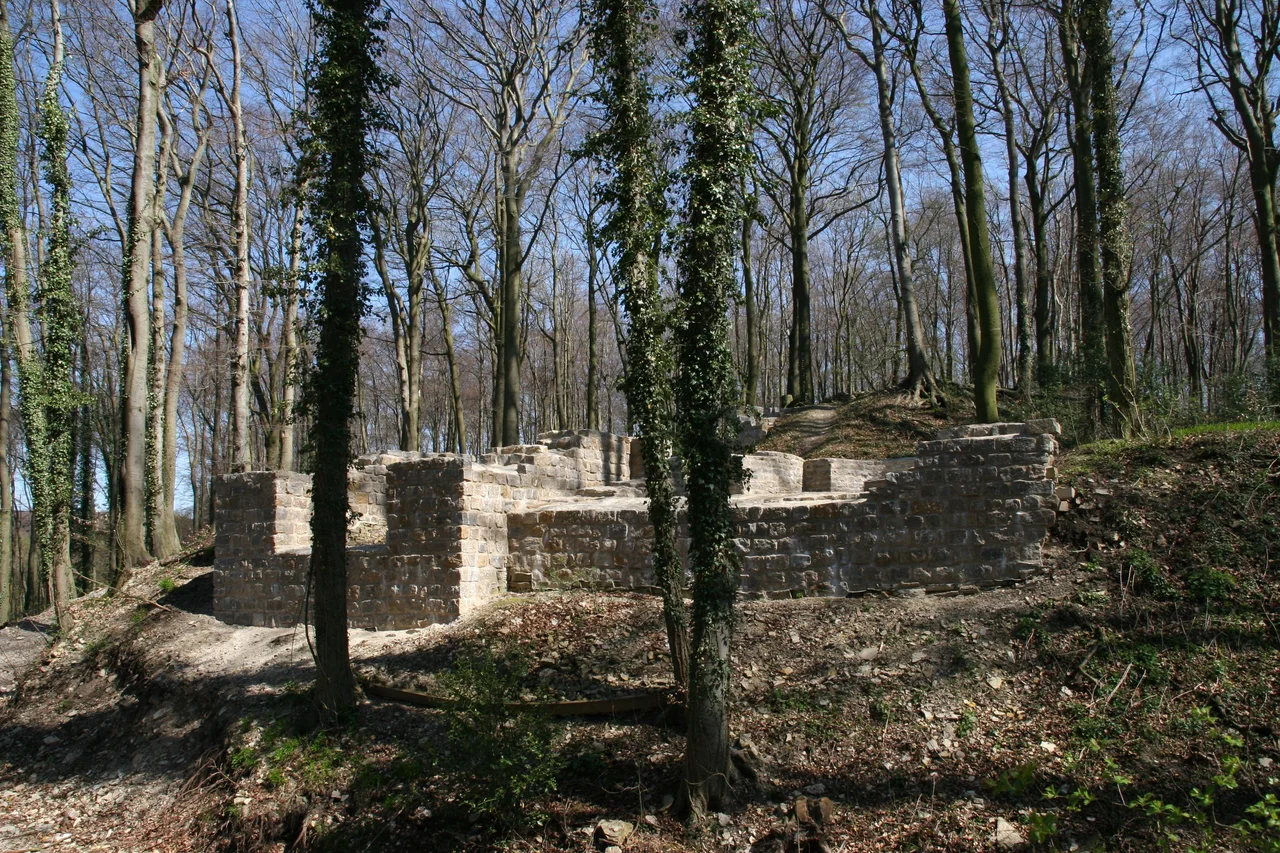

Holter Burg
From a rocky spur in the woods near Bissendorf, a single family produced an Archbishop of Cologne, an Imperial Arch-Chancellor, an Essen prince-abbess, and three successive bishops of Münster. The lords of Holte never controlled much territory, but for two centuries they punched extraordinarily above their weight in the politics of medieval Germany - and the place that anchored them was the Holter Burg, a hilltop fortress whose deep moats and crumbling foundations still pattern the forest floor.
A Castle on a Hill Spur
Around the year 1100, someone with money and ambition crowned a rocky hill spur near present-day Bissendorf with a tower castle. The plateau measured about fifty meters across. A round tower rose at the center, ringed by a wall roughly two meters thick - the enceinte, in the technical language of medieval fortification. Around the wall ran a moat up to twenty meters wide and ten meters deep, gouged into the bedrock on three sides. On the western flank no moat was needed: the hillside dropped away so steeply that any attacker would arrive winded and exposed. From wall-top to ditch-floor on the eastern side, the drop was sixteen meters. It was a small castle, but a deeply serious one. This was the third hill castle in the Osnabrück Land, alongside the older Iburg and the Wittekindsburg near Rulle.
A Dynasty in Mitres
What made the Holter Burg matter was not its stones but its bloodline. The lords of Holte married well and produced churchmen of unusual reach. Wigbold of Holte became Archbishop of Cologne and Arch-Chancellor of the Holy Roman Empire - a position that put him among the great Imperial electors. Beatrice of Holte ruled as prince-abbess of Essen, one of the few women in medieval Germany who held both spiritual and temporal sovereign power. Three brothers - Burchard, William I, and Ludolf of Holte - held the bishopric of Münster in succession. From one small castle in the Westphalian woods came a familial concentration of ecclesiastical influence that few baronial houses in Europe ever matched.
Burned and Rebuilt and Burned Again
Power attracts attention, and attention attracts arson. The Holter Burg may have been first destroyed as early as 1147, when the Bishop of Osnabrück, Philip of Katzenelnbogen, joined forces with the counts of Ravensberg in a feud against the lords of Holte. The castle was rebuilt. It came down again - perhaps between 1308 and 1315, perhaps earlier; the most recent archaeology dates a fire layer in the soil to the mid-thirteenth century. The lords of Holte eventually accepted that the old hilltop site was no longer worth defending. They moved down and built Schloss Ledenburg in the nearby village of Nemden, calling it the New Holter Burg. The medieval original was left to the trees.
What the Forest Hides
Walk the site today and the castle reveals itself slowly. Within a double ditch system covering roughly 5,000 square meters, you can trace the plan of the round tower - a circle of foundation stones half-buried in moss. Sections of the enceinte still rise from the leaf litter. The deep moats remain unmistakable, even nine hundred years after they were cut. In 1997 and again in 2006, archaeologists from Osnabrück conducted excavations and stabilization work, uncovering a chamber gate, the chapel's foundation, and signs of the bergfried (keep). The investigations were aimed not just at understanding the ruins but at making the site accessible to visitors. There is no museum, no entrance fee, no audio guide - just earthworks in a forest, telling a story about a family that once held the bishoprics of an empire.
From the Air
Located at 52.21°N, 8.19°E in the wooded hills east of Osnabrück, near the village of Bissendorf in Lower Saxony. The site sits at the edge of the Wiehen Hills. The nearest major airport is Münster Osnabrück (ICAO: EDDG) roughly 40 km west. Hannover (EDDV) lies about 120 km east. From the air, the wooded ridge and the small clearing of the castle plateau are difficult to identify without close inspection; the surrounding villages of Bissendorf and Nemden provide orientation. Best viewed at low altitude on clear days when the forest canopy texture varies.
Nearby Stories
- Ibbenbüren 2.3 km away
- Münster-Handorf Airfield 4 km away
- Diepholz 9.2 km away
- Minden 9.7 km away
- RAF Gütersloh 12 km away
- Hermannsdenkmal 14 km away
- Emsland Railway 31 km away
- Ahlden House 56 km away