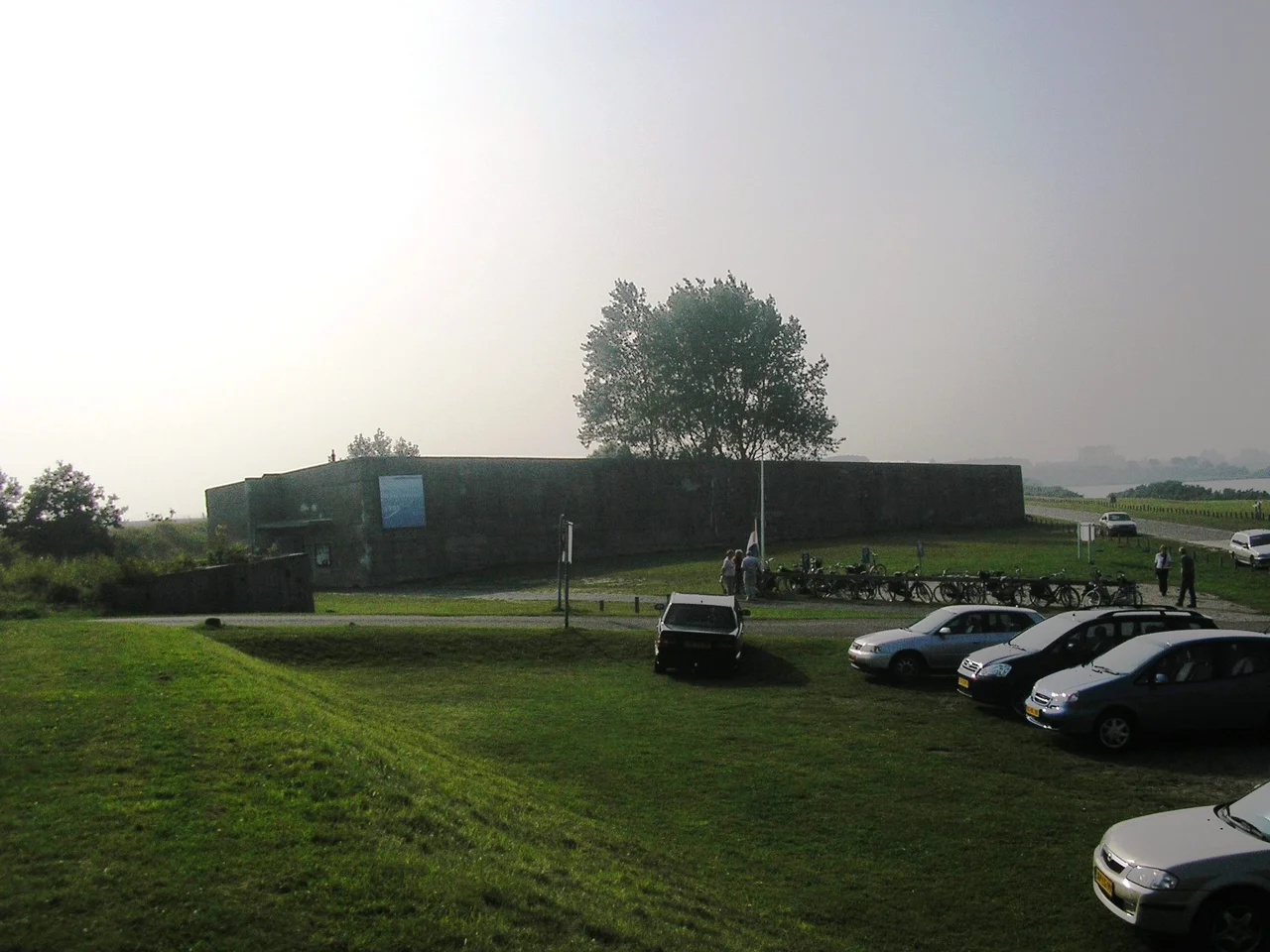

Watersnoodmuseum
The exhibit is called 1835+1. The first number is the count of Dutch victims of the 1953 flood whose names were known. The +1 is a baby. She was born on the night the dykes broke, and she died with her mother before anyone could write down a name. The Watersnoodmuseum sits on the dyke south of the village of Ouwerkerk on Schouwen-Duiveland, and it is built — literally built — inside the four concrete caissons that workers floated into the last hole in the dyke in November 1953, eleven months after the water came through. The walls of the museum are the walls of the wound. Everything inside is what the village has chosen to do with the memory.
The Last Breach
After 1 February 1953, the dykes of Zeeland were broken in sixty-seven places, and they had to be closed one by one through a year of cold weather and short supplies. The breach near Ouwerkerk on Schouwen-Duiveland was the last and the worst — it kept widening with every tide, and ordinary materials would not hold. The Dutch found a solution by reusing four Phoenix caissons originally built by the Allies for the Mulberry harbour on D-Day, vast hollow concrete boxes that could be towed into place, sunk, and locked down with stone and clay. They sealed the gap at Ouwerkerk in November 1953. The same caissons are still there. They are the museum.
Ria Geluk's Working Group
It took forty years for the survivors to be ready to build a museum. After the 1993 commemoration of the flood's fortieth anniversary, a working group formed around a Schouwen-Duiveland woman named Ria Geluk, who had lived through the flood as a child. By 1997 the group had momentum; volunteers led by Evert Joosse, an architect from Kloetinge, fitted out the first caisson; a trial opening followed in autumn 2000. On 2 April 2001, the Minister of Transport Monique de Vries cut the ribbon on a museum the survivors had built themselves. In July 2008 the expansion began. By April 2009 all four caissons were open and connected by underground corridors, and Prime Minister Jan Peter Balkenende re-opened the enlarged museum. In 2016 the Dutch government formally designated it the National Knowledge and Memorial Centre for the Flood of 1953.
Caissons of Memory
Each caisson holds a chapter. The first is Facts. It tells what happened on the night and in the first days after — the dyke holes plugged with sandbags, the boats that converged from every nearby harbour to lift survivors off chimneys and roofs, the Polygoon newsreel footage that shocked the country into understanding what its southwest had endured. The second caisson is Emotions. This is where the multimedia monument 1835+1 lives, where the names of every known victim are inscribed in niches along the corridor, where photographs of survivors look back at you and where the relief that poured in from around the world — the postcards, the foreign helicopters, the pea soup sold door to door by Dutch soldiers — is remembered alongside the loss. The third caisson is Reconstruction: a replica of one of the prefabricated houses that Scandinavia donated by the thousand, the equipment used to rebuild the dykes, and the slow story of how the devastated polders came back. The fourth caisson is Future, with touchscreens and a reality-based game that lets visitors play with safety scenarios for the Rhine–Meuse–Scheldt delta. Rijkswaterstaat donated the equipment.
Numbers, and the People Behind Them
The official Dutch death toll was 1,836, but a museum is not a spreadsheet, and the working group understood that. Behind the names on the wall stand specific stories: a twenty-year-old man from Oude-Tonge named Jos de Boet who lost forty-two family members in a single night; a baby born and lost before she was named; entire neighbourhoods on Schouwen-Duiveland and Goeree-Overflakkee where there was no one left in the morning to tell who had been there before. The museum's task is to hold those particulars without flattening them into a number. The 2011 Siletto Award, which recognises museums for their work with volunteers, went to the Watersnoodmuseum partly because so many of the people telling the stories had lived them. That changes what a museum can do.
Standing on the Dyke
Walk out of the museum and you stand on the very dyke whose breach the caissons closed. The Oosterschelde stretches out to your west, framed by the Oosterscheldekering somewhere on the horizon. Birds work the mudflats. Inside, the building is dim and cool and very quiet. Outside, the wind is doing what wind always does on a Dutch dyke — testing the work. The museum is a promise the survivors made on behalf of the dead, and the promise is being kept by the people who come in and read the names. Ouwerkerk is a small village. The thing it has built here is not small at all.
From the Air
The Watersnoodmuseum sits at 51.62°N, 3.98°E on the southern dyke of Schouwen-Duiveland, just south of the village of Ouwerkerk. From the air, the four caissons appear as a distinctive rectangular structure embedded directly in the dyke line, with the Eastern Scheldt to the west and the polders of Schouwen-Duiveland to the north. Best viewed from 2,000–5,000 ft. Nearest airports: Midden-Zeeland (EHMZ) ~15 nm southwest, Rotterdam The Hague (EHRD) ~30 nm north. The site is a few nautical miles east of the Zeeland Bridge and the Oosterscheldekering, making it a natural waypoint when exploring the Delta Works from the air.
Nearby Stories
- Hulst 1.6 km away
- L. Smit en Zoon 5 km away
- Westmalle Abbey 7.7 km away
- NAC Breda 12 km away
- Calandbrug 14 km away
- Battle of Damme 19 km away
- Battle of Cadzand 26 km away
- Southern Bight 51 km away