
Hulst
Sebastien Le Prestre de Vauban, the French marshal who designed half the star forts in Europe and successfully besieged the other half, came to take Hulst in 1702. He went home without it. That makes this small Zeelandic town - population around 28,000, set right on the Belgian border in the eastern wedge of Zeelandic Flanders - the only fortress that ever told Vauban no. The name Hulst is Dutch for holly. Look at the town from above and you will understand why: the star-shaped ramparts spread out like the points of a holly leaf, a perfect green pattern of grass-covered bastions and water-filled moats that has barely changed in three hundred and fifty years.
A Town Cut Like a Leaf
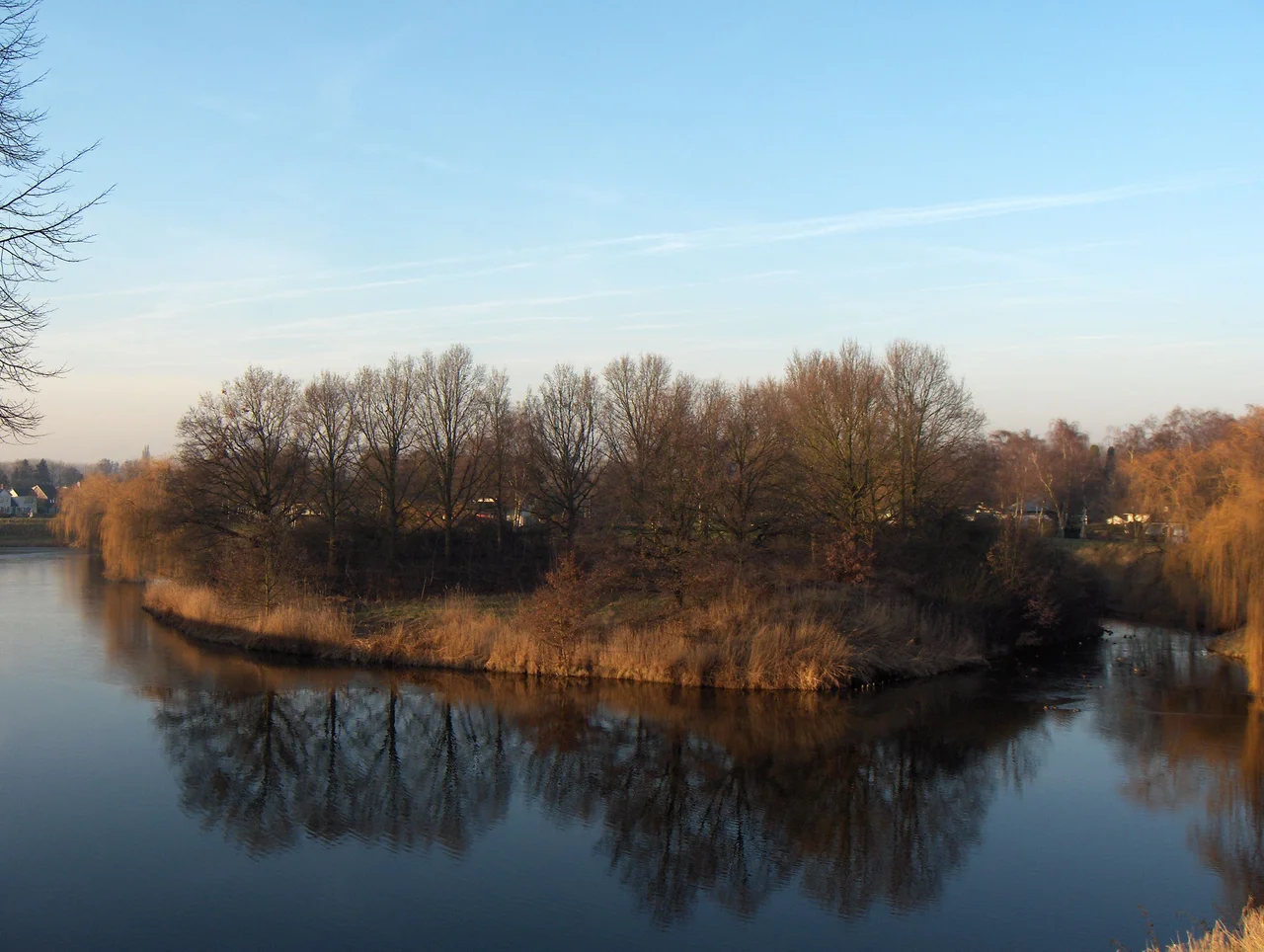
Hulst received city rights in the 12th century, but the shape that makes the place famous came later - in the 17th century, when Dutch engineers built the star fort whose outline still defines the town today. From the air, the bastions, ravelins, and curtain walls form a precise geometric pattern: every angle calculated to let defenders fire along the face of the next wall, every moat sized to drown an attacking sapper. The locals will tell you the town crest shows holly growing around it because the battlements look like holly leaves. Whether the leaf inspired the fort or the fort inspired the leaf, the heraldry is too neat to argue with. You can still walk the entire circuit of the ramparts in about an hour, past the Gentse Poort and the surviving brick gatehouses, watching ducks where soldiers once watched for the Spanish.
Last Town to Fall, and to Fall Back
During the Eighty Years' War, Hulst was the gate between Catholic Flanders and the Protestant Dutch Republic, and it changed hands three times in fifty years. Maurice of Orange took it from the Spanish in 1591. Five years later, Archduke Albert of Austria - a Cardinal Archduke, no less - retook it for Spain in a short, brutal siege that ended on 18 August 1596. The Dutch tried again in 1640 and were beaten back. In 1645, Frederick Henry, Prince of Orange, finally retook the town for the Republic - the last major Spanish foothold north of the Scheldt. From then on, Hulst was Dutch. The Spaniards never came back. The French would try in 1702, with Vauban himself directing the siege, and find that whoever had upgraded the fortifications in the meantime had been paying attention. Hulst held. In 1747, with a less competent garrison commander and a stronger French army, the French finally walked in.
A Basilica at the Center
At the geometric heart of Hulst, where the streets converge and the rampart-walk ends, stands the Basilica of St Willibrordus - a Gothic church begun around 1200, expanded in the 15th century, and damaged enough times to qualify as a survivor in its own right. The tower has been knocked down by lightning (1668), fire (1876), and the Polish Panzer Division (1944, who shelled it to dislodge German lookouts). The current spire, a striking modernist construction by Jan Brouwer from 1957, is crowned by an eight-meter statue of Christ surrounded by concrete angels and tuning forks. Pope Pius XI elevated the church to basilica status in 1935. It is, depending on your taste, either a beautiful piece of 20th-century sculpture grafted onto a 15th-century body, or the strangest church spire in the Netherlands. Probably both.
Painters, Bishops, and a Pun
For a town this small, Hulst has produced an unreasonable number of painters: Gillis Mostaert the Elder and his brother Frans, both born here in 1528; Cornelis de Vos, born 1584, who painted the famous View of Hulst in 1628 - one of the only contemporary images of the town under siege; and Paul de Vos, the Baroque master of animal and hunting scenes. Cornelius Jansen, born in Hulst in 1510, became the first Bishop of Ghent. Even the town's branding has wit. Since 2018, Hulst has put up a giant letter sculpture you can read two ways - 'i hulst' (I love Hulst, after Amsterdam's I Amsterdam) or 'in ulst' (which works in the local Zeelandic dialect, where the H at the start of a word disappears). The locals will tell you the joke without prompting.
The Drowned Land
North of Hulst, where the municipality ends, the land does not so much stop as forget itself. The Verdronken Land van Saeftinghe - the Drowned Land of Saeftinghe - is one of the largest tidal salt marshes in northwestern Europe, a labyrinth of creeks and reedbeds that was farmland once, before the dikes were cut in the 16th century to drown out the Spanish and never quite rebuilt. Underneath the mud, locals will tell you, is a sunken city; the Saeftinghe legend is the one every Zeelandic grandparent knows. Today the marsh is a nature reserve, home to thousands of geese and one of the largest birding sites in the country. You can stand on the old Hulst ramparts at sunset and watch the light flatten itself out over the polder, all the way to the Western Scheldt. The fortress did its work. The drowned land is finishing the job.
From the Air
Coordinates 51.316°N, 4.054°E, in the eastern wedge of Zeelandic Flanders, just inside the Dutch-Belgian border. The star fort is the visual signature - look for the geometric green pattern of bastions and water-filled moats. Best viewed at 2,000-4,000 ft for the full star shape. Nearest airports: Antwerp International (EBAW) 30 km southeast, Rotterdam-The Hague (EHRD) to the north.
Nearby Stories
- Molenbeek-Ter Erpenbeek 2.5 km away
- Sint-Maartensdijk Castle 5.9 km away
- Westmalle Abbey 7.8 km away
- Hof van Cleve 8.1 km away
- Rotselaar 10 km away
- Sluis 12 km away
- NAC Breda 15 km away
- Southern Bight 78 km away