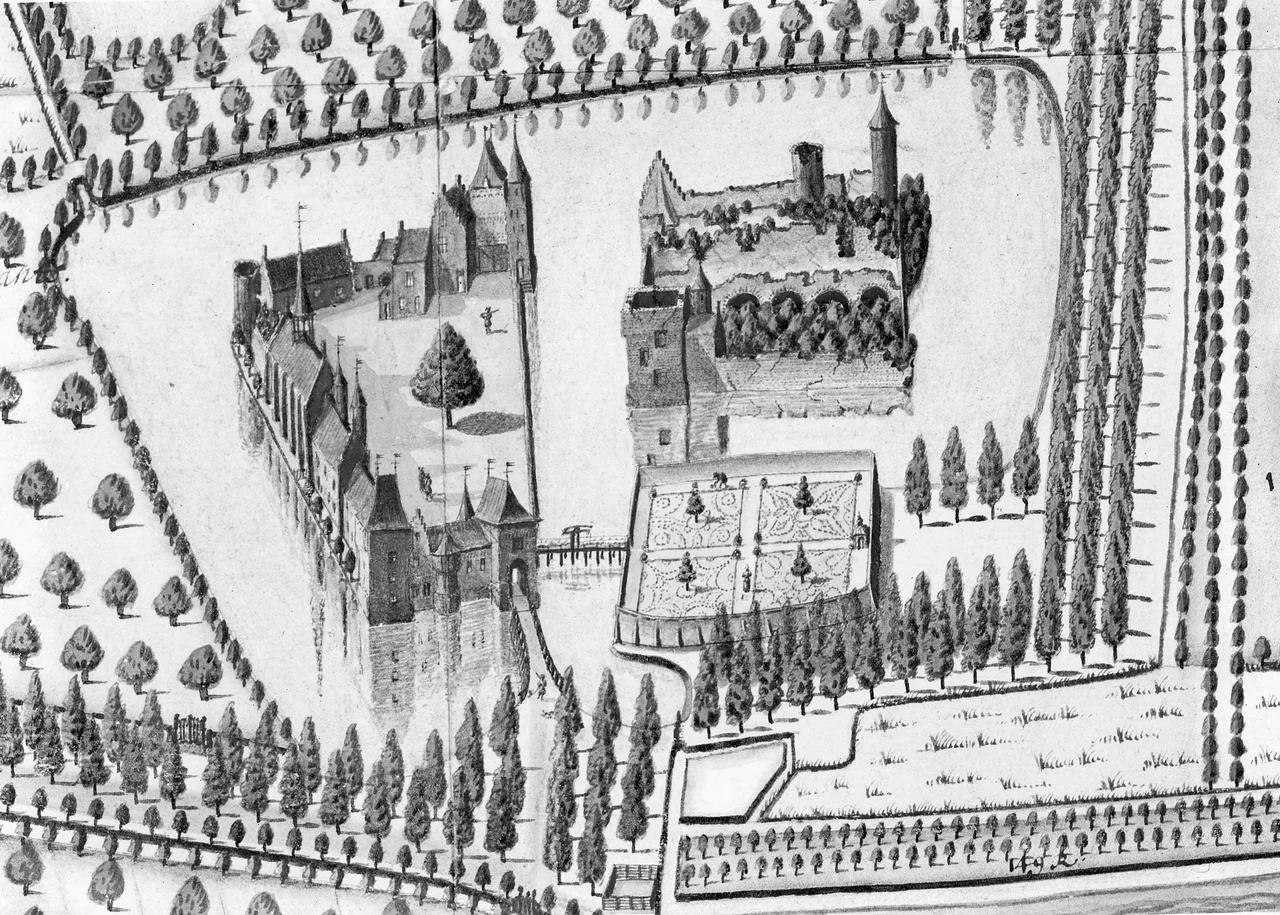

Sint-Maartensdijk Castle
Sometime before 1341, Knight Pieter Gherontszoon and his sons were ambushed near Scherpenisse on the road to court. Their attackers - members of the Van Borselen clan and their allies - tied them up, clubbed them to death where they lay, then loaded the bodies into a boat, crossed the Pluimpot, and spent the night camped at the foot of Sint-Maartensdijk Castle. The castle belonged to Pieter's father. It was a message. Whatever Sint-Maartensdijk would become over the next five centuries - the seat of medieval power brokers, the dowry of Anna van Egmont, an Orange family possession, eventually nothing at all - it began with bodies left at the gate.
Water Castle of the Polder
Sint-Maartensdijk sits in the Oudelandpolder, the oldest reclaimed land west of the Pluimpot - a tidal trench that once cut the island of Tholen in two. The village began as Haestinge, named perhaps for the hare on its old coat of arms or perhaps for an older name of the Pluimpot itself; after a new church to Saint Martin of Tours went up in 1357, the village took its saint's name. The castle stood about a hundred meters north of where the city walls would later run. It began modestly: a solitary tower house, walls two and a half meters thick at the base, with a water well sunk inside so the defenders could not be cut off from drink. In its second phase, the Van Bordene family - who took their name from the trench - expanded it into a proper water castle, an irregular square ringed by four or five semicircular towers and two smaller ones, all set at deliberately uneven intervals to confuse attackers' calculations of where the next arrow slit would appear.
The Borselen Inheritance
After the 1342 reckoning for the Scherpenisse murders - banishments handed down by the Count of Holland, some lenient, some not - the lordship of Sint-Maartensdijk shifted in 1354 to a different branch of Van Borselen. Floris I bought the title from Count William V for 1,600 gemeten of land, about 628 hectares of polder and marsh. He had picked the winning side in the Hook and Cod Wars and became a councilor of the count and castellan of Heusden. The Van Borselens held Sint-Maartensdijk for over a century. The most famous of them, Frank van Borssele, married Jacqueline, Countess of Hainaut - one of medieval Europe's most fought-over heiresses - in a love match that closed her tumultuous political career. They had no children. Frank lived mostly at Brielle, where the income was four times what Sint-Maartensdijk produced, but he still ordered the castle's elaborate stud farm built west of the bailey: a thirty-by-twelve-meter stable, a stable master's house, a brick slope where horses could walk down into the water, and a round structure that was probably a dovecote.
Becoming an Orange Possession
When Frank van Borssele died in 1470 without legitimate heirs, Sint-Maartensdijk passed through his sister Alienora down a chain of marriages - Van Buren, Van Culemborg, eventually to Floris van Egmont, Count of Buren, councilor of Charles the Bold and Maximilian I. His granddaughter Anna van Egmont was born to inherit it. In 1551, at age eighteen, she married a young German prince visiting the Habsburg court - William of Orange, the future William the Silent. Sint-Maartensdijk became Orange property the day she signed. Anna died seven years later, leaving William with two small children and a much larger estate than he had married for. Their son Philip William was kidnapped to Spain in 1568, where he spent twenty-eight years as a hostage of Philip II while his father led the Dutch Revolt. When Philip William finally returned to the Netherlands in 1596, he was the rightful Lord of Sint-Maartensdijk - but the castle was barely on his agenda. The Oranges had bigger problems. The lordship descended through Maurice, then Frederick Henry, who paused long enough in 1632 to build a chapel on the outer bailey - the same year his own brief invasion of Flanders was being fought.
Vanishing
By 1695 the main castle was visibly decaying. Successive Orange princes had almost never set foot in it. From 1710 they began pulling it down in pieces, selling the brick and timber, while the outer bailey kept its working farm going for another eighty-five years. The Batavian Republic took the rest in 1795 and sold the lands to the Oranges' former land agent, Marinus de Jonge van Ellemeet, who had no use for ruins. In 1818, after the affairs of the House of Orange were finally settled following the Napoleonic upheaval, the order came: demolish the outer bailey, dig out all foundations to six feet below ground level so plows would not strike them, finish before 1 May 1819. Only the gardener's house remained - a vaulted building that had doubled as the local prison. In 1963 it too was knocked down to make way for a bungalow. The archaeological excavations that followed, from 1965 to 1968, found what was left of the moats, the foundations of the towers, the brick slope where Frank van Borssele's horses had walked down to drink. Today the site sits between a cemetery and a parking lot. Five centuries of nobility, one murder at the gate, and a quiet patch of grass.
From the Air
Located at 51.55°N, 4.08°E on the island of Tholen in Zeeland, southwest Netherlands. The castle site is at the northern edge of the village of Sint-Maartensdijk, between a cemetery and a parking lot - traces of the moats are still visible in aerial photographs. The village's gothic Sint-Maartenskerk holds the damaged tomb of Floris van Borselen (d. 1422). The Pluimpot - the medieval trench that once split Tholen in two - is now polderized; its course can still be traced from the air. Nearest airports: Antwerp (EBAW) to the south, Rotterdam-The Hague (EHRD) to the north. Best viewed at low altitude to pick out the rectangular outline of the lost bailey.
Nearby Stories
- Hulst 1.6 km away
- L. Smit en Zoon 5 km away
- Westmalle Abbey 7.7 km away
- NAC Breda 12 km away
- Calandbrug 14 km away
- Battle of Damme 19 km away
- Battle of Cadzand 26 km away
- Southern Bight 51 km away