
Egmond Abbey
When the monks of Egmond rolled out their solar panels in the spring of 2003, they were doing something their tenth-century predecessors would have understood instinctively: putting the work of the day in the hands of God and the sun. Two weeks later the panels were gone. Someone had backed a van up to the abbey at night and stolen all 20,000 euros' worth. The monks, with the resigned good humor of people who have lost a great deal of property over the centuries, started an online fundraiser. New panels went up. The monastery, which has been destroyed once and rebuilt twice in eleven hundred years, kept going.
The Gospels and the Counts
Egmond Abbey is the oldest monastery in the Holland region. Dirk I, Count of Holland, founded it around 920-925 as a nunnery, set near a small wooden church built over the grave of Saint Adalbert, an eighth-century Northumbrian missionary whose bones drew pilgrims. In about 950 Dirk II and his wife Hildegard replaced the wooden church with stone and brought in Benedictine monks from Saint Peter's Abbey in Ghent. The original abbess, Erlinde - who was Dirk's own daughter - took her nuns to a new house at Bennebroek. To mark the consecration of the new stone church around 975, the count presented the abbey with an illuminated gospel book whose images are still studied today. The Egmond Gospels survived everything that came next, and now sit in The Hague as one of the oldest illuminated manuscripts produced in the Netherlands.
Scriptorium and Power
For six centuries the abbey grew. Its monks served as scribes in the chancery of the Counts of Holland; its scriptorium turned out chronicles that historians still consult. Its library was famous. Its property rights covered villages in three directions. North of the church grew Egmond Castle, built in 1129 by the knight Berwout van Egmond - hired by the count to protect the abbey, collect its rents, and represent his interests. From that arrangement sprang the House of Egmond, one of the most powerful noble families in the Low Countries. The relationship between the family and the abbots quickly became what such relationships always become: a polite, then less polite, then openly hostile power struggle that lasted four hundred years. In 1568 the head of the family, Count Lamoral of Egmont, was beheaded in Brussels by the Spanish Duke of Alba for his sympathies with the Dutch rebellion. His execution helped ignite the Eighty Years' War.
The Year of the Beggars
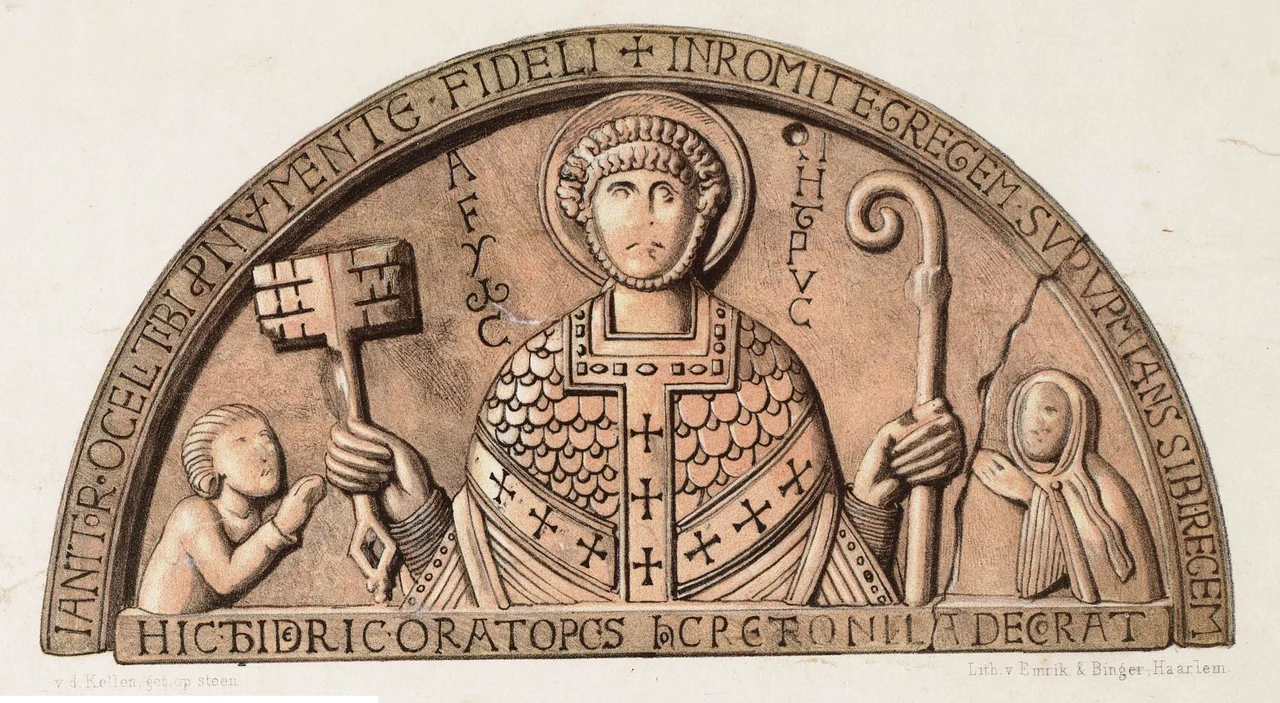
In 1573 the Spanish army was advancing through North Holland toward Alkmaar. The Protestant Sea Beggar commander Diederik Sonoy gave the order: destroy Egmond Abbey before the Spanish can use it as a base. The monks were driven out. The church was looted, the cloister demolished, the library burned - or so everyone thought. In fact Sonoy had sold the abbey's portable property before he ordered the buildings destroyed, and many of those objects survived in Protestant collections. The abbey's income was redirected to fund the brand-new University of Leiden. For the next two centuries Egmond was a romantic ruin, picturesque enough that Jacob van Ruisdael painted it in the late 1650s; the wreckage stood until about 1800, when even the rubble was carted off. The Egmond Tympanum - a twelfth-century carving of Saint Peter, Dirk VI, and Countess Petronilla - was rescued from a private collection and now hangs in the Rijksmuseum.
Rebuilding by Hand
In 1933 a new Benedictine community refounded the abbey on the original site, sent from the monastery at Oosterhout in Brabant. The architect Alexander Kropholler designed the buildings; construction began in 1935. The community was elevated to abbey status in 1950, and in 1984 the relics of Saint Adalbert - safe in Haarlem since 1573 - were returned home and enshrined beneath the altar. Today the Sint-Adelbertabdij makes its living the old monastic way: a shop that sells cheese and Sancti Adalberti beer from the local Brouwerij Egmond, ora et labora in the eight-times-a-day liturgy of the hours, and a guesthouse for retreatants. In December 2021 the monks gave a fragment of Saint Nicholas's rib, in their custody since 1087, to the Basilica of Saint Nicholas in Amsterdam. The bone had been waiting nine hundred and thirty-four years for a return trip.
From the Air
Coordinates 52.59 N, 4.66 E - in the village of Egmond-Binnen, in the dunes inland from the North Sea beach at Egmond aan Zee. From altitude the abbey shows as a compact tile-roofed complex with a cloister courtyard, on the inland edge of the dunes about 6 km west of Alkmaar. De Kooy (EHKD) is 30 km north, Schiphol (EHAM) 40 km south. Recommended viewing altitude 2,000-3,500 ft AGL in good visibility.
Nearby Stories
- Koopvaarders Lock 4.9 km away
- Enkhuizen 6 km away
- Blauw-Wit Amsterdam 6.3 km away
- Princess Amalia Wind Farm 6.4 km away
- Hollandse Kust Zuid Offshore Wind Farm 7.2 km away
- The Green Cathedral 7.4 km away
- Tjaskers in Friesland 19 km away
- Action of 22 September 1914 33 km away