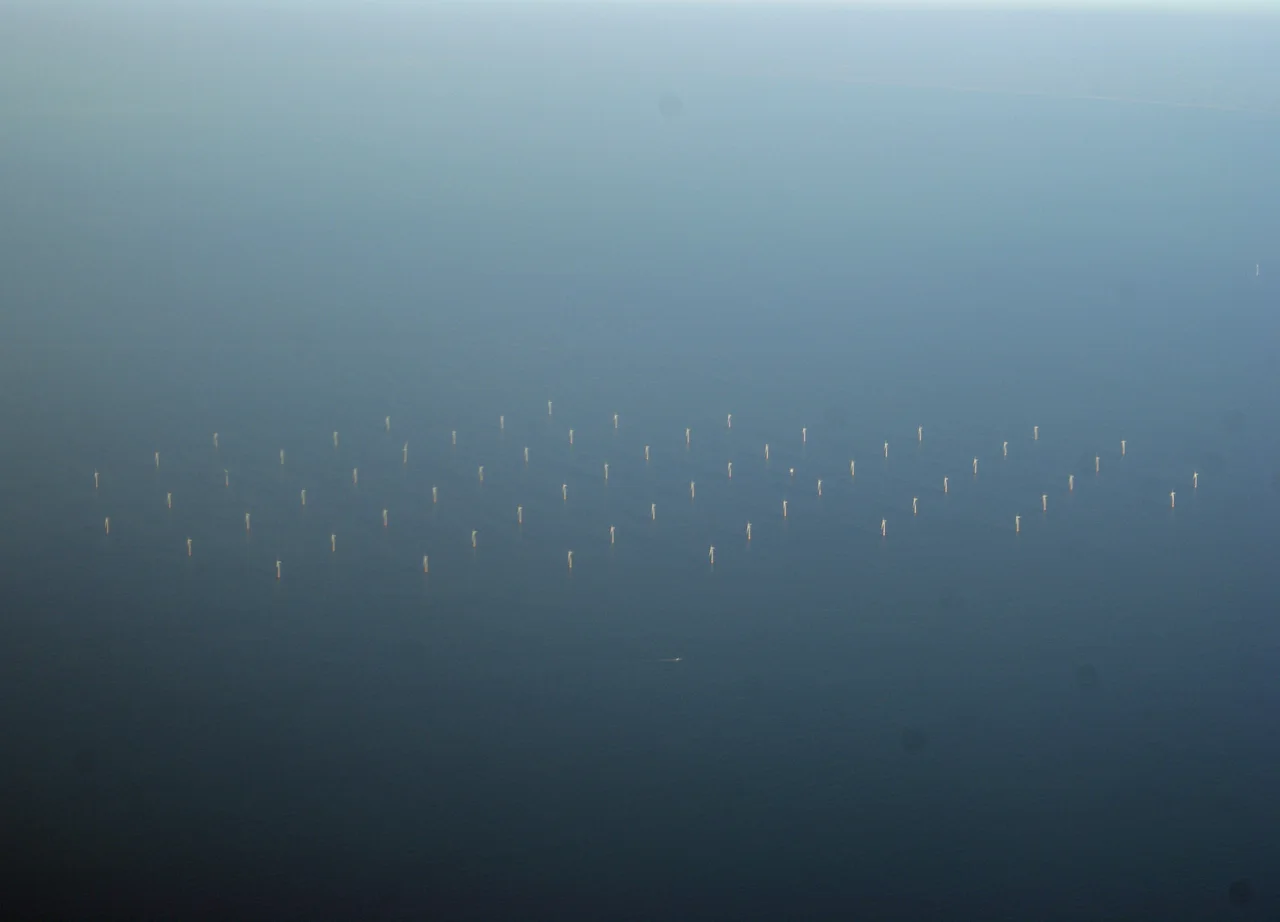

Princess Amalia Wind Farm
When the Princess Amalia Wind Farm opened in 2008, the princess it was named for was four years old. Catharina-Amalia, heir to the Dutch throne, would not visit her namesake project for another several years. The wind farm itself was on a similar trajectory: born promising, delayed by paperwork, eventually built around technology that was already starting to look dated by the time the foundations went in. And yet, two decades after its first kilowatt-hour reached the Dutch grid, the project still matters - because it cracked the financing puzzle that had been holding back offshore wind across Europe.
Naming a Wind Farm
It was called Q7 for years, after the rectangular cell on the Dutch hydrographic grid where it would be sited. Twenty-three kilometers off IJmuiden, in waters nineteen to twenty-four meters deep, sixty steel monopiles were driven into the seabed. As the project approached commissioning, the developers wanted a name that would mean something to ordinary Dutch citizens. They chose Princess Amalia, after Catharina-Amalia of the Netherlands - the daughter of then-Crown Prince Willem-Alexander and now, since her father's accession in 2013, heir apparent to the throne herself. The new name nudged a piece of energy infrastructure into the national family album.
The Q7 Financing Trick
What made Princess Amalia genuinely important had nothing to do with its turbines. It had to do with money. Before Q7, every offshore wind farm in the world had been built on corporate balance sheets - the developer's own equity, the utility's parent company guaranteeing the debt. The Q7 project pioneered non-recourse project finance for offshore wind: a structure where the project itself, not the parent company, took on the debt, and where lenders were repaid solely from the wind farm's electricity revenues. Trade press at the time called it the deal that breathed new life into offshore wind financing. Every project since has used some variation of the model the Princess Amalia developers cobbled together with their banks. The financial engineering, in a sense, was as innovative as the steel.
The Delay Tax
Project manager Bernard van Hemert later described what the years of permitting delay had cost: not just time, but technological currency. When Q7 was first specified, the Vestas V80 - a 2-megawatt turbine - was the largest commercial offshore machine on the market. By the time installation actually began, 3- and even 5-megawatt turbines were being delivered to other projects. The Q7 team had to install the spec they had permitted, because re-permitting would have added another two years. Sixty V80s went into the seabed. The farm's total nameplate capacity ended up at 120 megawatts - respectable in 2008, modest by 2010, undersized by 2015. The lesson was absorbed across the industry: in offshore wind, permitting delays do not just cost time, they freeze your technology choice at the moment of submission.
Working Conditions
Twenty-three kilometers offshore, in water averaging twenty-two meters deep, the maintenance environment is uncompromising. Service technicians ride out from IJmuiden on crew transfer vessels that wallow in any sea state above two meters. Once at the array they have to time their step onto the turbine ladder against the swell - a leap of perhaps half a meter, with cold North Sea water between vessel and access platform. From there it is a climb of eighty meters up an interior ladder to the nacelle, where the technicians replace yaw motors, swap gearbox oil, and chase down the small electrical faults that compound in salt air. The Vestas V80 was designed onshore. Marinizing it taught a generation of Dutch wind technicians what offshore work actually demands.
Outliving the Spec
Eneco still operates Princess Amalia today, well past the design life originally projected for the V80 turbines. Repowering was discussed in earlier years, but the farm is now scheduled for decommissioning by 2028 - one of the first Dutch offshore wind projects to reach end of life. The economics ruled out repowering: the existing foundations are sized for V80 loads, not for the 11- or 15-megawatt giants going up elsewhere in the Dutch sector. For now, the 60 original turbines keep turning, generating electricity that helped legitimize offshore wind as an asset class. The princess the farm was named for is now in her early twenties, training to be queen. Her wind farm trained Europe to finance the energy transition.
From the Air
Princess Amalia is centered at 52.59°N, 4.21°E, roughly 23 km west of IJmuiden and just north of the Hollandse Kust Zuid envelope. From altitude the 60-turbine array appears as a regular grid - smaller and more compact than its newer neighbors, with shorter towers (V80 hub heights are 59 m versus 100+ m for the newer machines). Best viewed from 4,000-8,000 ft on a clear day. Nearest airports: Amsterdam Schiphol (EHAM) 35 km east, Rotterdam The Hague (EHRD) 60 km southeast. Look for the older array nestled just south of the newer Hollandse Kust Noord turbines.
Nearby Stories
- Hofje Codde en Van Beresteijn 3.5 km away
- Hollandse Kust Zuid Offshore Wind Farm 5.3 km away
- Egmond Castle 6.2 km away
- SS Elbe 10 km away
- Fortifications of Den Helder 14 km away
- Action of 22 September 1914 22 km away
- Battle off Texel 42 km away
- Southern Bight 57 km away