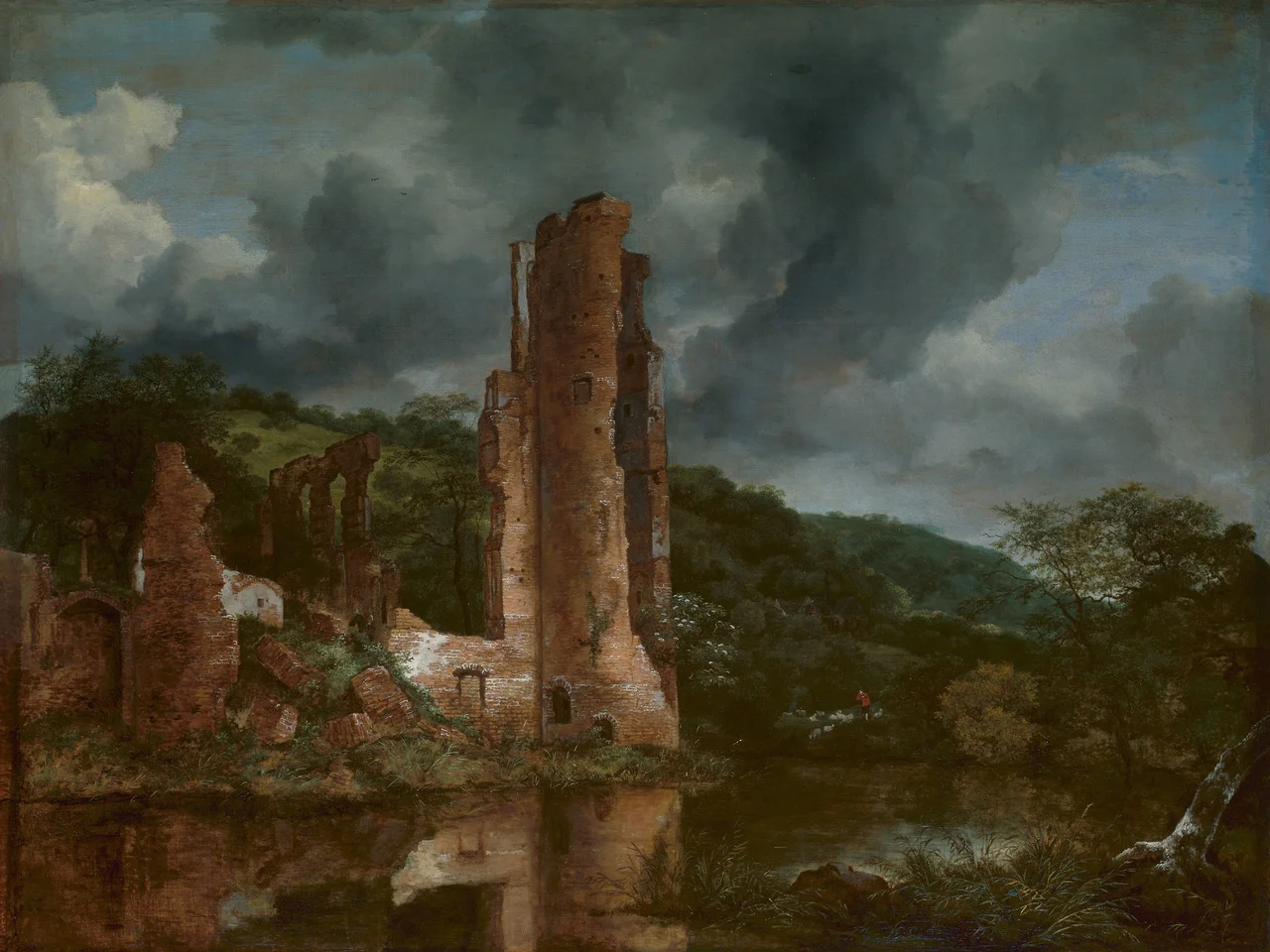

Egmond Castle
On 5 June 1568, in the Grand Place in Brussels, an executioner cut off the head of Lamoral, Count of Egmont. He was 45, a war hero of the Spanish crown he was now dying at the hands of, and the most senior nobleman of the Low Countries. The execution was meant to terrify the restive Dutch into obedience. It did the opposite. Within months, what had been protests against Spanish rule hardened into open rebellion. Five years later, in 1573, the same Prince of Orange who had failed to save Egmont gave the order to burn the count's ancestral seat - Egmond Castle, a few kilometers west of Alkmaar - to deny it to Spanish troops. The castle never recovered. Today the site is a low rectangle of brickwork in a green field, with a bronze statue of Lamoral standing where the great hall used to be. You can walk freely through what is left. There is no entrance fee, and very little to see, and yet something happened here that helped invent a country.
Stewards Who Became Sovereigns
The Egmond family started small. Around 1129 a man named Berwout was appointed steward of lands belonging to nearby Egmond Abbey, which had grown too rich for the abbot to manage alone. Berwout lived in a fortified farm - a hoeve - on a slight rise north of the monastery. His descendants joined the crusades and were rewarded with the hereditary lordship of Egmond. Over the next four centuries the family rose from local stewards to Princes of Gavere, Counts of Buren, and sovereign Dukes of Guelders. The castle grew with them. Excavations in the 1930s found traces of an early palisade with heavy oak piles, their heads scorched - probably the manor that the faction of Louis of Loon burned down in 1205, during a war over the County of Holland. Whatever stood before that fire has been guessed at but never proved.
The Round Water Castle
What replaced it was something rare in the Low Countries: a circular stone keep set inside a moat, completed in the early 13th century. The curtain wall ran in a not-quite-perfect circle, about 28 meters across at its widest, less than a meter thick, and rose from the water itself. Inside, buttresses supported a walkway around the top. There were three towers - a strong gatehouse on the south, and lighter towers added later on the northeast and northwest. Nothing was built inside the circle. It was a refuge, not a residence, and the family's daily living went on in the surrounding outer bailey. By around 1300 the round castle had outlived its usefulness, and a new square castle - the third version of Egmond - went up on the bailey grounds. The circular foundations were buried, forgotten, and only rediscovered when archaeologists began digging in 1933.
John III's Showpiece
By the end of the fifteenth century the Egmonds had become one of the wealthiest noble houses in the Burgundian Netherlands. John III, the first to bear the title Count of Egmont, decided his ancestral seat should look the part. Between roughly 1450 and 1525 the castle was enlarged and decorated: a great hall on the eastern side held a portrait gallery of his ancestors, a massive four-towered gatehouse went up on the outer bailey, and a stone lion and two lead dragons were set near the entrance (excavators found all three centuries later). Visitors called it the largest and most beautiful castle in Holland. John III was also, as it turned out, the last lord to think of Egmond as home. His descendants - statesmen and generals in the service of first Burgundy and then Spain - lived increasingly in palaces in Brussels and Zottegem. The Dutch castle stood emptier with each generation.
The Beheading That Changed Everything
Lamoral of Egmont, John III's grandson, was a soldier of formidable reputation - victor at Saint-Quentin and Gravelines, Knight of the Golden Fleece, Stadtholder of Flanders and Artois. He was also a Catholic and a loyalist. When Protestant agitation began to tear the Spanish Netherlands apart in the 1560s, Lamoral tried to find a middle way: petition the king, ask for reforms, urge moderation. King Philip II's response was the Duke of Alba, the Council of Troubles, and arrest warrants. Lamoral was taken from his quarters in Brussels in September 1567. After eight months in prison he was condemned for treason and heresy he had not committed. His public execution made the Dutch revolt unforgivable on both sides - and Egmont, who had been at best ambivalent about rebellion, became a martyr of it. Goethe wrote a play about him. Beethoven wrote the overture. The statue at the castle ruin is from 1997. An identical copy stands in Zottegem, in Flanders, where his body is buried.
Erasure and Excavation
The castle outlived its lord by only five years. In 1573 Diederik Sonoy's troops, acting on William of Orange's orders, set fire to both Egmond Castle and the neighboring abbey. The Spanish must not be allowed to use them. The Egmond family sold what was left in 1607 to pay debts. A side branch bought the ruin back in 1722 and restored two gate towers. Painters of the Dutch Golden Age - Hobbema, Ruisdael, Roghman, Pronk - found the picturesque crumbling walls irresistible, and Ruisdael's Landscape with the Ruins of the Castle of Egmond hangs today in the Art Institute of Chicago. Then in 1798 new owners sold the stones for demolition, and by 1836 the surface was bare. The loss caused a national outcry that helped invent the Dutch concept of the rijksmonument - the protected national heritage site - just in time to save Brederode Castle nearby. In 1933 the province of North Holland bought the swampy field where Egmond had stood. Three years of digging brought up the round castle's foundations, the square keep, the gate complex. The walls were rebuilt just high enough to read in plan. That is what stands today. A statue, a brick outline, the silence of an open field.
From the Air
Coordinates 52.622 N, 4.654 E, in the municipality of Bergen, about 7 km west of Alkmaar and roughly 1 km inland from the North Sea dunes. From the air the ruin appears as a faint pale geometry in green pasture, with the village of Egmond aan den Hoef immediately to the south. Nearest major airport: Amsterdam Schiphol (EHAM), 50 km south-southeast. Small-aircraft field at De Kooy (EHKD), 30 km north. Best photographed in low morning or evening light when the brickwork outlines cast shadows; cruising altitude 2,000-3,000 ft is ideal in clear conditions.
Nearby Stories
- Koopvaarders Lock 4.9 km away
- Enkhuizen 6 km away
- Blauw-Wit Amsterdam 6.3 km away
- Princess Amalia Wind Farm 6.4 km away
- Hollandse Kust Zuid Offshore Wind Farm 7.2 km away
- The Green Cathedral 7.4 km away
- Tjaskers in Friesland 19 km away
- Action of 22 September 1914 33 km away