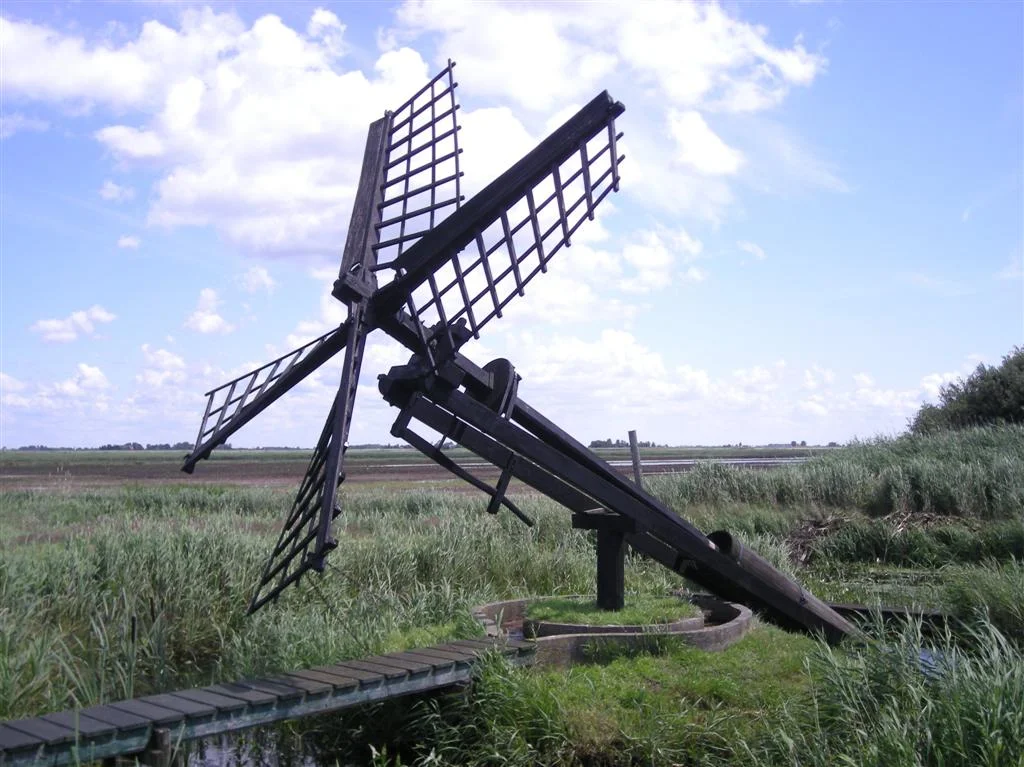

Tjaskers in Friesland
Picture the silhouette of a Dutch windmill — sails turning above a brick tower, four storeys tall, smock-shaped, monumental. Now shrink it. Take away the tower. Take away the cap. Take away the miller's lodging, the gallery, the brick. What you have left, leaning at a deliberate angle in a corner of a wet meadow, is a tjasker: four sails, a tilted wooden shaft, and an Archimedes screw drinking water from one ditch and pouring it into another. There are thirteen of them still working in Friesland, and they are the smallest practical windmills in the Netherlands.
Less, on Purpose
A poldermolen — the big drainage windmill — is a machine designed to dewater an entire polder, sometimes thousands of hectares. A tjasker is the opposite philosophy. One farmer, one wet plot, one ditch. The whole apparatus might span five meters from sail tip to sail tip. The Common sails on the Bolsward mill measure 5.20 m; the Augustinusga boktjasker reaches 5.80 m. You can lean against the shaft. You can, with a friend, turn the entire mill by hand to face a new wind. There is no grace note, no decorative miller's house, no stairway. Just the working geometry: wind in, water up, water out.
Paaltjasker and Boktjasker
Two forms survive. The paaltjasker stands on a single vertical post — paal means pole — and the whole tilted body of the mill swivels on top of it like a weather vane carrying its own engine. The boktjasker rests on a wooden trestle, the bok, a sturdier A-frame that holds the shaft above wetter ground. Only three boktjaskers remain anywhere: at Augustinusga, at Nijetrijne in De Rottige Meenthe, and a third in storage history. The other ten Frisian tjaskers are all paaltjaskers, scattered across pasture and peat reserve from Allingawier to Wijckel.
Built in 1915, Still Working
The tjasker between Workum and It Heidenskip is the rarest of them all. Farmer J. Noordenbos commissioned it in 1915 from millwright R. W. Dijksma. The mill has stood on the same plot ever since, draining the same meadow, turning when the wind allows. It is the only tjasker in the Netherlands that has remained functional in its original location for over a hundred years. Volunteer millers still operate it. The four Common sails span 5.40 m. On a windy afternoon you can hear the screw turning inside its wooden trough, water rising in a slow steady whisper, and remember that this was the working sound of half of Holland for centuries before electric pumps.
The Builder Who Did Not Stop
Roelof Dijksma kept building tjaskers into the 1970s, when almost no one else still knew how. He built the De Deelen mill in 1973 — fifth in a postwar series, sails covered in wooden slats instead of canvas. He was building one for Staatsbosbeheer at Veenwouden in 1975 when he died. The cousins Smid of Giethoorn finished that mill, then took over Dijksma's other unfinished assignments: Bolsward in 1976, De Hoeve in 1975. A craft that should have ended quietly was carried across the gap by two cousins who refused to let it. Sieds Wobbes from Warstiens built another in 1996, and another in 2001. Volunteers at Nij Beets built one in 2002 for the open-air museum there.
Why They Still Matter
None of these mills is needed in the engineering sense. Electric pumps move more water faster, and Staatsbosbeheer could regulate its nature reserves with a switch. But the tjaskers turn anyway, in De Deelen and De Rottige Meenthe and Stobbepoel, because someone built them, someone restored them, and someone walks out on weekends to set the sails. In a country that long ago decided what its landscape should look like, the smallest functional windmills are a quiet, deliberate insistence that the old shape is worth keeping. From a low pass over Friesland you can spot them — tiny crosses on the green — and know that each one is still pumping water uphill, exactly as designed.
From the Air
Centered near 53.05°N, 5.44°E. Tjaskers are small targets — best viewing 1,500–3,000 ft AGL with binoculars or a long lens. Notable locations: It Heidenskip (between Workum and It Heidenskip), Allingawier (Aldfaers Erf Route), Bolsward, De Deelen reserve west of Tijnje, De Rottige Meenthe near Nijetrijne, Stobbepoel near Elsloo, and Sânpoel along the N359 between Lemmer and Sondel. Nearest airports: Drachten (EHDR), Leeuwarden Air Base (EHLW), Lelystad (EHLE). Weather: clear winter and spring days give the best contrast; the slat-covered sails at De Deelen show well in low sun.
Nearby Stories
- Broeksterwâld 1.8 km away
- Rede van Texel 3.6 km away
- Heerenveen 6.1 km away
- North Holland 9.6 km away
- Zuiderzee Museum 11 km away
- Het Bildt 14 km away
- Meppel 15 km away
- Antiope 80 km away