.jpg)
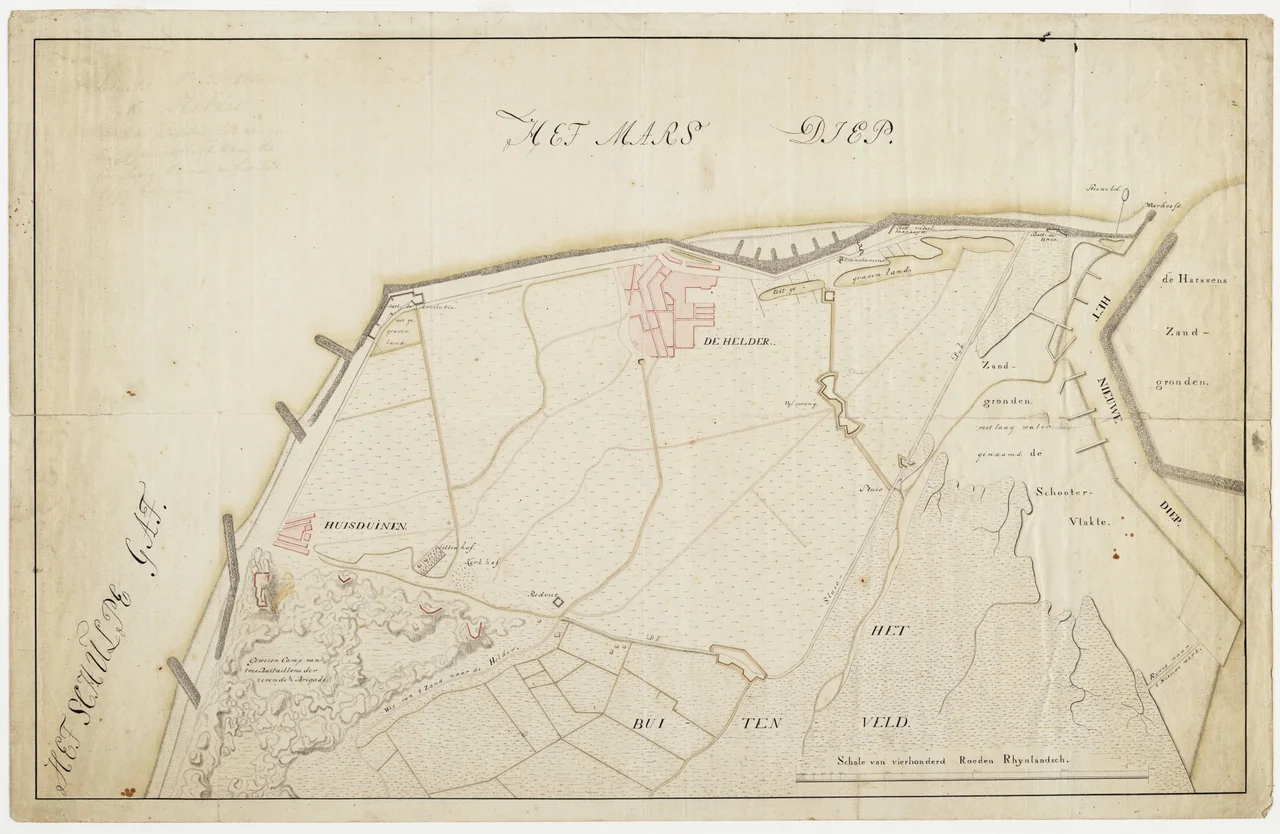
Fortifications of Den Helder
On 30 August 1799 the Dutch fleet, cut off from its anchorage by a British amphibious landing, surrendered without firing a shot. The capitulation at the Vlieter was a national humiliation - and a strategic lesson. Twelve years later, when Napoleon stood on the dunes of Den Helder and looked across the Marsdiep at Texel, he absorbed the lesson and gave the order. A naval base would be built here. A ring of fortifications would protect it. Six million francs would pay for the works. The result, expanded by every Dutch government for the next century, became the Stelling Den Helder - and earned the nickname 'the Gibraltar of the North'.
What Went Wrong in 1799
Begin with the disaster the fortifications were meant to prevent. In late August 1799 a combined British and Russian force landed at Callantsoog, just south of Den Helder, as part of the War of the Second Coalition. The Dutch had two battalions defending the Nieuwediep harbour, scattered between an old earth redoubt called Het Nieuwe Werk on the south side and a field fortification on the north. They had 61 24-pounder guns and 22 lighter pieces - on paper, a respectable force. In practice, the works did not form a coordinated defensive line. The defenders retreated, ceding the coastline. With the harbour mouth uncovered, the Dutch fleet pulled back to the Vlieter, was cornered there, and surrendered. The Vlieter incident exposed every weakness of Dutch coastal defence in a single afternoon. The fortifications that came later were the answer to it.
Napoleon, Kraijenhoff, and Six Million Francs
In 1807, King Louis Bonaparte of Holland - Napoleon's brother on the throne - toured the north and consulted Cornelis Kraijenhoff, the director of fortifications for the region. Kraijenhoff drew up an ambitious plan: a fort at the Kijkduin dune to cover the Schulpengat channel; brick towers in the tour-modèle style behind the existing batteries; a hardened Nieuwe Werk; and, most ambitiously, a fortress built directly on top of De Laan shoal in open water. The estimated cost was two million guilders. Then in October 1811 Napoleon himself visited Den Helder and Texel, made the decision personally, and committed six million francs. A naval base for building, repairing, and equipping warships - what became Willemsoord - would rise at the Nieuwediep. A string of fortifications would surround it. Construction of Fort Kijkduin and Fort Erfprins began almost immediately, then Fort Dirksz Admiraal. The French gave each work a name from their own pantheon - Fort La Salle, Fort Morland, Fort L'Ecluse - and the Dutch quietly renamed them all back after the French left.
The Armoured Revolution
The Battle of Hampton Roads in March 1862, where the USS Monitor and the CSS Virginia fought to a smoking draw, ended the era of wooden warships in a single day. Every coastal-defence ministry in Europe took notice. In June 1864 a new Dutch coastal-defence commission convened, recommended fixed fortifications supported by shallow-draught armoured rams and monitors, and called for the heaviest available guns on turntables. For Den Helder the commission proposed four new brick towers - at De Laan, De Hors, Harssens, and Zuidwal - each armed with eight to twelve heavy guns in armoured iron cupolas. Most of these never materialised. What did was Fort Harssens, begun in 1879 under Minister of War Den Beer Poortugael, the only Dutch coastal work built specifically to fight modern battleships. Its two Gruson cupolas mounted four Krupp 30.5 cm guns - far heavier than anything else in the Stelling. Between 1875 and 1878 Fort Erfprins was modernised, gaining an underground barracks for about a thousand men, protected from grenade fire, with emplacements for new 24-centimetre guns. Just before World War I the government decided to upgrade Fort Kijkduin with armoured cupolas mounting the 28 cm SK L/45 - then the war broke out, and the upgrade never happened.
Two Wars, One Garrison After Another
During the First World War the Dutch stayed neutral; the Stelling was manned by the mobilised army, although by 1906 most of its artillery had already been obsolete for a decade. Only Fort Harssens's guns posed any real threat to a modern battleship. Through the interwar years the Dutch economised hard on defence. New light anti-aircraft pieces were added; the heavy guns received no investment. Around 1930 the Harssens 30.5s were quietly decommissioned. In May 1940 the German army marched into Den Helder, took over the entire network of forts, dismantled the obsolete Dutch guns to recycle the metal, and used the works for its own purposes - the harbour mattered to the Kriegsmarine for its small craft and coastal convoys. The Germans poured concrete bunkers and flak emplacements into the dunes and into the existing forts. Layers of fortification began to pile on top of one another: French masonry, Dutch brick, German concrete. Many of those layers still stand.
From Garrison to Walking Tour
After 1945 the works were militarily obsolete - too small for modern guns, too exposed for missile defence, too valuable for the navy to abandon entirely. Decommissioning ran from 1951 to 1957. The army handed Fort Erfprins to the navy in 1950 as a training facility. Other forts sat empty. Then, in 1989, a foundation called Stichting Stelling Den Helder set out to save what was left. Guided tours began at Fort Kijkduin. In 1992 the foundation took ownership of that fort outright. In 1993 a subsidy of 7.2 million guilders funded a major restoration. Fort Westoever followed. The Cold War's end made the project urgent: as the navy contracted, the municipality looked to tourism, and the chain of brick redoubts that had failed against the British in 1799, scared off no one in 1914, and surrendered without a fight in 1940 found a peaceful third act as a heritage trail. Today eight elements remain in good enough condition to visit: Forts Kijkduin, Erfprins, Dirks Admiraal, Harssens, Westoever, and Oostoever, plus Batterij Kaaphoofd and Oostbatterij.
From the Air
Coordinates: 52.9584°N, 4.7580°E. The Stelling Den Helder spans roughly 5 km of coastline on the northern tip of the North Holland peninsula, defending the Nieuwediep entrance and the Marsdiep channel to Texel. From above, look for: Fort Erfprins at the northwest tip, Fort Kijkduin on the dune ridge to the west, Fort Harssens on the east bank of the Nieuwediep, and Forts Westoever and Oostoever flanking the canal entrance. Active naval base - check military airspace. Nearest airports: De Kooy heliport (EHKD) just south, Schiphol (EHAM) about 65 km south.
Nearby Stories
- Zuiderzee Museum 3.6 km away
- Battle of Bergen, 1799 7.8 km away
- West Frisian Islands 12 km away
- Tjaskers in Friesland 13 km away
- Princess Amalia Wind Farm 16 km away
- Battle of Camperdown 28 km away
- Holmes's Bonfire 33 km away
- Antiope 35 km away