
Súdwest-Fryslân
In 2011, a stroke of a pen in Leeuwarden turned five old municipalities into one. Sneek, Bolsward, Workum, Hindeloopen, IJlst, Stavoren — towns that had carried their own coats of arms since the Middle Ages — woke up the next morning still themselves, but also part of something larger called Súdwest-Fryslân. The name is plain Frisian for Southwest-Friesland, and it is now the largest Dutch municipality by area: 841 square kilometers of meer and meadow, sailing canals and church-tower silhouettes, where the wind off the IJsselmeer arrives flat and the land hardly bothers to rise to meet it.
Six Towns, One Name
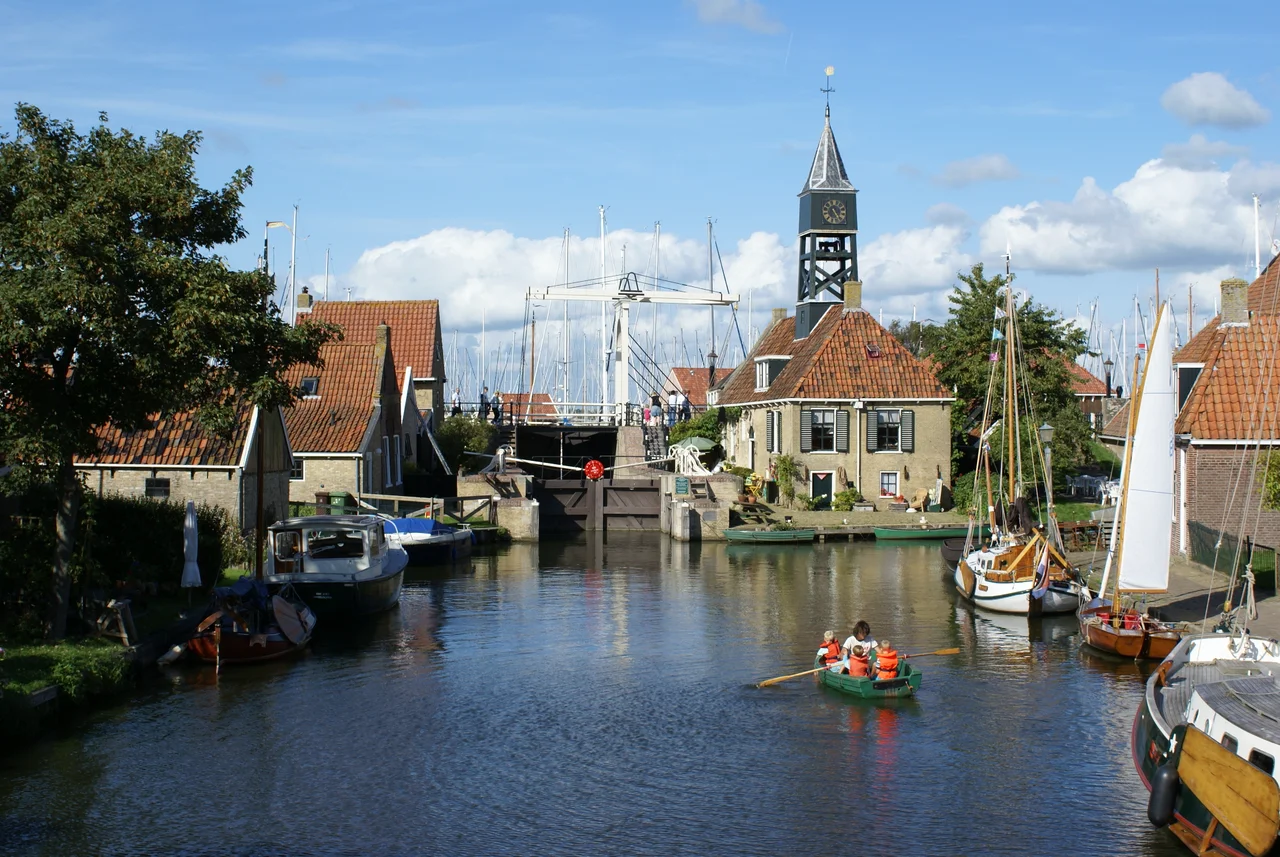
What the merger did not erase is the older arithmetic of place. Six of the eleven historic Frisian cities — the elfsteden whose names form the route of the legendary skating tour — sit inside this single municipality. Sneek keeps its watergate and its Friday market. Bolsward still wears the brick of its fifteenth-century Martinikerk. Hindeloopen, smallest of the eleven, paints its furniture in cabbages and tulips the way it has for centuries. Workum dries its bricks at the same kilns. Stavoren, oldest of them, faces the sea that nearly drowned it. IJlst sharpens skates on the Geeuw. Drive twenty minutes between any two and you cross a republic of fields, sheep, and Holstein-Friesian cattle so calm they seem painted on.
Pim Mulier of Witmarsum
In 1865, in the village of Witmarsum, a boy named Pim Mulier was born. He would grow up to introduce tennis to the Netherlands. Then athletics. Then cricket. Then field hockey. Each of these arrivals required convincing skeptical Dutchmen that the game was worth their time; Mulier persisted. The first national football association in the Netherlands traces back to him too. It is a strange fact about this quiet corner of Friesland — pasture and reed and herringbone-paved streets — that one of its sons spent his life teaching the country how to play. He died in 1954, having lived long enough to see the games take root.
Wartime Prime Minister, Modern Racer
Other native sons left in other directions. Pieter Sjoerds Gerbrandy was born in Goënga in 1885 and would lead the Dutch government-in-exile from London during the German occupation, prime minister from 1940 to 1945 — a Frisian voice on BBC radio telling occupied Holland to hold on. The mathematician and astronomer Willem de Sitter, born in Sneek in 1872, gave his name to a cosmological model that shaped early thinking about an expanding universe. And from the same Sneek streets came Nyck de Vries, born in 1995, a Formula E world champion who would later race in Formula One. The town's population is under thirty-five thousand. Its export, evidently, is range.
Water as Geography
Everywhere here the map is half blue. The Sneekermeer, the Heegermeer, the Slotermeer — shallow inland lakes laced together by canals so that on a July afternoon the whole municipality seems to be moving by sail. Skutsje, the broad-bellied Frisian working boats once used to haul peat and milk, now race each other every summer in a circuit that takes them from town to town. Drainage ditches square the fields into the green graph paper that pilots see from above. The land was patiently won from water and is patiently kept from it; pumping stations hum quietly beside roads that run dead straight along old dike lines. Even the silence has a sound — the sound of a windpump turning.
The Frisian Tongue
Listen and you'll hear it: not Dutch but West Frisian, the language closest to English among living tongues. Súdwest-Fryslân, brea (bread), tsiis (cheese). The names of the hamlets read like nowhere else — It Heidenskip, Ysbrechtum, Goënga, Tjerkwerd, Idsegahuizum. Each one a few houses around a small white church, surrounded by fields that have been farmed since the eighth century. The mergers came, and went, and may come again; the language and the meadow and the wind keep their own slower calendar.
From the Air
Coordinates 53.00°N, 5.54°E. Recommended viewing altitude 3,000–6,000 ft AGL for the patchwork of lakes, polders, and historic towns; higher (8,000–12,000 ft) for the larger geometry of the IJsselmeer shoreline. Visual landmarks: the Sneekermeer due east of Sneek; the Afsluitdijk closing the IJsselmeer to the west; church towers of Bolsward, Workum, and Hindeloopen ranged along the old coast. Nearest airports: Drachten (EHDR) ~35 km northeast, Leeuwarden Air Base (EHLW) ~30 km north, Lelystad (EHLE) ~50 km southwest. Weather: marine influence brings frequent low cloud and brisk westerlies; best clarity on cold-front days when wind veers northwesterly.
Nearby Stories
- Broeksterwâld 1.8 km away
- Rede van Texel 3.6 km away
- Heerenveen 6.1 km away
- North Holland 9.6 km away
- Zuiderzee Museum 11 km away
- Het Bildt 14 km away
- Meppel 15 km away
- Antiope 80 km away