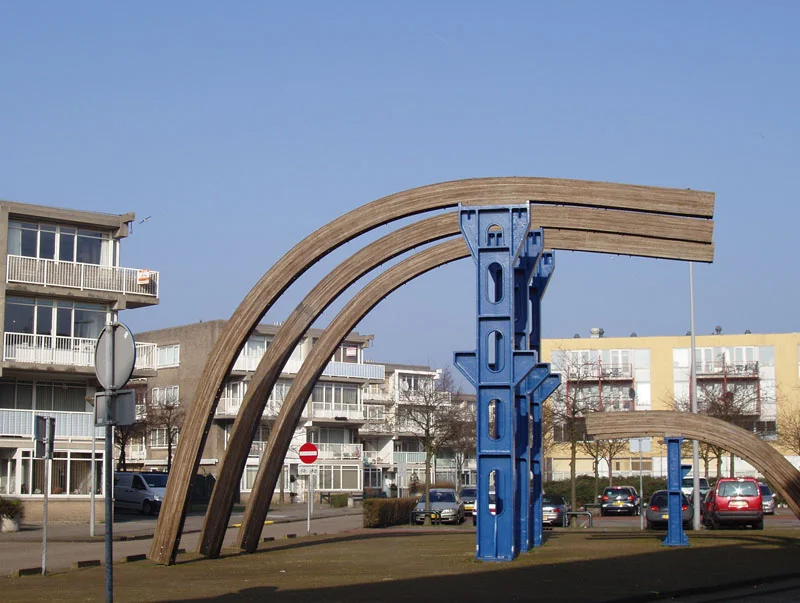

Amsterdamsche Droogdok Maatschappij
In May 1879, a steamer called Stad Amsterdam was lifted clear of the water on the north shore of the IJ, riding on an iron raft 360 feet long that had just been christened Koninginnedok — the Queen's Dock. The lift was successful. The dividend that first year was a modest 2.5 percent. Nobody on the wooden gantries that day could have known they had just opened a shipyard that would run for a hundred and six years, employ over a thousand people at its peak, survive two world wars, and finally collapse not from foreign competition but from the arithmetic of its own payroll.
Why ADM Had to Exist
By the 1870s, Amsterdam had a problem the wooden floating docks of the Oosterdok could not solve. The Reederij der Drijvende Droogdokken — the company that had built Europe's first modern floating dry dock back in 1842 — could lift Dutch merchantmen of 600 tons, but it could not lift the new generation of steamships. Stoomvaart Maatschappij Nederland, founded in 1870 to run regular service to the Dutch East Indies via the Suez Canal, owned four giants like the SS Willem III that did not even fit through the canal connecting Amsterdam to the sea. SMN was operating from Nieuwediep, sharing the navy's drydock at Willemsoord by special arrangement. When the new North Sea Canal opened in November 1876, ships could finally reach Amsterdam directly — but the city had nowhere to dock them. SMN went to its shareholders in May 1875 with a proposal: put up half a million guilders to found a proper dry-dock company. Permission was granted. On 17 August 1877, Amsterdamsche Droogdok Maatschappij was founded by contract, with SMN holding 270 of its 400 shares.
Queens, Kings, and Princes
ADM bought a stretch of marshy land called the Buitenvogelwijkslanden on the north side of the IJ Bay — the eastern part of Volewijk headland — and tendered for its first iron drydock on 8 January 1878. The design came from John Elder & Co. of Glasgow, the great Scottish shipyard. The result was Koninginnedok, capable of lifting four thousand tons, built in pieces that were assembled and launched separately. East of the dock, architect Van Gendt laid out workshops of 57 by 20 meters — a copper foundry, steam hammers, planers and drills all driven by overhead line shafts and belts that ADM had bought wholesale from the defunct Bosch Reitz yard in Den Helder, so the existing machines could be slotted directly into a new layout. The dock did good business. By 1880 dividends were nearly 8 percent. ADM bought out its only serious competitor, Von Lindern's NMSD, in 1884. Wilhelminadok followed in 1899 to handle the still-larger ships that the new IJmuiden lock could pass; Julianadok, 139 meters long and capable of lifting twelve thousand tons, was launched in 1911 and could even dock itself by disassembling into three sections. The names told the story: Koningin, Koning, Wilhelmina, Juliana, Prins Hendrik — the dynastic vocabulary of a confident Dutch industrial age.
The Inter-War Squeeze
The First World War was good for Dutch shipping and very good for ADM. By 1918, dividends hit 15 percent. The good years did not survive long. By 1925 ADM cut wages by 5 percent twice and paid no dividend at all — the first time in forty-eight years. The Great Depression made it worse. In 1933, only 237 ships visited the docks; the company posted operating losses for three years running. There was a memorable bright spot in December 1932 when Prins Hendrikdok lifted the wreck of the MS Pieter Corneliszoon Hooft to seal her leaks. In 1938 ADM sold Julianadok outright to a buyer from the Free City of Danzig, who promptly towed it east — a decision that freed capital but lost the company its largest dock. World War II began in something close to business as usual: profits were steady, dividends paid. The reckoning came in September 1944, when retreating German forces destroyed almost everything that lifted ships. Prins Hendrikdok was blown up with a ship still inside it.
The Postwar Bonanza and the Costs of Westhaven
ADM rebuilt. By 1947 the company was profitable again, by 1950 the rebuilt Prins Hendrikdok was almost continuously occupied, and the postwar shipping boom carried high dividends into the 1950s. From 1950 to 1965 ADM even built new ships — modestly, by assembling sections in its own dry docks and launching them by lowering the dock — a clever use of repair capacity in slack quarters. In 1958 the company announced an ambitious second yard at Westhaven in Amsterdam West: forty-two hectares, a 189-meter dock 5 capable of lifting 18,000-ton freighters, a 155-meter pier with two 15-ton cranes. Construction began in 1961. Through 1971 turnover grew 20 to 25 percent year on year. Then, in 1975, came a sudden operational loss of 6.5 million guilders, followed by 9.9 million in 1977. Staff fell from 1,337 to 984 in a single year. As part of the reorganization, ADM closed Westhaven and concentrated on its original location. By autumn 1978 the board expected to finish the year without further losses.
The Forced Merger
That recovery was about to be undone by a government policy nobody at ADM had been consulted on. In early 1978 the other big Amsterdam shipyard, NDSM with three thousand employees, was failing badly. Its parent company Rijn-Schelde-Verolme and the Dutch government decided the answer was to merge the ship-repair operations of NDSM and ADM into a single new company. ADM had reorganized; NDSM had not. The board of ADM was not informed before the policy was set. The new entity — Amsterdamse Droogdok Maatschappij BV, deliberately spelled without the old "ch" — operated from NDSM's grounds at the Klaprozenweg. ADM NV kept its original land, renamed itself ADM Beheer, and held 53 percent of the new BV against the government's 47. The plant was modern. The workforce was the problem. ADM BV had too many people in indirect roles, and too many of those who did repair ships were ill or idle. Over 1979 the new company lost 20.4 million guilders. In 1980 it lost 26 million. By early 1985 it was filing for bankruptcy, the final inventory auctioned in November 1986.
What's Left
The grounds where ADM was founded on the Meeuwenlaan were sold off in 1980 — turned, eventually, into the cultural district now known as NDSM-werf, where artists and squatters built a parallel city through the 1990s. The Westhaven site was squatted from 1987, briefly cleared, squatted again in 1997 as something approaching Amsterdam's answer to Freetown Christiania, and finally evicted by force in January 2019. In September 2025 the municipality of Amsterdam bought the old ADM Westhaven terrain back for 165 million euros. The dynastic dock names — Koninginnedok, Wilhelminadok, Julianadok — survive only in archive photographs and the marine engineering literature. But the iron lift technology that ADM perfected, scaling up from the wooden Oosterdok rafts of 1842 to ships of twenty-five thousand deadweight tons by the 1960s, shaped a century of Amsterdam's relationship with the sea.
From the Air
The original ADM site sits on the north bank of the IJ at approximately 52.382°N, 4.916°E, directly across the water from Amsterdam Centraal station and just east of the NDSM-werf cultural district. Schiphol Airport (EHAM) is about 14 km southwest. Best aerial viewing at 1,500-3,000 ft AGL on a clear day to make out the saw-toothed outlines of the old slipways and the geometry of the inner harbors along the IJ's north shore. Ferries cross from Amsterdam Centraal to the NDSM and Buiksloterweg piers, providing a useful surface-level reference for the historic shipyard zone.
Nearby Stories
- Polanen Castle 1.6 km away
- Gouda 2.6 km away
- Princess Amalia Wind Farm 3.5 km away
- The Green Cathedral 4.2 km away
- Egmond Abbey 7.1 km away
- Dorestad 7.7 km away
- Hollandse Kust Zuid Offshore Wind Farm 11 km away
- Enkhuizen 16 km away